

Lean Ethereum is not a single network upgrade. It is a draft multi-year direction expected to guide Ethereum development over roughly three to four years, potentially changing most of the protocol’s core components, including consensus, data availability, state storage, execution, privacy and post-quantum security.
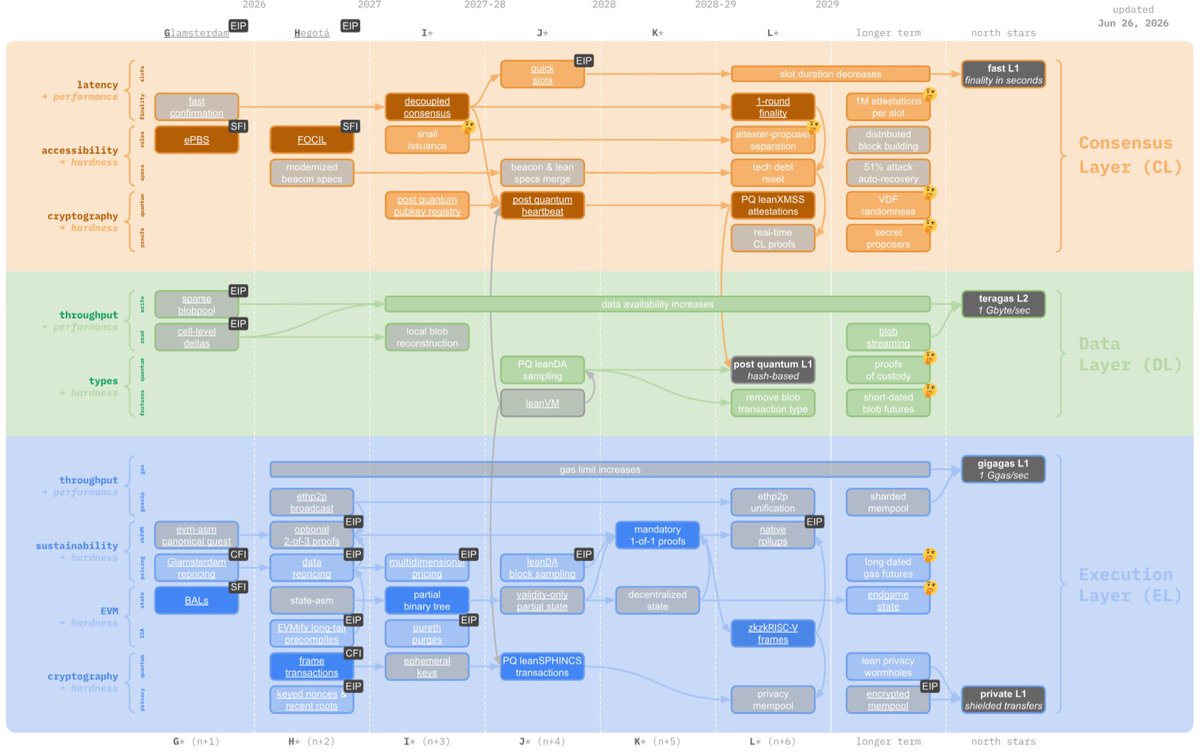
Buterin said the transition could gradually replace nearly every major component of Ethereum while preserving backward compatibility wherever possible. The objective is to allow existing applications and assets to continue operating as the underlying protocol evolves, similar to the gradual transition that culminated in The Merge.
The updated roadmap followed a meeting of Ethereum researchers in Berlin and builds on the Strawmap framework introduced by Ethereum Foundation researcher Justin Drake. The draft outlines approximately seven potential hard forks through 2029, but it is intended as a coordination tool rather than a fixed implementation schedule.
Its long-term goals include reducing transaction finality from minutes to seconds, substantially increasing Layer-1 and Layer-2 throughput, replacing quantum-vulnerable cryptography and making privacy a first-class objective.
Buterin described Hegotá, the upgrade expected to follow Glamsterdam, as likely to be the final fork before the Lean Ethereum phase begins. However, upgrade dates and included features remain subject to change as research and testing progress. The nearer-term Glamsterdam upgrade remains the network’s immediate development priority.
Some Transaction Costs Could Fall More Than Tenfold
According to Buterin, one of the most significant changes under Lean Ethereum concerns how the blockchain stores its state.
Ethereum currently stores wallet balances, smart contracts and DeFi positions within a flexible but increasingly expensive state structure. The roadmap proposes retaining this dynamic state for complex applications while introducing new, more scalable storage types for simpler assets and operations.
Under the draft scenario, Ethereum could maintain approximately 2 TB of dynamic state and support around 100 TB of additional scalable state by 2030. These figures are long-term targets rather than guaranteed capacity commitments.
Many ERC-20 tokens, NFTs and relatively simple DeFi applications could voluntarily move to the new storage model, while more complex protocols may continue using the existing dynamic state. Buterin estimated that applications redesigned around the more efficient structure could reduce the cost of certain operations by more than tenfold.
Ethereum researchers are also exploring execution environments better suited to recursive cryptographic proofs. LeanISA and RISC-V are currently among the leading options.
This should not be interpreted as a confirmed or immediate replacement of the Ethereum Virtual Machine. Buterin described a possible long-term architecture in which the protocol interacts directly with leanISA or RISC-V while EVM applications remain supported through a compiler or compatibility layer.
Quantum Resistance and Privacy Become Top Priorities
One of the most notable changes in the updated roadmap is the higher priority given to post-quantum security.
Sufficiently powerful quantum computers could eventually break several cryptographic systems currently used by Ethereum, including validator signatures, account signatures and the KZG commitments used for blob data. No existing quantum computer is capable of doing this today, but replacing these systems could require years of research, testing and migration.
Buterin said the development of quantum-resistant commitments for blobs has become particularly urgent. Blobs provide temporary data storage used by Layer-2 networks to publish transaction information to Ethereum at lower cost.
The roadmap considers replacing vulnerable KZG commitments with alternatives based on quantum-resistant technologies such as STARKs or lattice-based cryptography. The final mechanism has not yet been selected.
Privacy has also become one of Strawmap’s five long-term “North Stars,” alongside faster finality, greater Layer-1 throughput, increased Layer-2 capacity and post-quantum security.
This does not mean that all transactions will automatically become private at the protocol level. Ethereum researchers are considering privacy improvements across wallets, applications, infrastructure and the base layer, while the precise design and upgrade schedule remain under development.
Lean Ethereum was presented shortly after the Ethereum Foundation completed a major internal restructuring. The organisation reduced its workforce by 54 positions as it reorganised its activities around protocol development, user access, community support and institutional adoption.
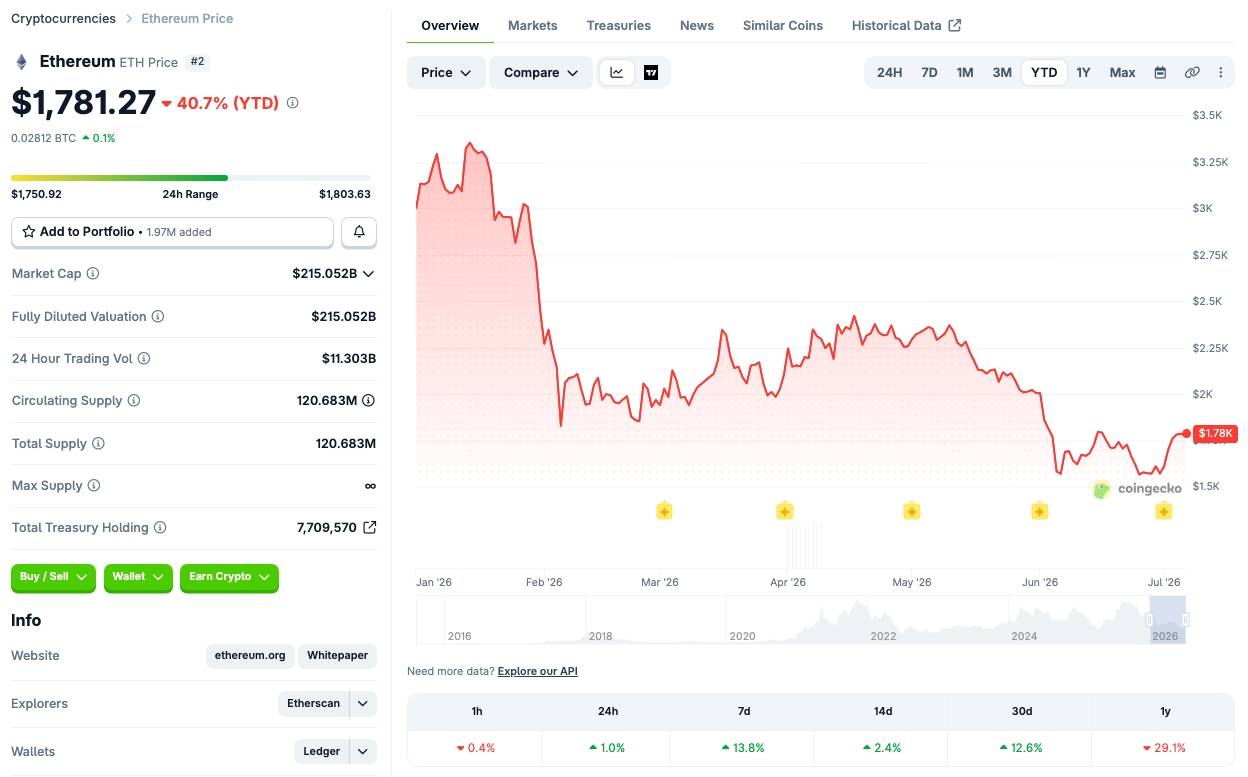
At the time of publication, ETH was trading near $1,781 and had gained approximately 1.2% over the previous 24 hours. The price movement should not be attributed solely to the roadmap, as Ether was also reacting to broader cryptocurrency-market conditions.
Conclusion:
Lean Ethereum is one of the network’s most ambitious technical programmes since The Merge, but it remains a draft roadmap rather than an approved package of upgrades. Its success will depend on research progress, testing, developer coordination and the ability to introduce major architectural changes without disrupting existing applications. If implemented successfully, the programme could improve Ethereum’s scalability, security, privacy and suitability for DeFi, stablecoins and tokenised assets.
