

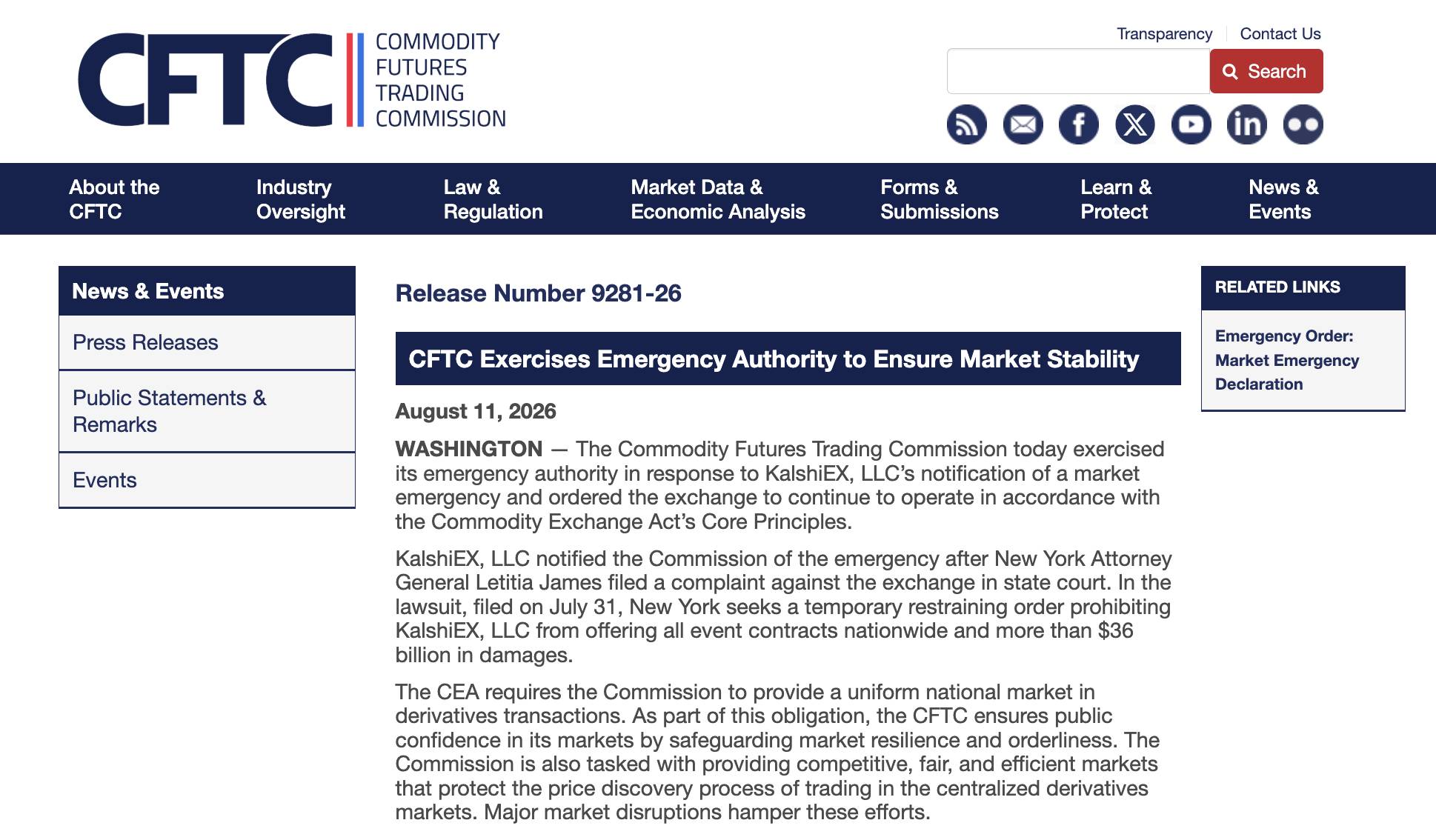
On August 11, the CFTC said it had acted in response to a market-emergency notification submitted by KalshiEX, LLC and ordered the exchange to continue operating in accordance with the Core Principles of the Commodity Exchange Act (CEA).
The intervention followed a lawsuit filed by New York Attorney General Letitia James on July 31. New York alleges that Kalshi is operating an illegal and unlicensed gambling business by offering prediction contracts, including sports-related markets, without complying with state gaming requirements.
According to the New York Attorney General's office, the state is seeking an order stopping Kalshi from operating as an unlicensed gambling business, as well as fines, forfeiture of allegedly unlawful gains and restitution for affected users. The complaint also accuses Kalshi of avoiding requirements that apply to licensed gambling operators in New York, including state taxation and age restrictions.
The CFTC said the New York action goes further, noting that the state is seeking a temporary restraining order that would prevent Kalshi from offering all event contracts nationwide and is pursuing more than $36 billion in damages.
Kalshi subsequently notified the federal regulator that such an order could create a market emergency. Because the platform operates as a CFTC-regulated designated contract market, transactions match participants across multiple states and are processed through centralized clearing infrastructure. Kalshi argued that forcing the exchange to halt or sharply restrict activity in a major jurisdiction could reduce liquidity and disrupt trading beyond New York.
The CFTC responded by invoking its emergency powers under the Commodity Exchange Act. Rather than ruling on whether Kalshi's contracts constitute lawful gambling under New York law, the Commission framed its action around its federal responsibility to preserve orderly, resilient and efficient derivatives markets.
CFTC Chairman Michael S. Selig has taken a particularly strong position in the dispute, arguing that federally regulated derivatives exchanges should not be subject to a separate set of gaming rules in every state.
“New York has no business regulating these interstate financial markets. The Commission is required by law to ensure order in these markets.”
Selig argued that exchanges such as Kalshi operate across state lines, matching bids and offers from customers in different jurisdictions before submitting transactions to a clearinghouse that supports customers nationwide. From the CFTC's perspective, allowing individual states to impose conflicting gaming requirements could fragment what Congress intended to function as a national derivatives market.
However, the scope of federal preemption remains contested in the courts. In a separate dispute between Kalshi and the New York State Gaming Commission, a federal judge on July 7 denied Kalshi's request for a preliminary injunction that would have prevented state officials from enforcing New York gambling laws against its sports-event contracts.
In that court ruling, the judge found that Kalshi had not demonstrated a sufficient likelihood of success on its argument that the Commodity Exchange Act preempts New York gambling laws as applied to sports-related event contracts. Courts in other jurisdictions have reached different conclusions, leaving the broader jurisdictional question unsettled.
The latest intervention is therefore part of a wider conflict between federal derivatives regulation and state gambling authorities rather than a final determination that states have no authority over prediction markets.
The CFTC has become increasingly active in defending what it views as its jurisdiction over federally registered derivatives exchanges. According to the Commission, it has filed lawsuits involving Arizona, Connecticut, Illinois, Kentucky, Minnesota, New Mexico, New York, Rhode Island and Wisconsin, while also submitting amicus briefs in several federal and state appellate proceedings.
At the same time, Chairman Selig has moved to establish a clearer regulatory framework for prediction markets. In March, the CFTC launched an Innovation Task Force covering crypto assets, blockchain technology, artificial intelligence, prediction markets and event contracts. The agency has also opened a formal rulemaking process aimed at clarifying how event contracts should be treated under the Commodity Exchange Act.
The New York dispute highlights the central unresolved issue facing the U.S. prediction-market sector: whether contracts offered through federally regulated derivatives exchanges should primarily fall under CFTC oversight or remain subject to state gambling rules when they reference sports and other events traditionally regulated at the state level. The CFTC's emergency action keeps Kalshi's federal market infrastructure operating for now, but the underlying jurisdictional conflict is likely to continue through the courts and the agency's rulemaking process.
