
The proposal is intended to reduce Aave’s operational and risk burden as activity on several smaller markets has fallen below the level required to justify continued support. It is not a response to a new exploit involving one particular asset or blockchain, and it has not yet become a final governance decision.
![maave [ARFC] Low Adoption Asset Deprecation on Aave V3 Governance](/images/20260730103550-00fb7812-cfc1-43f7-8092-b68dd0c0616b-2.jpg "maave [ARFC] Low Adoption Asset Deprecation on Aave V3 Governance")
Aave Proposal Targets Six Blockchain Deployments
LlamaRisk published the proposal on July 29 in coordination with other Aave service providers working on risk reduction. It applies the principles of the new Aave Risk Framework and Technical Asset Listing Framework, which introduce clearer standards for deciding when an asset or an entire market should be retired.
The proposal recommends winding down:
- 50 low-adoption reserve listings across 11 Aave V3 deployments;
- 21 matured Pendle Principal Token markets that no longer serve an active lending purpose;
- all 25 reserves operating on Sonic, Scroll, zkSync, Metis, Soneium and Aptos.
Together, the measures cover 96 reserve listings. Some represent the same underlying asset on different networks, so this should not be described as 96 separate tokens.
The individually selected reserves hold approximately $85.3 million in supplied assets and $11.5 million in debt. The six whole-market wind-downs account for another $12.8 million in supply and $4.1 million in outstanding borrowing. In total, around $98.1 million in deposits and $15.6 million in debt fall within the proposal’s scope.
Users Would Be Given Time to Exit Existing Positions
Aave would not immediately liquidate every user or remove the markets without warning. The proposed wind-down would take place in stages. The first step would be to freeze affected reserves. This would prevent users from making new deposits, opening new loans or using additional amounts of the asset as collateral. Supply and borrowing caps would also be reduced to a nominal value of one, effectively preventing new activity.
Existing positions could initially remain open. For borrowed assets, the reserve factor may be increased so that a larger share of interest flows to the protocol treasury and suppliers receive a lower yield. This is intended to encourage depositors to withdraw and borrowers to repay voluntarily.
For the six complete market closures, the proposal recommends raising the reserve factor on borrowed assets to 99% and setting the interest-rate model’s base rate to 5%. Further increases could be introduced if borrowers do not reduce their positions.
If exposure remains after the initial phase, Aave may gradually adjust borrowing rates or collateral liquidation thresholds. The objective is to unwind the markets without creating avoidable liquidation pressure for users.
Why Small Markets Are Expensive to Maintain
Every asset listed on Aave creates a fixed operational workload regardless of how much capital it attracts. The protocol and its service providers must maintain price oracles, monitor liquidity, review risk parameters and ensure that liquidations can be executed safely.
A reserve with only a few thousand dollars of activity may therefore require much of the same infrastructure as one holding hundreds of millions of dollars. When user activity and protocol revenue fall too far, the cost and risk of maintaining the listing can exceed its economic value. Aave’s proposed framework treats declining liquidity, unreliable price feeds, weak borrowing demand and revenue below operational costs as valid reasons for deprecation.
For a wider explanation of how lending markets, liquidations and oracle risks work, see FORECK.INFO’s guide to the DeFi ecosystem, its leading protocols and major risk factors.
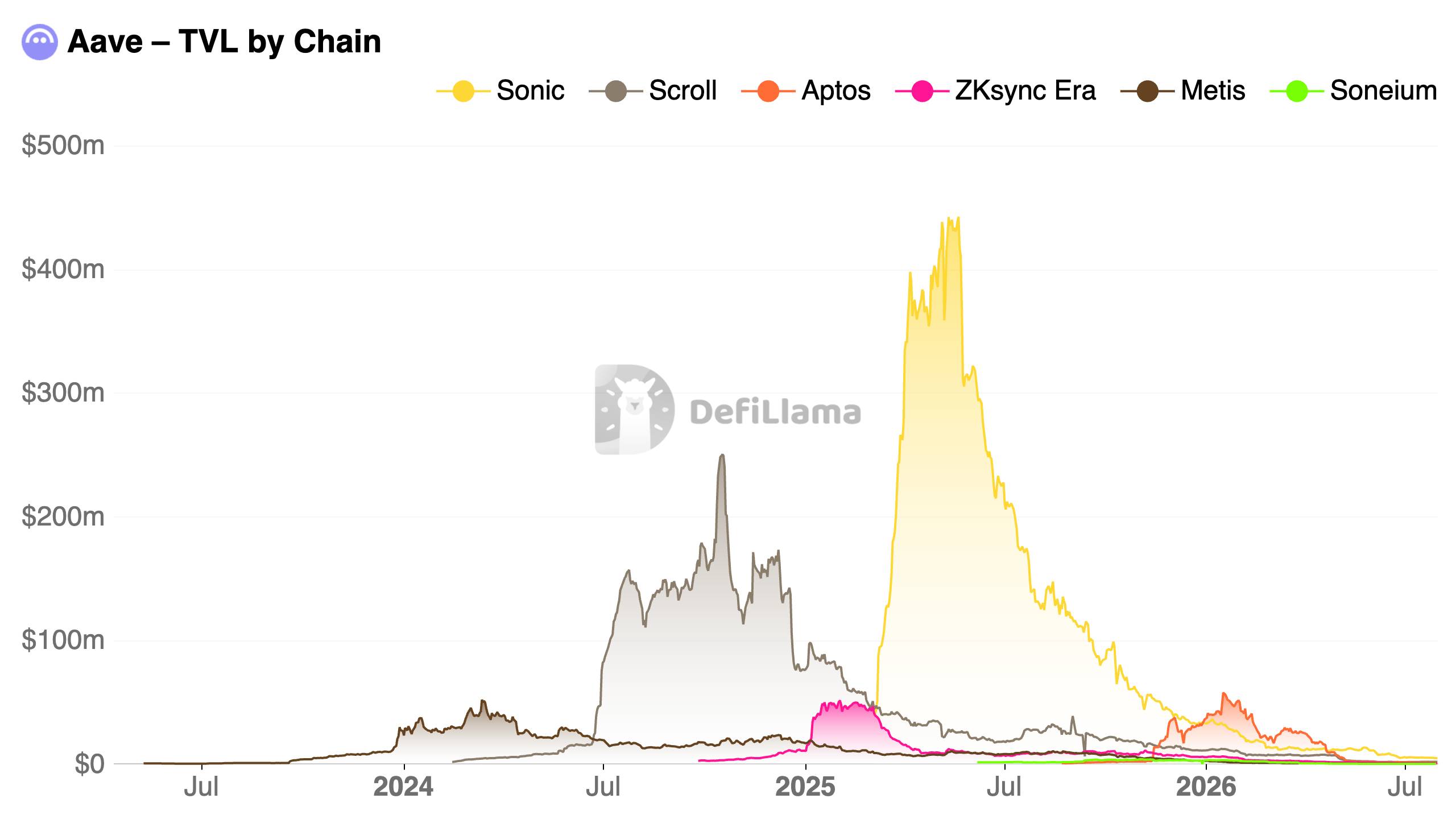
Deposits Have Fallen Sharply Across the Six Networks
The six deployments selected for a complete wind-down have experienced major declines in deposits or available liquidity during the previous six months.
- Sonic: deposits fell 74% from $28.9 million to $7.6 million, with around $2.7 million still borrowed.
- Scroll: deposits declined 86% from $16.1 million to $2.2 million, with approximately $422,000 in debt.
- zkSync: deposits dropped 88% from $7.2 million to about $844,000, while outstanding borrowing stood near $235,000.
- Metis: deposits fell 79% from $1.4 million to roughly $297,000, with around $31,000 borrowed.
- Soneium: deposits declined 95% from $3.2 million to approximately $173,000, with about $38,000 in debt.
- Aptos: available liquidity fell 94% from $18 million to around $1 million. The Aave market held approximately $1.7 million in supplied assets and $719,000 in debt.
At the current level of activity, the Sonic, Scroll and zkSync deployments each generate less than $5,000 in protocol revenue per quarter. Metis, Soneium and Aptos each generate less than $1,000 per quarter.
According to LlamaRisk, this revenue is not sufficient to cover oracle maintenance, continuous monitoring, parameter management and the other operational support required for each deployment.
Bridged Tokens and Expired Assets Are Also Being Removed
Not every asset is being targeted purely because of weak demand. The proposal also covers several structural cases where continued support is no longer considered necessary.
Bridged versions of stablecoins, including USDC.e and USDbC, would be removed from markets where native USDC is already available. Maintaining both versions creates duplicated infrastructure and introduces additional bridge-related risk without providing a clear benefit to users. MaticX would also be wound down after its issuer, Stader, decided to sunset the token. The asset has already been assigned a loan-to-value ratio of zero and borrowing has been disabled.
The 21 Pendle Principal Tokens included in the proposal have passed their maturity dates. Once a PT reaches maturity and can be redeemed for its underlying asset, there is little reason to maintain it as a separate long-term lending reserve.
The Proposal Follows Aave’s Broader Risk Review
The market cleanup comes several months after the April 2026 rsETH incident linked to Kelp DAO’s LayerZero bridge. An attacker introduced 116,500 unbacked rsETH and used the tokens across DeFi lending markets, including Aave.
Aave’s initial incident analysis estimated potential bad debt of between approximately $123 million and $230 million, depending on how losses were allocated and how much collateral could be recovered. The protocol later coordinated recovery measures and tightened its approach to cross-chain collateral, oracle dependencies and low-liquidity markets.
However, the new deprecation proposal explicitly states that it is a portfolio-level risk-reduction measure rather than a reaction to a problem involving one particular asset. Many of the affected reserves were already frozen, had borrowing disabled or had their caps reduced before the latest proposal was published.
FORECK.INFO previously examined Aave’s post-incident position, governance changes and institutional interest in Kraken Reportedly Eyes Aave Stake as Founder Rejects 70% AAVE Discount Claim.
Aave Remains the Largest DeFi Lending Protocol
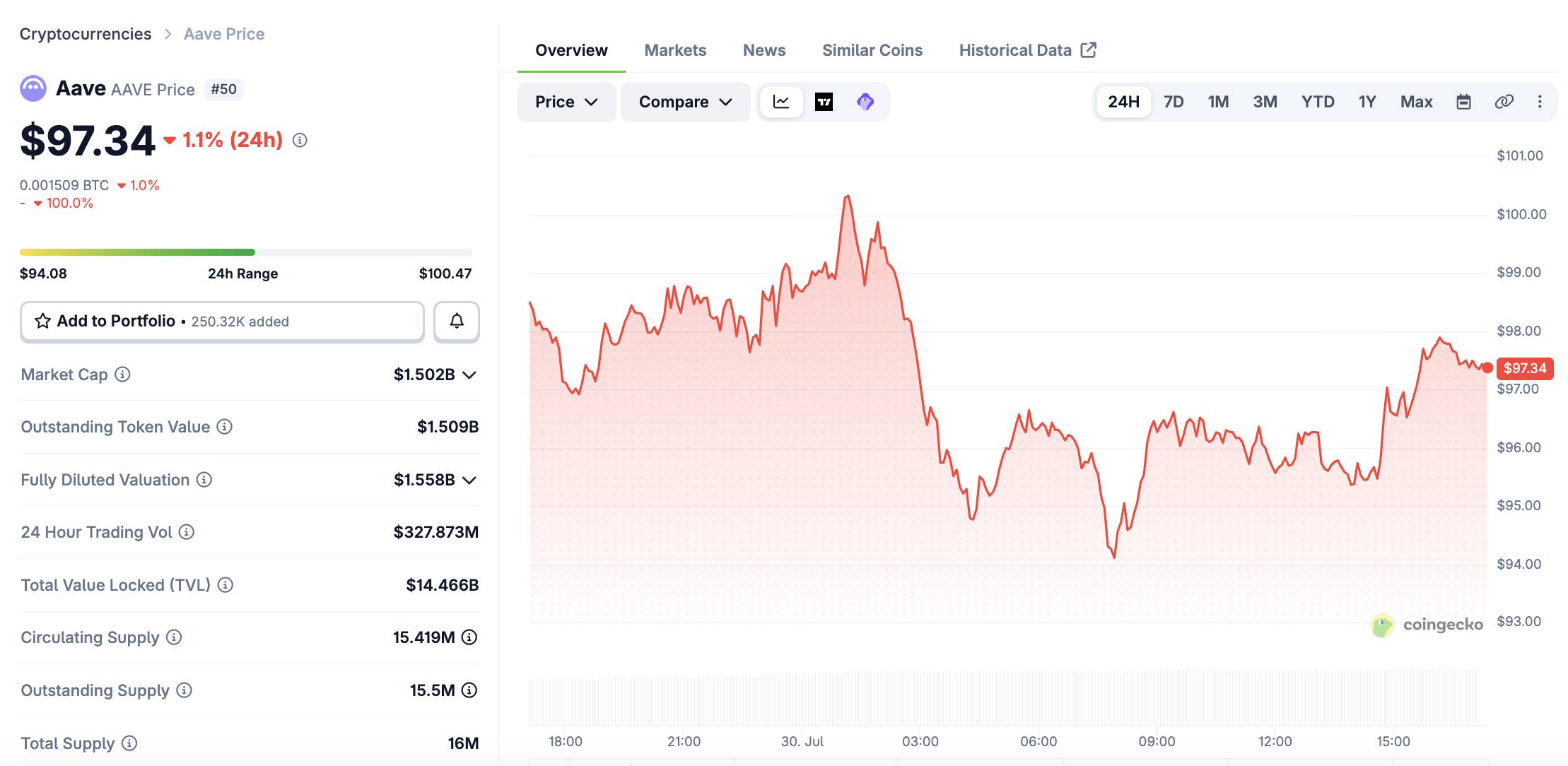
Despite the planned reduction in smaller markets, Aave remains the largest decentralized lending protocol by total value locked. At the time of publication, DefiLlama tracked approximately $14.3 billion in Aave TVL across 23 blockchain networks. The proposed closures would therefore affect only a relatively small share of Aave’s total capital. The six complete market wind-downs contain about $12.8 million in supplied assets, representing less than 0.1% of the protocol’s reported TVL.
The strategy appears to prioritize larger and more economically sustainable markets rather than maintaining the widest possible multichain presence. By removing underused reserves, Aave could reduce oracle dependencies, governance overhead and the number of potential failure points that must be monitored.
What Happens Next?
The proposal is currently at the Aave Request for Final Comments stage. It must move through the protocol’s governance process before the recommended changes can be implemented.
If approved, the first actions would include freezing the remaining active reserves, reducing supply and borrowing caps and changing reserve factors and interest-rate parameters. Service providers would then monitor user exits and decide whether additional measures are required. Once positions on the six networks have been reduced sufficiently, their price oracles could be replaced with fixed-price adapters so the deployments can be retired completely.
For users with funds on affected markets, the proposal does not mean assets have already been removed. However, depositors and borrowers should monitor Aave governance updates and review their positions before restrictions begin.
Conclusion
Aave’s proposed cleanup marks a shift away from expansion for its own sake and toward a more selective multichain strategy. The six targeted deployments have lost most of their liquidity, while the revenue they produce is no longer enough to justify their operational cost.
The proposal would wind down more reserve listings than the original headline suggested: 50 low-adoption reserves, 21 matured Pendle PTs and 25 reserves across six complete deployments. Together, they hold around $98.1 million in supplied assets and $15.6 million in outstanding debt. The changes remain subject to governance approval. If adopted, they would be implemented gradually, giving users time to withdraw deposits or repay loans while Aave reduces the risk and maintenance burden associated with underused markets.
