
Investment Dominates, Payments Lag
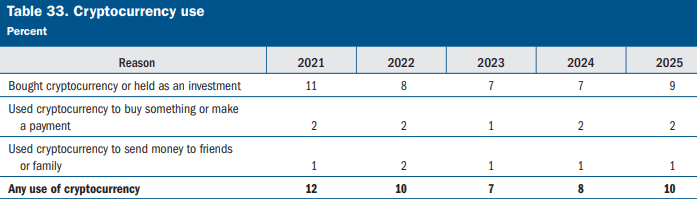
The primary use case remains investment by a wide margin. Around 9% of respondents used cryptocurrency as an investment vehicle. Actual transactional use is far more modest: only 2% used crypto to make payments, and just 1% used it to send money to family or friends.
The gap between crypto as a store of value and crypto as a medium of exchange is striking. Despite ongoing efforts by payment providers to integrate Bitcoin and stablecoins into retail commerce, the Fed data confirms that real-world payment adoption remains limited.
Notably, in many crypto payment cases the initiative came not from consumers themselves but from businesses. More than a quarter of those who used cryptocurrency for payments reported doing so because the merchant offered or preferred that payment method. Users cited faster transaction speeds and lower fees as the main advantages of paying with crypto.
The Unbanked Lead in Transactional Use
One of the more telling findings concerns access to traditional banking. Americans without a bank account used cryptocurrency for transactions at significantly higher rates: 6% of the "unbanked" used crypto for payments or money transfers, compared to just 2% among those with conventional bank accounts — suggesting that crypto's most meaningful real-world utility still lies at the margins of the traditional financial system.
The numbers paint a consistent picture: cryptocurrency remains a fixture in the US financial landscape, but its role as an everyday payment tool still lags far behind its role as an investment asset.
