
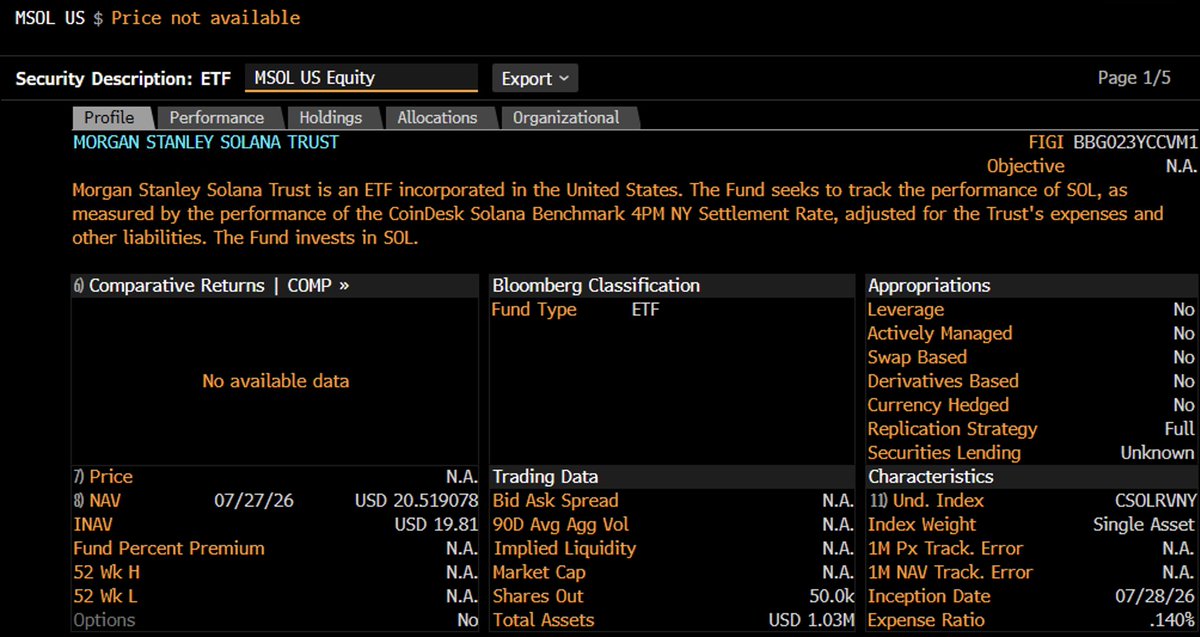
The Morgan Stanley Ethereum Trust began trading on NYSE Arca under the ticker MSSE, while the Morgan Stanley Solana Trust launched under the ticker MSOL on July 28. Both products seek to track the performance of their respective underlying assets while reflecting rewards generated by staking part of the ETH and SOL held by the trusts.
MSSE and MSOL Provide Indirect Crypto Exposure
Exchange-traded products allow investors to gain exposure to the price of an underlying asset through a conventional brokerage account without purchasing, transferring or storing the asset directly.
MSSE holds ether and tracks the CoinDesk Ether Benchmark 4PM NY Settlement Rate. MSOL holds SOL and follows the CoinDesk Solana Benchmark 4PM NY Settlement Rate. Investors should note that owning shares in either trust is not the same as directly owning ETH or SOL. Shareholders cannot independently transfer, use or stake the underlying tokens.
The products are also structured as crypto ETPs rather than conventional investment-company ETFs. They are not registered under the Investment Company Act of 1940 and therefore do not receive all of the regulatory protections associated with traditional mutual funds and ETFs.
Morgan Stanley Sets Both Fees at 0.14%
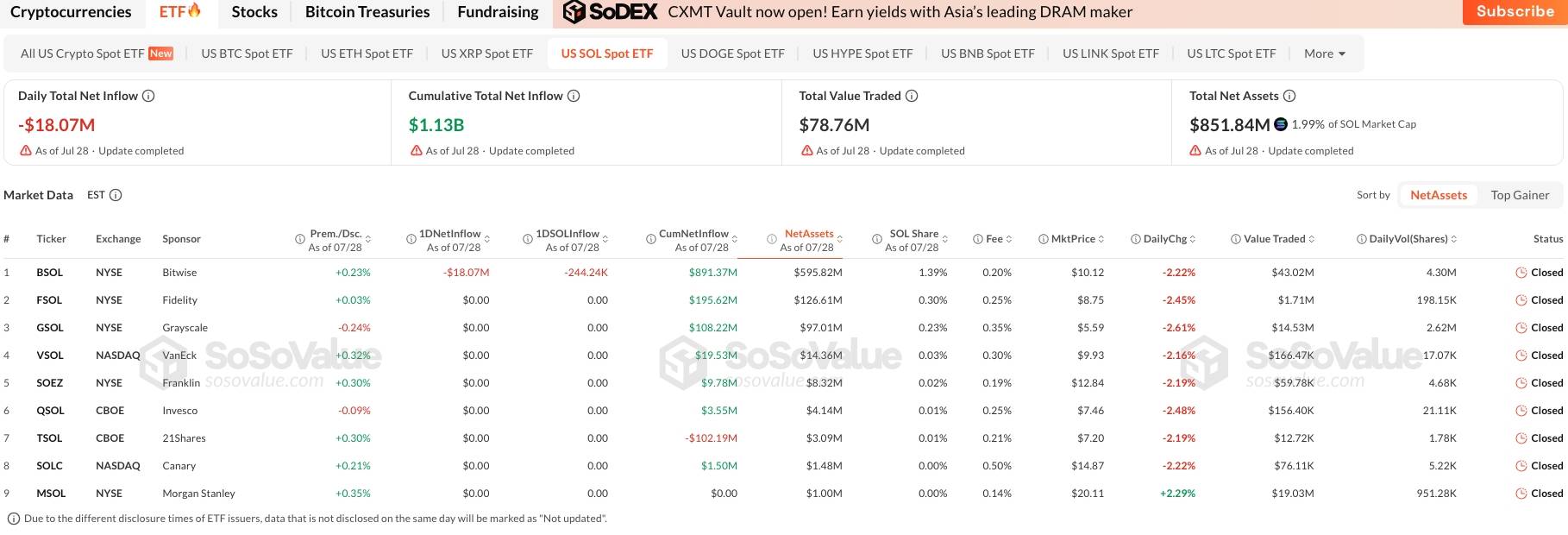
MSSE and MSOL each carry an annual expense ratio of 0.14%, placing them among the most competitively priced single-asset cryptocurrency products in the US market. The pricing continues the strategy Morgan Stanley used for its first crypto product, the Morgan Stanley Bitcoin Trust, which also launched with a 0.14% annual fee.
Low fees have become an important competitive tool in the US crypto ETP market. Products tracking the same digital asset generally provide similar price exposure, meaning that management costs, liquidity, spreads, staking policies and distribution can become major factors influencing investor demand.
Morgan Stanley’s pricing could therefore place additional pressure on competing issuers to reduce fees or offer temporary waivers to defend their market share.
Ethereum Trust Plans to Stake 50% to 80% of Its ETH
Under normal market conditions, Morgan Stanley intends to stake between 50% and 80% of the ether held by MSSE. The exact proportion may change depending on redemption activity, available liquidity, Ethereum validator queues, regulatory considerations and the reliability of third-party staking providers.
The trust must retain enough unstaked ETH to process share redemptions, cover expenses and distribute staking income. Ethereum’s activation and withdrawal queues may also delay how quickly assets can enter or leave staking.
Staking allows the trust to receive protocol rewards generated by validators that help verify transactions and secure the Ethereum network.
Solana Trust May Target Up to 100% Staking
MSOL has a more aggressive staking policy and may seek to stake up to 100% of its SOL holdings. However, this does not mean that all SOL will remain staked at all times. Morgan Stanley’s liquidity model determines how much SOL must remain immediately available for redemptions, operating expenses and distributions.
The actual proportion will therefore vary. Morgan Stanley’s launch disclosures state that both MSSE and MSOL are generally expected to stake less than their entire holdings as part of their liquidity-management policies.
Morgan Stanley Will Not Keep the Staking Rewards
Morgan Stanley Investment Management said it will not retain any portion of the staking rewards generated by MSSE or MSOL for itself.
That does not mean investors will receive 100% of the gross rewards produced by the networks. Third-party validators and staking service providers may charge fees, while trust expenses and operational costs can also reduce the amount ultimately reflected in shareholder returns. Staking rewards are variable rather than guaranteed. They depend on network conditions, validator performance, participation rates and changes to the Ethereum and Solana protocols.
The trusts may also suffer losses if validators perform poorly, experience security failures or become subject to penalties. Staked assets can remain temporarily inaccessible while waiting to enter or exit the validator system.
Staking Marks a Change From Early Ethereum ETPs
The addition of staking represents a significant change from the first generation of US spot Ethereum products.
When the initial spot ETH ETPs launched in the United States, they did not include staking. Investors therefore had to choose between holding an exchange-traded product for convenient price exposure and holding ETH directly to earn protocol rewards.
MSSE combines these two elements within a single exchange-traded structure, although investors give up direct control of the ETH and depend on Morgan Stanley’s custodians, validators and liquidity policies.
MSBT Attracts More Than $381 Million
MSSE and MSOL follow the launch of the Morgan Stanley Bitcoin Trust, or MSBT, earlier in 2026.
As of July 16, MSBT held more than $381 million in assets under management. Morgan Stanley described it as the first cryptocurrency ETP introduced by an asset manager affiliated with a major US bank.
FORECK.INFO previously examined how the company used low fees and its internal distribution network when Morgan Stanley launched the MSBT Bitcoin ETP.
The Bitcoin product’s early growth appears to have encouraged Morgan Stanley to expand its crypto lineup beyond BTC into assets that can also generate staking income.
Morgan Stanley’s ETP Platform Exceeds $14 Billion
Morgan Stanley Investment Management said its full ETF and ETP platform now manages more than $14 billion across 22 products. The lineup includes traditional fixed-income and equity strategies alongside the company’s three digital-asset products linked to Bitcoin, Ethereum and Solana.
Morgan Stanley may also benefit from distribution through its wider wealth-management and brokerage ecosystem. Its existing advisor relationships and E*TRADE platform could provide access to investors who are interested in digital assets but do not want to use a cryptocurrency exchange or manage private keys.
Competition in Crypto ETPs Is Expanding
The launch brings another major traditional financial institution into the US market for Ethereum and Solana investment products.
Competition is no longer limited to providing basic price exposure. Issuers are increasingly competing through management fees, staking policies, reward-sharing structures, custody arrangements, liquidity and access through established financial-advisor platforms.
Staking may make ETH and SOL products more attractive because the underlying assets can generate protocol rewards. However, it also introduces additional operational, liquidity and security risks that do not exist in products holding non-staking assets such as Bitcoin.
Key Risks for Investors
MSSE and MSOL remain highly speculative products whose values are directly linked to volatile cryptocurrency markets.
Shares may trade above or below the net value of the assets held by the trusts. Investors also face custody risks, validator failures, cyberattacks, regulatory changes and potential delays in withdrawing staked assets. There is no guarantee that either trust will earn staking rewards or successfully track the price of its underlying asset after fees and expenses.
Conclusion: Morgan Stanley’s Ethereum and Solana ETPs expand the role of traditional financial institutions in the cryptocurrency investment market. Their 0.14% fees and staking capabilities make them highly competitive, while the success of MSBT gives the company an established foundation for attracting investors. However, staking adds liquidity, validator and custody risks, and the products should not be treated as equivalent to directly holding ETH or SOL.
