
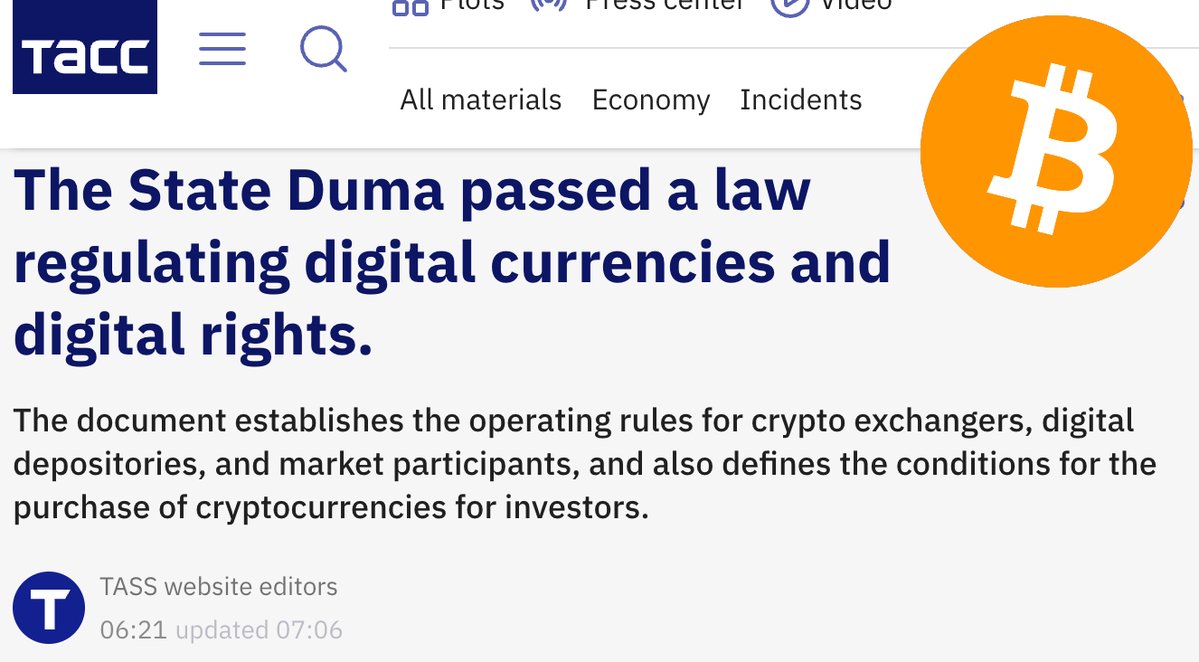
According to TASS, the law covers the entire chain of activities involving cryptocurrencies and digital rights, including trading, accounting, custody, mining, issuance and circulation. The regulatory framework also applies to crypto exchanges, custodians, brokers, asset management companies, trading system operators and clearing organizations.
Russia is not legalizing cryptocurrency as a widely accepted means of domestic payment. The ruble will remain the country’s only legal tender, while the use of Bitcoin or other cryptocurrencies to purchase goods and services within Russia will remain prohibited. The law also bans advertising or distributing information suggesting that crypto can be used to pay for goods, services or intellectual property.
However, Moscow is opening an important channel for international transactions. Cryptocurrency may be used to settle foreign trade contracts between Russian companies and overseas partners, as well as certain transactions involving digital assets, securities and crypto obtained through mining.
This provision is particularly significant as Russia faces growing pressure from Western sanctions. The European Union has previously warned that Russia is becoming increasingly dependent on cryptocurrency for international transactions, while the bloc’s latest sanctions have directly targeted crypto platforms and service providers linked to the country.
For Russian citizens, the new legislation introduces a clearly tiered investment system:
- Non-qualified investors will be allowed to purchase only highly liquid cryptocurrencies through authorized intermediaries and must first pass a specialized knowledge test. The annual limit will be set at 300,000 rubles per intermediary, equivalent to approximately $3,800.
- Qualified investors will be able to purchase any cryptocurrency without being subject to this limit. Previous crypto trading experience may also be considered when determining whether an individual qualifies for this status.
- Crypto holders will have the right to seek legal protection through the courts, including in cases where the assets were not previously declared. Russian sources also report that the legislation establishes cryptocurrency as a legally recognized form of property, creating a framework for resolving ownership disputes and related claims.
Crypto businesses will be subject to registration and regulatory supervision. From July 1, 2027, only organizations included in a special registry will be permitted to conduct full-scale cryptocurrency exchange activities. During the transition period, some companies may continue operating before this deadline. Service providers will also be required to meet capital requirements and remain under regulatory oversight.
Banks will also be placed on the front line of enforcement. If a credit institution or a branch of a foreign bank suspects that a transaction is connected to an entity not authorized to conduct cryptocurrency exchange activities, it must refuse the transfer. This provision could place greater pressure on peer-to-peer trading and informal or black-market exchanges once the new system becomes operational.
Stablecoins and Cross-Border Trade Are the Bigger Strategic Move
The legislation was approved while the Bank of Russia is considering a separate regulatory framework for ruble-backed stablecoins. In a consultation paper published in June, the central bank said that the global stablecoin market had expanded significantly over the previous two years and that such assets could play a role in both investment and cross-border payments. The regulator is examining issues including redemption at par value, repayment periods, reserve adequacy and the financial stability of issuers. However, Moscow still intends to maintain the ban on using stablecoins and digital financial assets for payments between Russian residents, aiming to prevent fragmentation of the domestic payment system.
The State Duma’s decision does not amount to the full legalization of Bitcoin in Russia, according to FORECK.INFO analysts. More accurately, it represents an attempt to move the crypto sector out of the regulatory grey zone and into the formal financial system, while giving the state greater control over the market’s entry and exit points.
Conclusion: Russia is not legalizing cryptocurrency as a general domestic payment method; it is bringing the sector under tighter state control while preserving crypto’s role in international trade. The new framework may benefit licensed exchanges, custodians and financial institutions, but retail participation will remain restricted and unregulated P2P activity is likely to face greater pressure.
