

According to an announcement released on June 25, SBI completed the first issuance of JPYSC in partnership with Singapore-based fintech company Startale Group.
SBI Shinsei Trust Bank will manage the reserve assets backing the stablecoin, while SBI VC Trade, a licensed Japanese cryptocurrency exchange, will distribute the product to users.
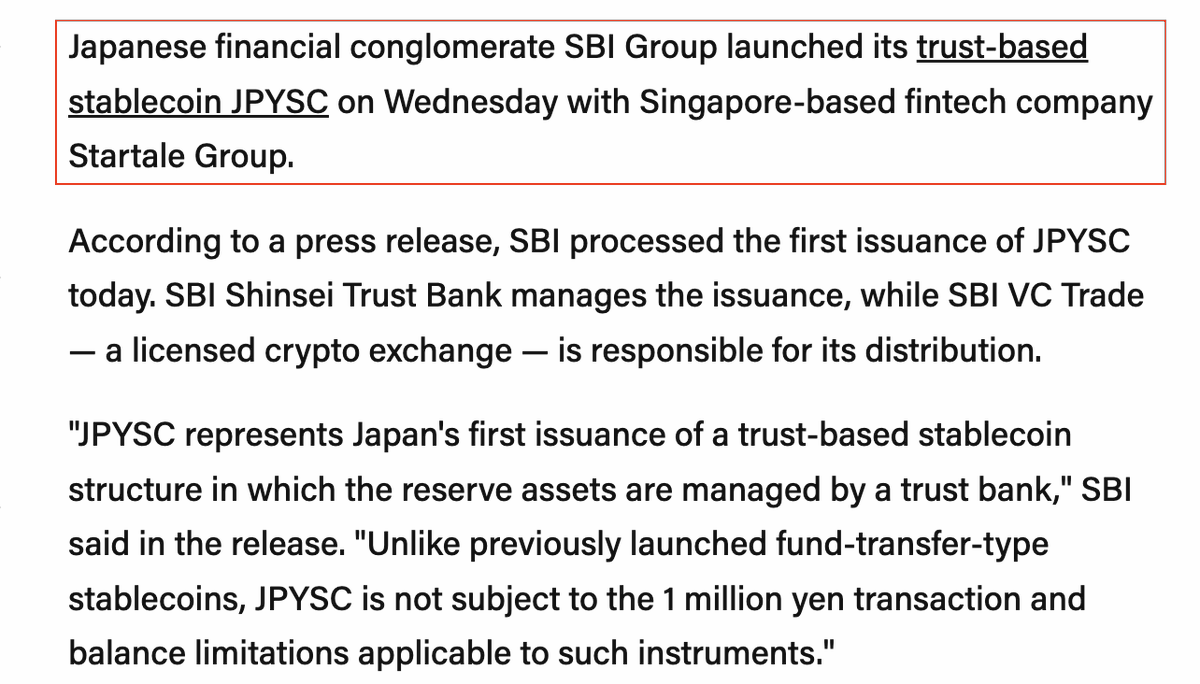
According to SBI, JPYSC is Japan’s first yen-pegged stablecoin issued under a model in which a trust bank manages all collateral assets. It is also the first stablecoin of this type recognised by Japanese regulators as a legal electronic payment instrument under the Payment Services Act.
The main advantage of JPYSC is that it is not subject to transaction size limits that apply to many existing yen stablecoins. Stablecoins currently operating in Japan are often limited to JPY 1 million per transaction or account balance. As JPYSC is issued under a trust bank model, it is not subject to these restrictions.
SBI expects this structure to make JPYSC more suitable for large-value transactions by corporations, financial institutions, and professional investors, while also serving the payment needs of retail users.
In the long term, SBI aims to make JPYSC a digital yen for blockchain-based financial activities, including foreign exchange trading, lending, tokenised real-world asset settlements, and cross-border payments.
Although the issuance has been completed, JPYSC is still being introduced on a limited scale. During the initial phase, the stablecoin will only be available to users with accounts at SBI VC Trade.
SBI said that the scope of use will be expanded once regulators provide greater clarity on the legal and tax framework for stablecoins in Japan. SBI VC Trade has also announced plans to launch a JPYSC lending service in the near future.
Japan Accelerates the Stablecoin Race
Previously, in October 2025, Japanese regulators approved JPYC as the country’s first legally recognised yen-pegged stablecoin.
Japan’s largest financial institutions are also actively entering the sector. Three major banks — MUFG, SMBC, and Mizuho — are reportedly developing a joint stablecoin project.
In early June 2026, the banking group stated that it plans to begin real commercial stablecoin transactions during the 2026 fiscal year.
Conclusion
The launch of JPYSC reinforces Japan’s move toward regulated stablecoin adoption within traditional finance. Its trust bank-backed structure could support wider use in institutional payments, tokenised assets, and cross-border transactions.
