

There is currently a 60 million CU cap in place, and an increase to 100 million was previously discussed. However, the developers argue that block performance should be determined not by an arbitrary cap, but by validator hardware capacity.
Rationale for the proposal
The initiative is based on the Alpenglow upgrade, which has already received near-unanimous approval in voting. The upgrade will cut block finalization from 12.8 seconds to 100–150 ms, reduce network congestion, and remove excessive gossip messages.
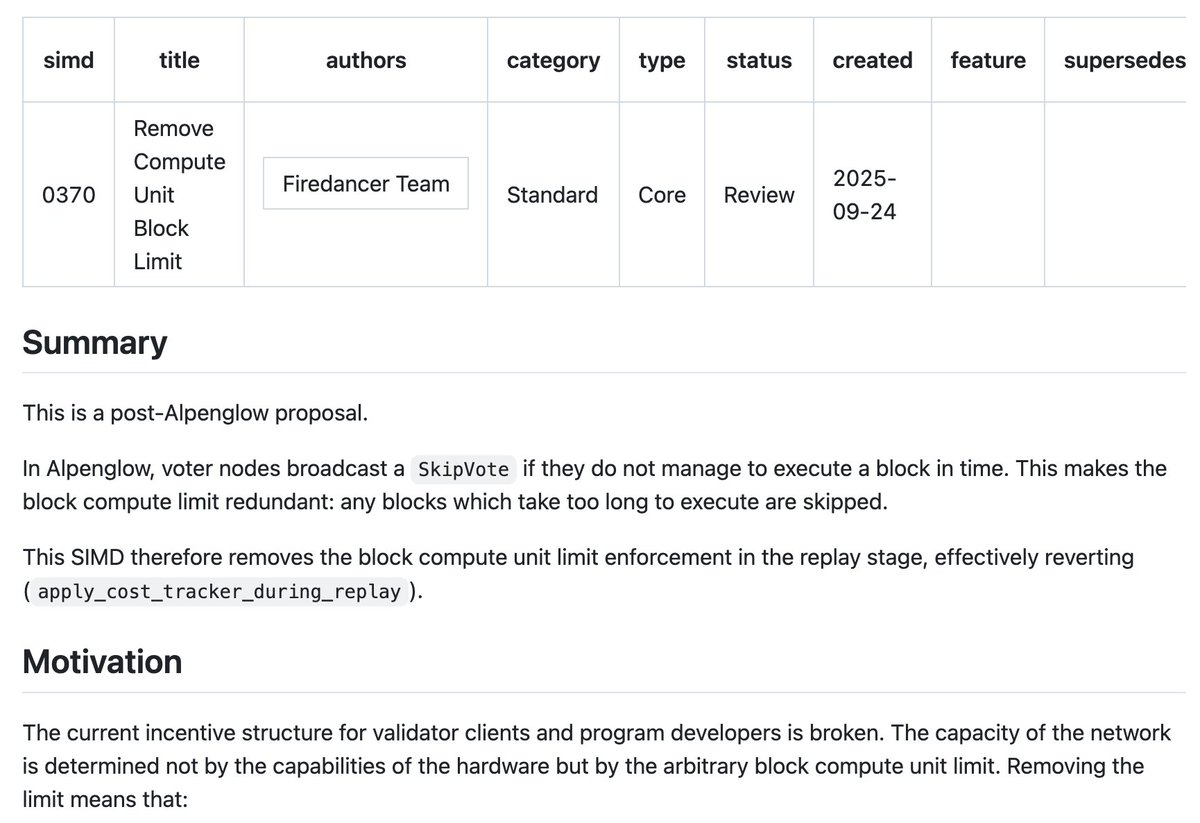
In the new architecture, nodes with less powerful hardware will be able to use the skip-vote mechanism to skip “overloaded” blocks. More performant validators, by contrast, will be able to include more transactions and earn additional fees. This creates a dynamic system where throughput grows with demand rather than being manually adjusted.
“The current incentive structure is flawed: network capacity is determined not by hardware, but by an artificial per-block CU limit,” the Firedancer team noted.
In their view, this will trigger a “flywheel effect”: ongoing node optimization raises the network’s baseline capacity, which in turn allows block limits to be safely expanded further.
Risks and criticism
Roger Wattenhofer, head of research at Anza and initiator of the Alpenglow upgrade, supported the idea but warned that removing the cap could lead to centralization and stability risks if an ultra-powerful block producer were to dominate.
1/ SIMD-0370, by Jump’s Firedancer team, proposes removing Solana’s fixed compute unit block limit after Alpenglow. This would eliminate static caps on block limits and have validators skip blocks they can’t process in time. Here’s what changes 🧵 pic.twitter.com/xge1IViKnH
— Anza (@anza_xyz) September 27, 2025
Similar concerns were voiced by systems engineer Akhilesh Singhania, who noted that more expensive, higher-performance setups could crowd out smaller validators and concentrate control of the network in fewer hands. Nevertheless, supporters of the initiative believe the potential risks can be mitigated.
Context and ecosystem investments
In early September, Jump Crypto, Galaxy Digital, and Multicoin Capital launched Forward Industries, making a major bet on Solana’s growth. The project received $1.65 billion in cash and stablecoin commitments, underscoring large players’ strategic interest in the ecosystem.
Conclusion
If SIMD-0370 is adopted, Solana could move to a model where network throughput is determined by market demand and validator hardware levels. This could improve efficiency and validator revenues, while also introducing risks of centralization and added complexity for smaller operators. Note that the upgrade is expected to cut transaction finality from 12.8 seconds to 150 milliseconds, while other improvements aim to enhance network resilience.