
The euphoria surrounding XRP has faded noticeably. After peaking at $3.56 last year, Ripple’s token has lost more than half of its value in the latest correction. Although Ripple continues to generate positive headlines, achieve regulatory progress, and strengthen its market position, this has so far failed to provide meaningful support for the price. The question now is how deep the correction could become and which levels are moving into focus.
XRP still has not decoupled from Bitcoin
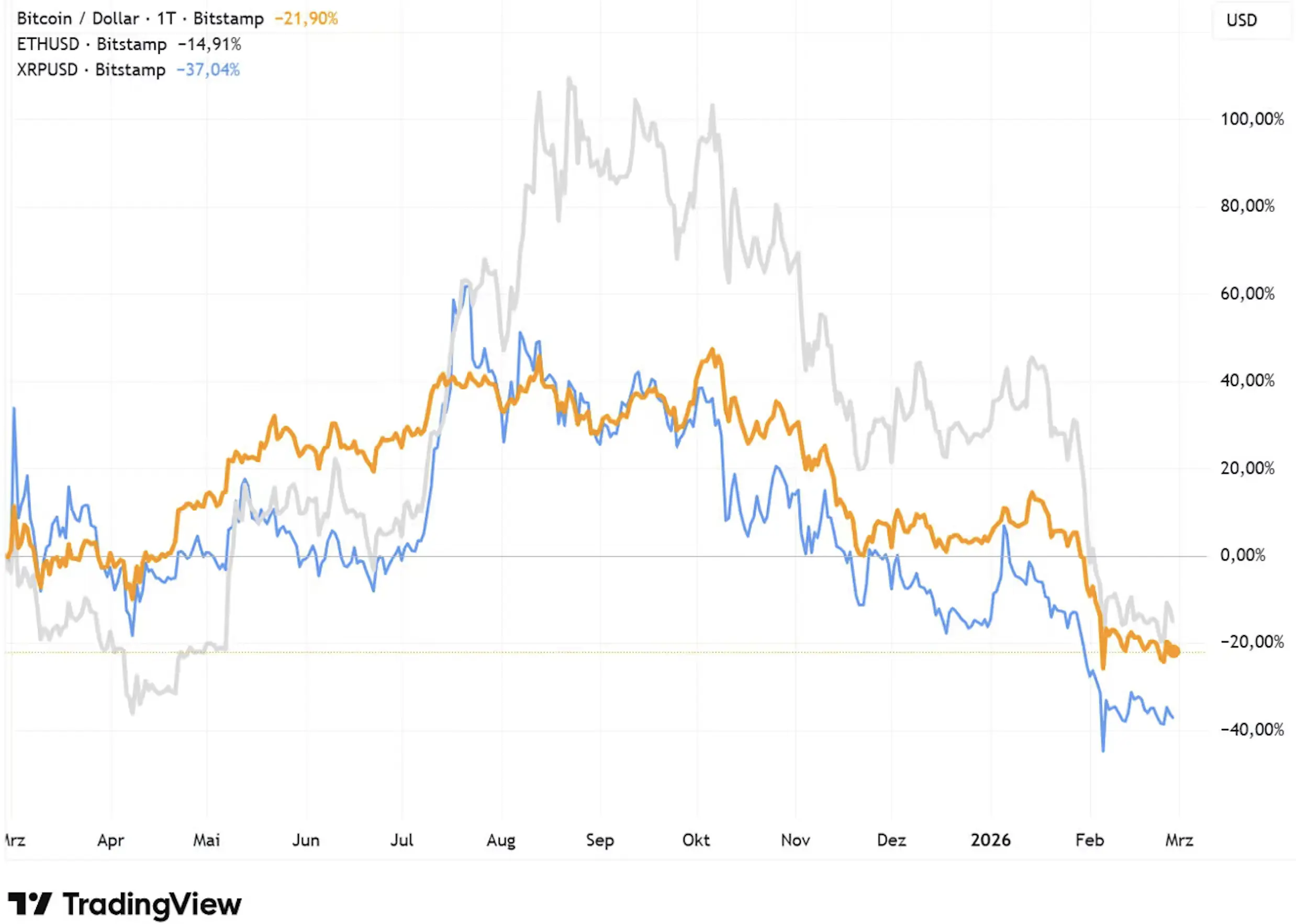
Many analysts had expected major altcoins, including XRP, to gradually break away from Bitcoin’s market cycles. In practice, however, that has not happened. Despite growing institutional interest in crypto and regulatory progress around Ripple Labs, XRP remains heavily dependent on the market leader’s price action. As with Ethereum, periods of Bitcoin weakness continue to trigger disproportionately larger losses in XRP. Over the past year, BTC has declined by around 22%, while XRP has fallen by roughly 37%.
ChatGPT does not draw a definitive conclusion that a full-scale long-term bear market has already begun. According to the model, the classic four-year cycles are still in play, but no longer in a mechanical way: corrections often arrive earlier, while the evolving structure of the market helps moderate the most extreme moves. That said, this provides no structural advantage for XRP. Despite regulatory progress, there are still no clear signs of sustainable independence from Bitcoin.
In an environment of heightened uncertainty, XRP remains vulnerable to broad market dynamics. In the event of another downturn in 2026, ChatGPT expects the token to face “a prolonged, exhausting cooling phase with high volatility.” Gemini, for its part, argues that the market is currently going through not systemic capitulation, but rather a cleanup of speculative excess, with pressure partly cushioned by the growing institutional presence and the expansion of spot ETFs. Even so, a rapid decoupling of XRP from Bitcoin remains unlikely despite greater regulatory clarity and rising on-chain utility.
According to DeepSeek, a prolonged bear market similar to 2018 looks less likely. Instead, the market could enter a lengthy sideways phase marked by periodic shocks, in which XRP—like other major altcoins—would continue to suffer from the dominant influence of macro conditions and Bitcoin. Regulatory breakthroughs and institutional adoption may support the project, but XRP’s beta effect relative to the broader market will remain dominant until its own use case begins generating substantially greater monetary value.
How deep could the XRP correction go?
Historically, altcoins often form their lows later than Bitcoin. If a full crypto winter scenario does unfold in 2026, the strongest downward pressure on XRP could come toward the end of the year or even extend into 2027.
In its scenario analysis, ChatGPT sees XRP potentially falling into the $0.60–$0.90 range. A deeper decline would likely require a new systemic crisis or a major regulatory shock. Without such extreme events, a prolonged bottoming phase appears more likely than a sudden capitulation. Spot ETFs may soften the move, but they are unlikely to prevent a bear market entirely—they would only change its shape.