

The latest escalation in tensions between the United States and Iran triggered an immediate reaction across the cryptocurrency market. Bitcoin briefly dropped toward the 63,000$ level, while around 1.8 billion dollars in open positions were liquidated or closed in the derivatives market. The rapid decline in open interest suggests traders were reducing risk and unwinding leveraged positions. Notably, however, the market did not enter a classic panic phase.
No capitulation from short-term investors
The market’s initial reaction was most visible in the derivatives segment. Roughly 1.8 billion dollars in open positions were closed within a short period. Open interest fell sharply as traders exited leveraged positions and reduced exposure.
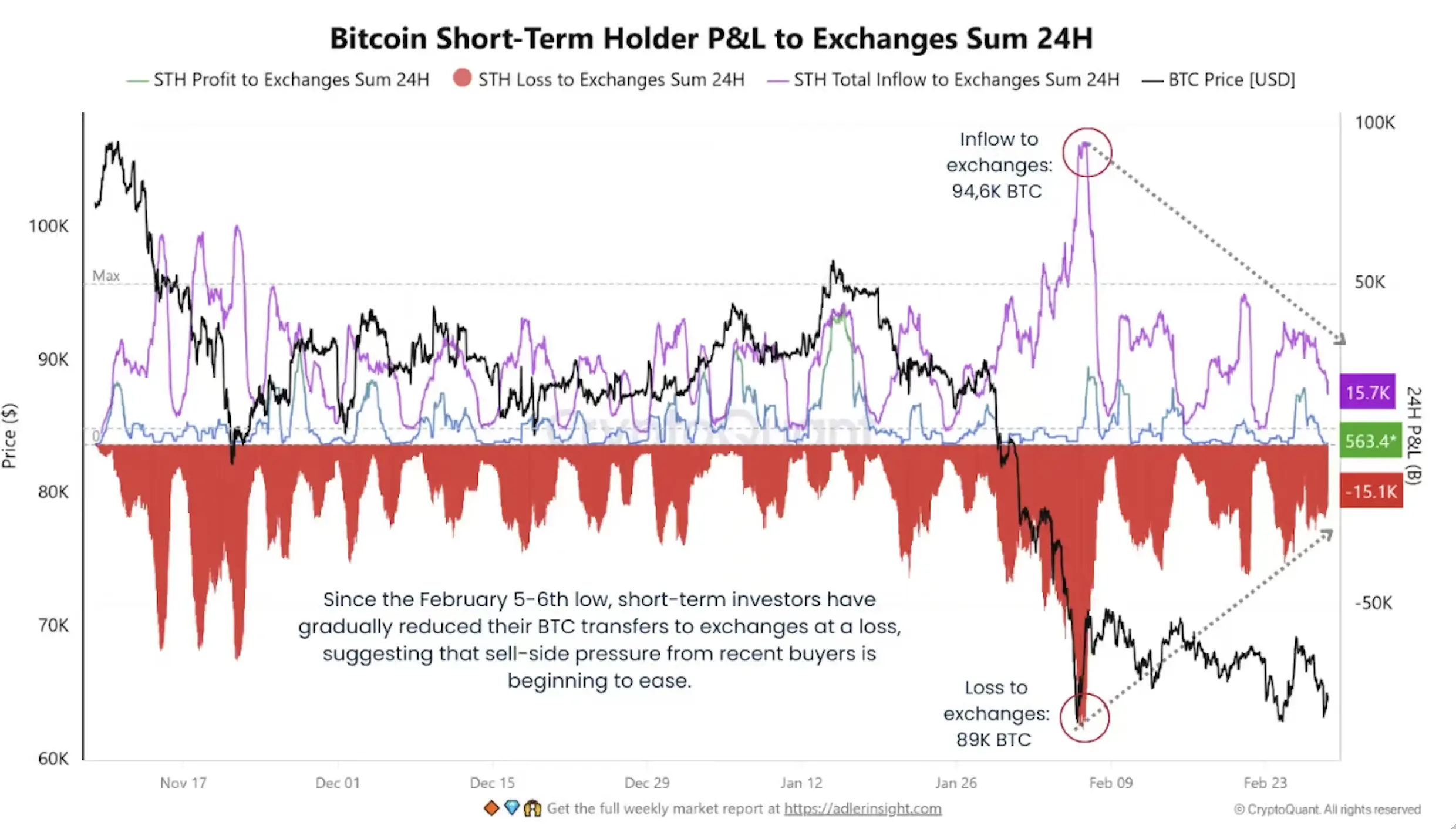
Even so, this market “cleanup” was not accompanied by traditional panic selling. Geopolitical shocks usually trigger heavy selling from short-term market participants. The current data, however, paints a different picture.
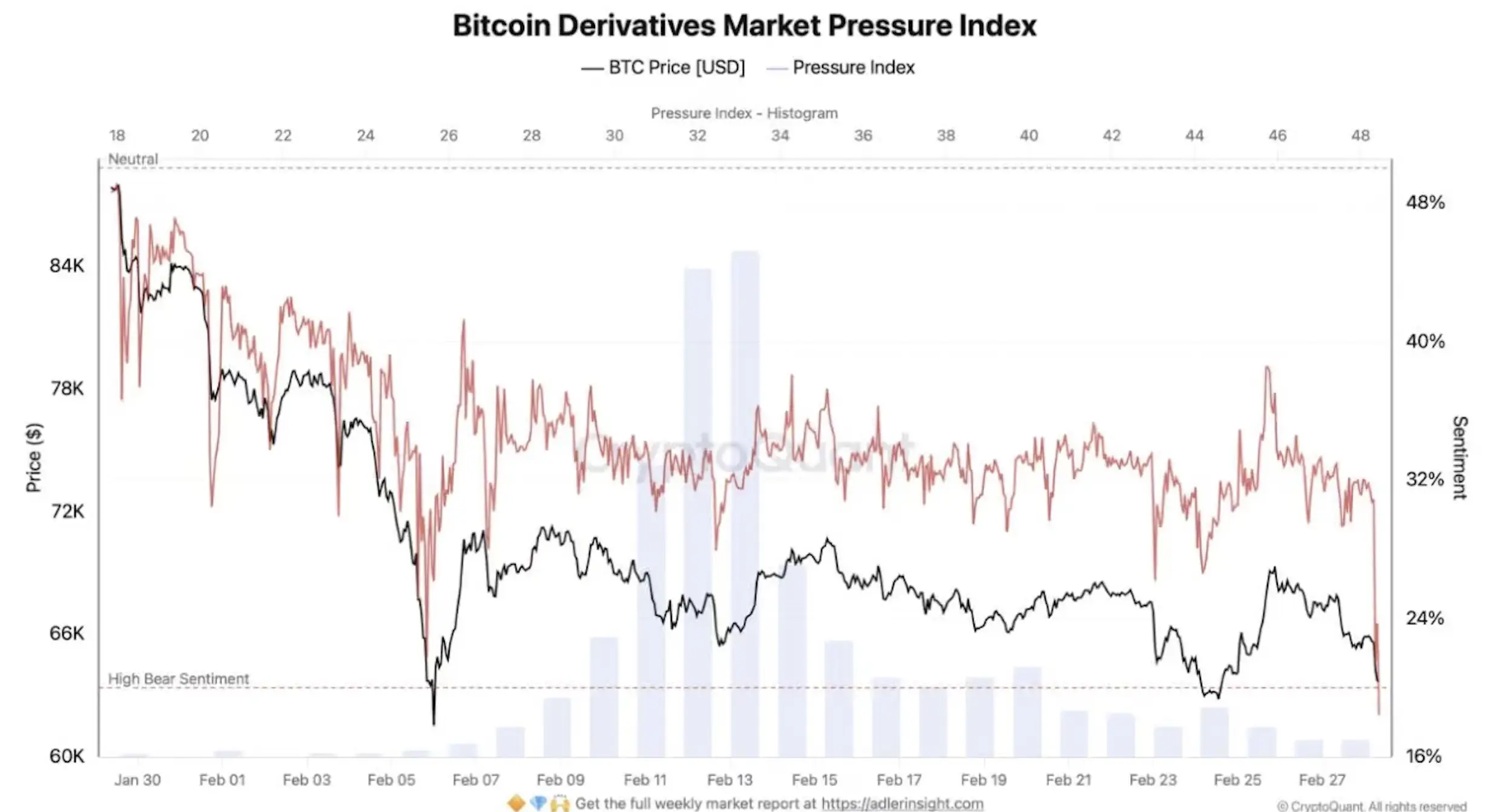
So-called Short-Term Holders — investors with a relatively short holding horizon — did not move unusually large volumes of BTC to exchanges at a loss, even as the price slipped toward 63,000$. There was no significant spike in loss-driven exchange inflows.
This stands in clear contrast to the situation at the beginning of February. Back then, around 89,000 BTC were sent to exchanges at a loss within 24 hours — a clear capitulation signal. Since that event, selling pressure has gradually weakened, and even during the latest escalation the market did not show similar behavior. This points to a structural change: the derivatives market was flushed out, but short-term investors did not rush to dump their holdings.
Bitcoin price: recovery without trend confirmation
After the initial drop, Bitcoin recovered faster than many traditional markets. While equity indices remained under pressure from geopolitical risks, BTC climbed back toward the 70,000$ area.
Importantly, the rebound was accompanied by growth in both spot and futures trading volumes. This points to real demand in the spot market rather than a purely short-term move driven by leverage. At the same time, funding rates remained negative, suggesting there was no overheated long positioning. Overall, the structure of the rebound looked healthy.
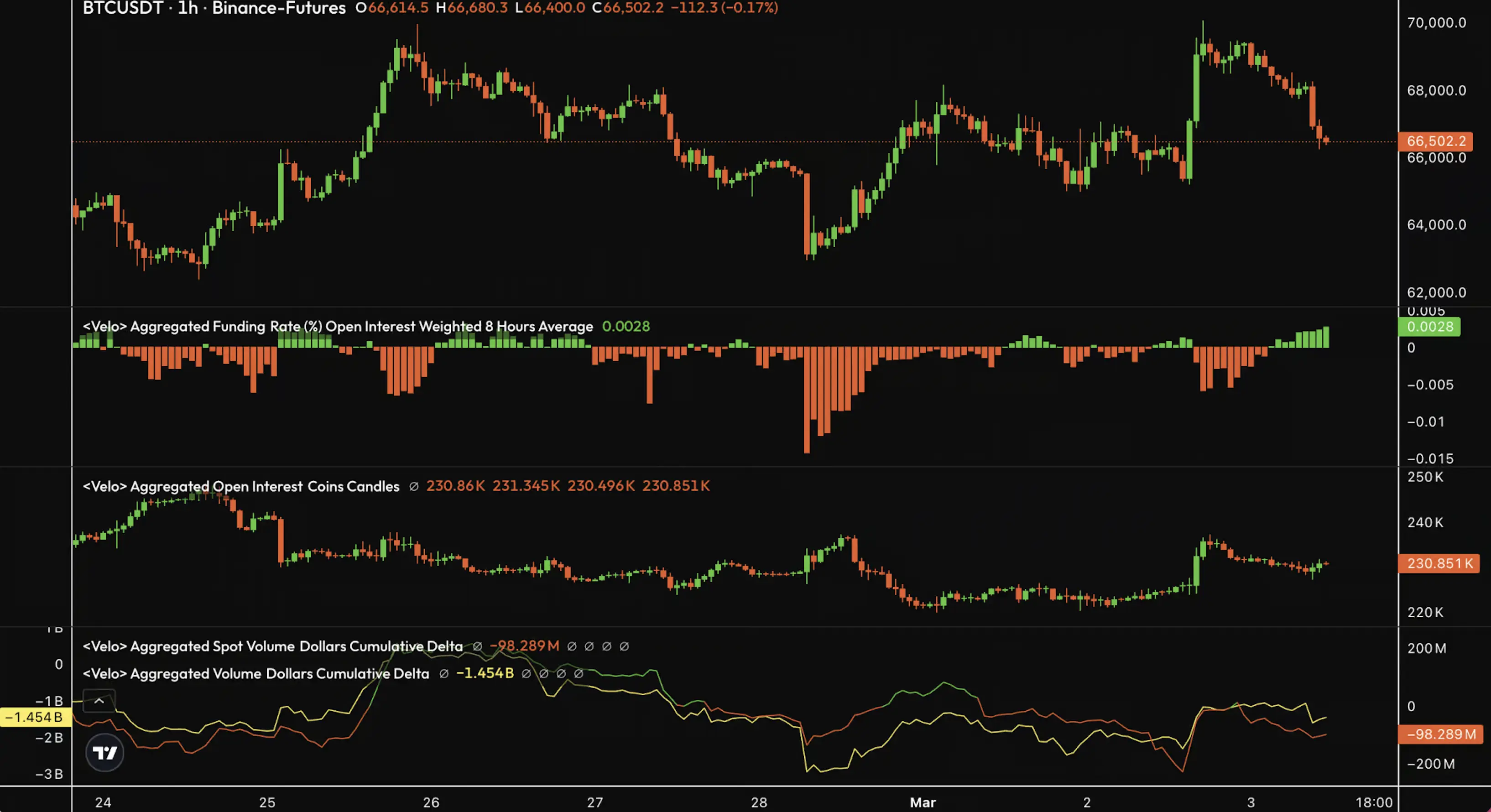
Even so, the 70,000$ level once again acted as a serious resistance zone. The asset failed to establish itself above that mark and is now trading back near 66,000$. As a result, there is still no confirmation of a sustainable trend reversal.
Geopolitics remains the key risk factor
The situation in the Middle East remains a major source of uncertainty for global markets. Special attention is focused on the Strait of Hormuz, through which about 20% of global oil supplies pass.
A prolonged disruption of this route could have a serious impact on the energy market. Analysts at major banks including JPMorgan and Barclays believe that if the conflict escalates over several weeks, oil prices could rise to 100–125$ per barrel.
A sharp rise in oil prices would fuel inflation expectations and could limit central banks’ ability to ease monetary policy. For risk assets, including Bitcoin, that creates a complicated macroeconomic backdrop. On one hand, BTC is showing relative resilience; on the other, the global environment remains unstable.
Most BTC buyers are now underwater
Another structural factor is the distribution of realized purchase prices. The data shows that a significant share of investors who bought Bitcoin over the past two years are now sitting on unrealized losses. Historically, situations like this have often marked turning points in the market cycle. Major selloffs usually occur when most participants are still holding substantial unrealized gains. When a large share of the market is already underwater on paper, the incentive to sell tends to decline.
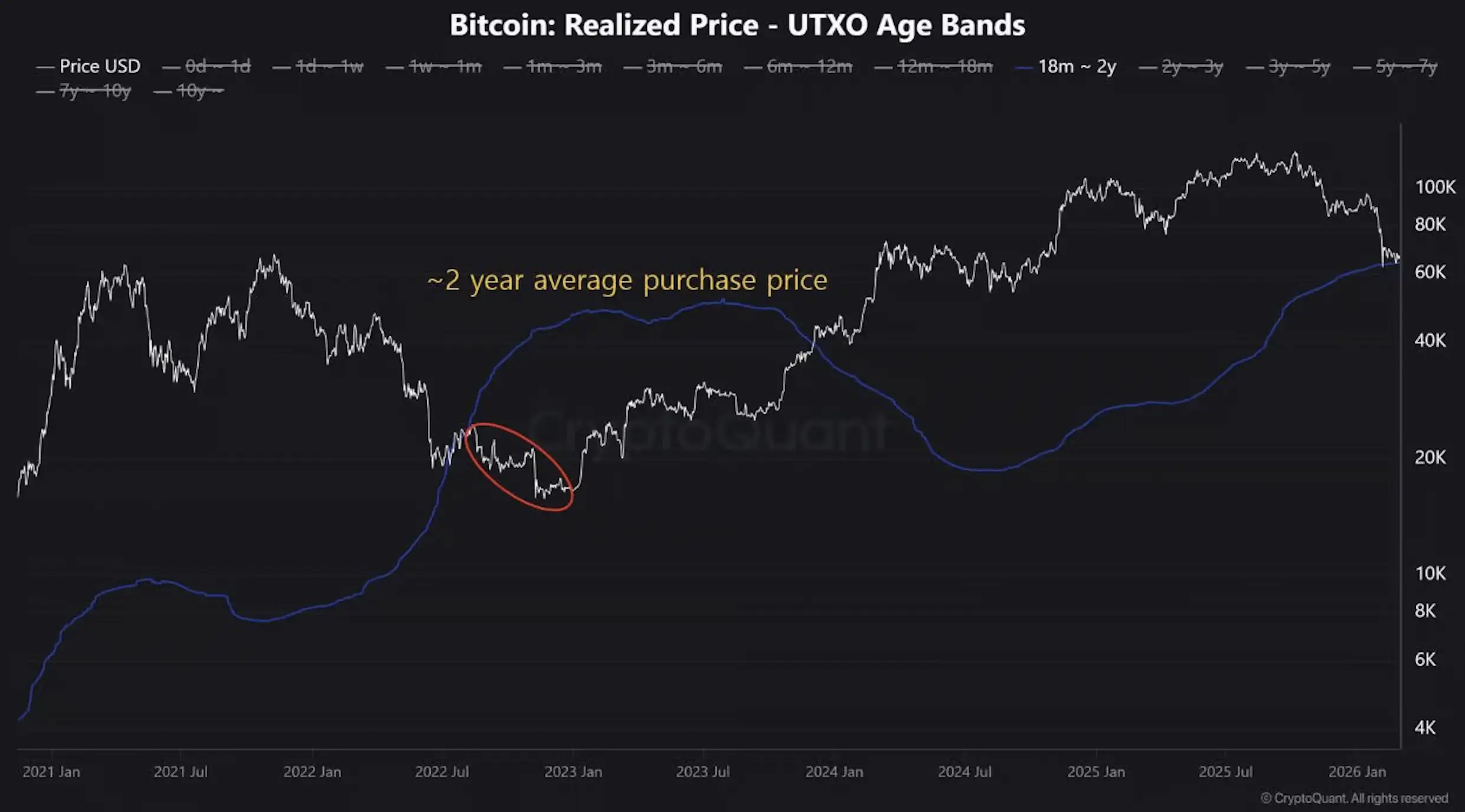
Investors who are already deep in the red are generally less likely to sell impulsively, except during periods of true panic. That is why this type of market structure often creates the conditions for stabilization.
This does not mean the market has already found its final bottom. However, there is a growing possibility that a significant portion of speculative pressure has already been removed.
If Bitcoin falls toward 60,000$ or lower, even more market participants would move into loss territory, which could intensify short-term pressure. At the same time, from a longer-term perspective, this kind of setup has historically been associated more with accumulation phases than with the beginning of fresh systemic crashes.
Conclusion
Bitcoin remains caught between geopolitical risk and a structural market reset. The escalation of the conflict between the United States and Iran led to a major reduction in leveraged positions in the derivatives market, but it did not trigger broad investor panic selling.
The recovery looked solid, but it failed to establish a confirmed upward trend. With Bitcoin currently trading around 66,000$, the short-term picture remains uncertain. At the same time, the data shows that a large share of investors is already in the red — a market condition that has historically been more closely associated with stabilization phases than with the beginning of a new systemic collapse.