

According to Brandt, the Clarity Act is indeed necessary to establish a clearer legal framework, but it is unlikely to alter Bitcoin’s fundamental valuation. In comments to Cointelegraph, the trader stressed that the passage of the bill does not constitute a major macroeconomic event and should not be viewed as a catalyst for a new price trend. He noted that regulation alone does not automatically make an asset more valuable, despite the long-standing skepticism toward government intervention among parts of the Bitcoin community.
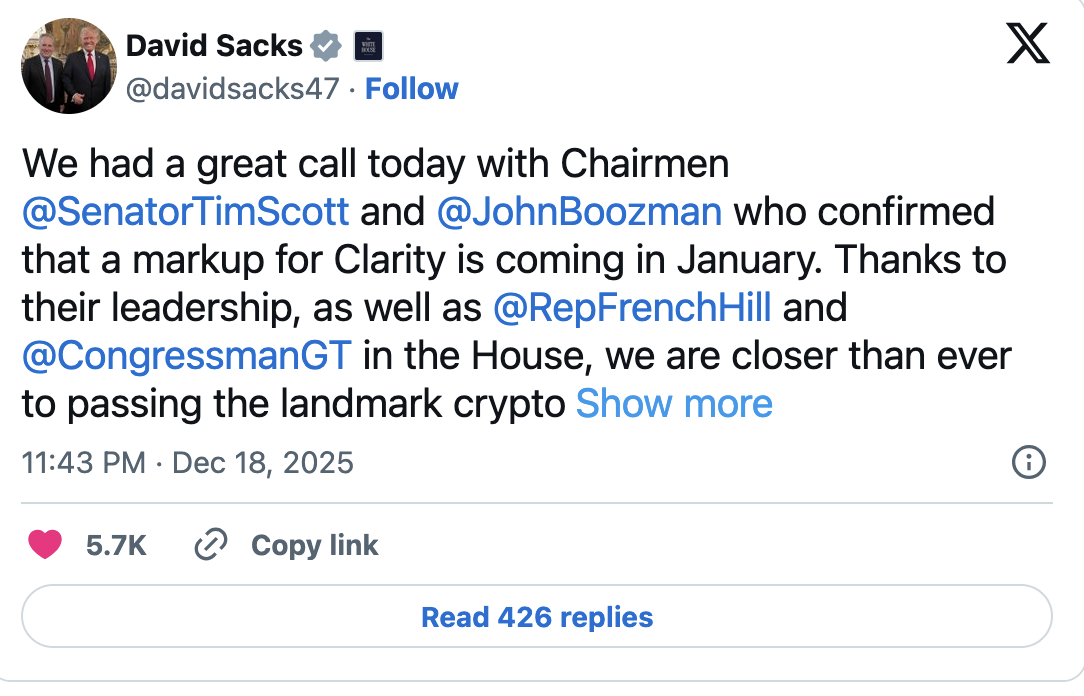
Interest in the legislation intensified following recent remarks from the White House. David Sacks, the U.S. government’s adviser on cryptocurrency and artificial intelligence, said authorities are “closer than ever” to passing comprehensive digital asset regulation. According to him, lawmakers aim to complete the process in January. The Clarity Act is expected to clearly define the responsibilities of regulatory agencies and address long-standing legal uncertainty faced by crypto companies.
Despite his restrained view on the bill’s short-term implications for Bitcoin, Brandt acknowledged that the Clarity Act would be a positive development for the industry as a whole. A well-defined regulatory framework could support greater institutional participation over the long term, he said, but it should not be interpreted as a trigger for rapid price appreciation.
Other market participants share a similar assessment. John Glover, chief investment officer at crypto lending platform Ledn, noted that a potential approval of the legislation is largely already priced in and is unlikely to generate a significant market reaction in the near term.