

According to the latest report from the World Platinum Investment Council (WPIC), total platinum supply in 2025 may reach 7,129 thousand ounces, up 2.0% year-on-year. Despite an expected 5.0% annual decline in mining output, analysts believe that a positive impulse from the South African industry—where free cash flow could triple to 1.7 billion rand in 2026—will support overall production levels. Against this backdrop, major financial institutions are revising price targets: analysts at Bank of America Corp. have raised their medium-term forecasts for platinum and palladium to $2,450 per ounce and $1,750 per ounce, respectively. This suggests a structural advantage for platinum within the price spread, as its upside potential is estimated at 25.0–30.0%, while gains in palladium remain constrained by structural changes in the automotive sector.
In recent months, platinum has posted a deeper correction than palladium due to its higher share of investment demand, which, according to WPIC data, accounts for up to 20.0% of total consumption. Elevated sensitivity to U.S. dollar dynamics and expectations surrounding Federal Reserve interest rate policy has narrowed the platinum–palladium spread to $335.0, close to a three-year low, compared with a stable range of $600.0–800.0 in 2023–2024.
Fundamental factors remain supportive: experts estimate that the platinum market will post a deficit of 400.0–500.0 thousand ounces this year amid stagnant production and rising industrial usage. Additional support comes from the recovery of the automotive sector, where platinum is increasingly substituting palladium in gasoline catalytic converters, as well as from hydrogen technologies, where the metal is used in electrolyzers and fuel cells. According to the International Energy Agency (IEA), consumption in this segment could more than double by 2030.
Meanwhile, data from the Commodity Futures Trading Commission (CFTC) show that long positions held by real-money traders declined by 2.731 thousand to 15.082 thousand, while short positions stand at 13.224 thousand. The gap between these figures has narrowed significantly from over 40.0 thousand in early December. According to CME Group, 19.711 thousand platinum futures contracts and 0.538 thousand options were recorded yesterday, compared with 64.0 thousand and 3.5 thousand, respectively, at the end of January. This suggests that the current corrective trend may persist for some time.
Support and Resistance Levels
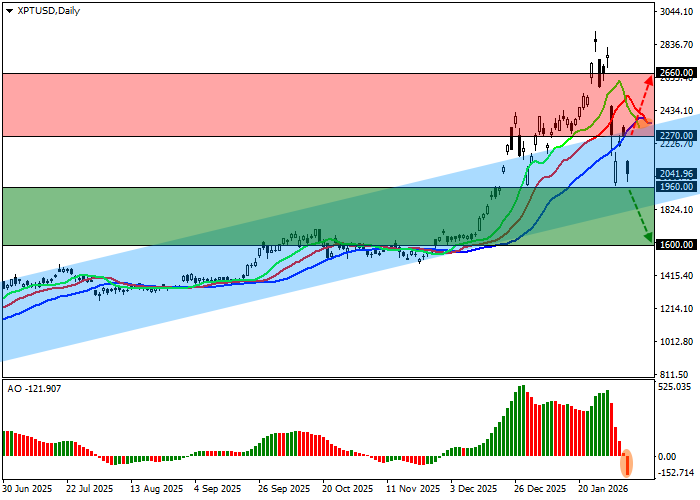
On the daily chart, the instrument is attempting to extend its decline while holding above the lower boundary of an ascending channel with dynamic limits at 2200.00–1700.00.
Technical indicators reinforce the sell signal: the AO histogram remains in negative territory below the zero line, while the fast EMAs of the Alligator indicator stay below the signal line.
Resistance levels: 2270.00, 2660.00.
Support levels: 1960.00, 1600.00.
Trading Scenarios XPT/USD
Short positions can be opened after a confirmed break and consolidation below 1960.00, targeting 1600.00. Stop-loss: 2100.00. Time horizon: 7 days or more.
Long positions can be opened after a breakout and consolidation above 2270.00, targeting 2660.00. Stop-loss: below 2100.00.
Scenario
| Timeframe | Weekly |
| Recommendation | SELL STOP |
| Entry Point | 1959.95 |
| Take Profit | 1600.00 |
| Stop Loss | 2100.00 |
| Key Levels | 1600.00, 1960.00, 2270.00, 2660.00 |
Alternative Scenario
| Recommendation | BUY STOP |
| Entry Point | 2270.05 |
| Take Profit | 2660.00 |
| Stop Loss | 2100.00 |
| Key Levels | 1600.00, 1960.00, 2270.00, 2660.00 |