
Although gross domestic product (GDP) growth in the region remains among the slowest of major economies, the eurozone continues its gradual recovery. In France, the manufacturing PMI rose from 50.7 to 51.0 points in January, while the services PMI declined from 50.1 to 47.9 points, resulting in a drop in the composite index from 50.0 to 48.6 points. Germany posted significantly stronger results: manufacturing PMI climbed from 47.0 to 48.7 points, services PMI increased from 52.7 to 53.3 points, and the composite indicator rose from 51.3 to 52.5 points. Across the EU, manufacturing and services indices adjusted from 48.8 to 49.4 points and from 52.4 to 51.9 points, respectively, leaving the composite index unchanged at 51.5 points.
Meanwhile, European Commission President Ursula von der Leyen announced that the signing of a “historic trade agreement” with India is approaching. Free trade negotiations officially resumed in 2022 after nearly a nine-year pause, and more than ten negotiation rounds have since taken place. According to the Commission, EU–India trade exceeded €120 billion in 2024, with the eurozone remaining India’s largest trading partner, while India ranks as the EU’s ninth-largest partner. The proposed deal could boost trade flows by 30–40% in the medium term. Key disputes persist over tariffs on automobiles and alcohol, which reach 100–150% in India, as well as sustainability requirements and access for European companies to India’s public procurement market, estimated at over $500 billion annually. The EU, in turn, remains cautious regarding visa policy and labor market access. The agreement will be the central topic of the 16th EU–India Summit in New Delhi on January 27, attended by von der Leyen, European Council President António Costa, and EU High Representative for Foreign Affairs and Security Policy Kaja Kallas.
The U.S. dollar index (USDX) stands at 96.80, its lowest level since September 23, continuing the negative trend that began in mid-January following Donald Trump’s initial comments regarding Greenland. Although tensions surrounding U.S. intentions to acquire the island have eased and the White House abandoned plans to impose 10.0% tariffs on eight European countries, the dollar remains under strong pressure. On Wednesday at 21:00 (GMT+2), the Federal Reserve will hold its policy meeting, with officials widely expected to keep interest rates unchanged at 3.50–3.75%. According to the CME FedWatch Tool, the probability of this outcome stands at 97.2%. This increases the likelihood of rate cuts later in the year, as the Fed has projected a total reduction of 50 basis points for 2026.
Support and Resistance Levels
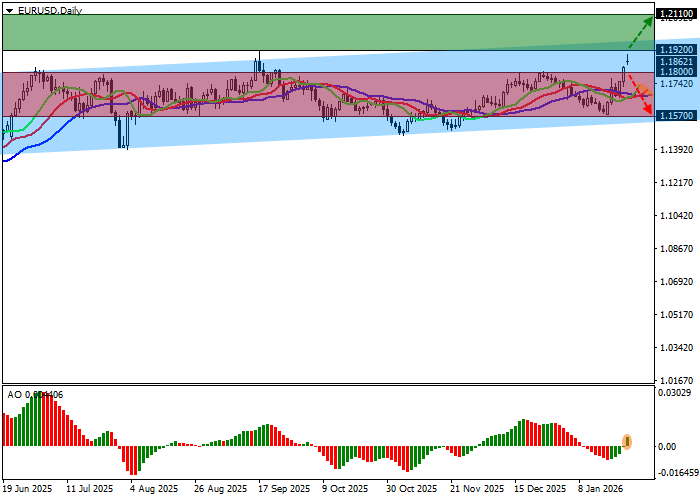
On the daily chart, the pair is correcting higher, approaching the resistance line of an ascending channel bounded by 1.2000–1.1560.
Technical indicators reinforce the buy signal formed last week: the fast EMAs of the Alligator indicator remain above the signal line, widening their range, while the Awesome Oscillator histogram is forming corrective bars in positive territory.
Resistance levels: 1.1920, 1.2110.
Support levels: 1.1800, 1.1570.
Trading Scenarios and EUR/USD Forecast
Long positions can be opened after a breakout and consolidation above 1.1920, with a target at 1.2110 and a stop-loss at 1.1830. Time horizon: 7 days or more.
Short positions can be opened after a breakout and consolidation below 1.1800, with a target at 1.1570 and a stop-loss near 1.1900.