

As expected, the regulator kept the benchmark interest rate unchanged at 0.75% by an eight-to-one vote. Only board member Hajime Takata argued that the price stability target has largely been achieved and proposed raising the short-term rate from 0.75% to 1.00%. However, during the subsequent press conference, Governor Kazuo Ueda did not provide clear signals of an imminent tightening of monetary policy, which initially weighed on the national currency. He emphasized that more time is needed to assess the effects of previous rate hikes, the latest of which occurred in December, and that future decisions will be carefully evaluated at each meeting. As usual, he refrained from directly commenting on the yen’s exchange rate, noting only that excessive weakening could temporarily increase inflationary pressure.
The current policy stance carries a strong political dimension. In December, the Bank of Japan raised rates to their highest level in 30 years, and further tightening ahead of snap elections could have intensified criticism from the government. Prime Minister Sanae Takaichi, whose party is preparing for elections on February 8, has repeatedly advocated for looser monetary policy and active fiscal support. Despite the cautious rhetoric, the regulator expressed confidence in the resilience of Japan’s economic recovery, raising its GDP growth forecast for fiscal 2025 from 0.7% to 0.9%.
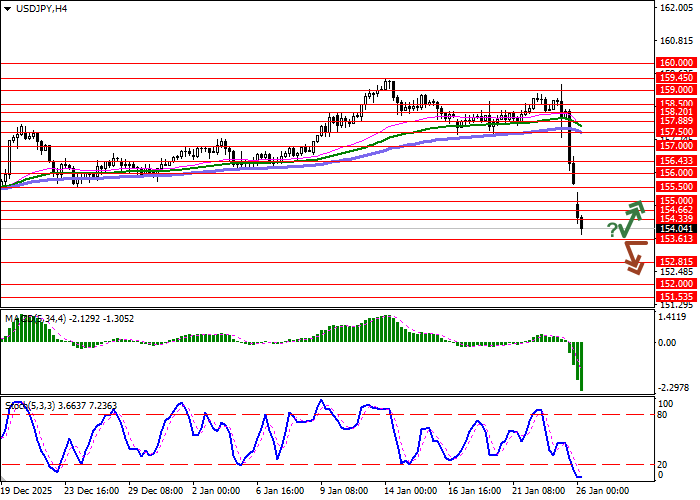
The main catalyst behind the sharp reversal in USD/JPY was growing market concern about potential direct intervention by Japan’s Ministry of Finance and the Bank of Japan. The exchange rate’s approach toward the 159.00 level per dollar was widely seen as a “red line,” beyond which official intervention could follow. Analysts noted that sharp price fluctuations near these levels signal elevated market nervousness. Sohei Takeuchi of Sumitomo Mitsui DS Asset Management confirmed that reaching this threshold increases the likelihood of exchange-rate checks — precautionary actions aimed at cooling speculative pressure. As a result, the yen received strong short-term support from technical and psychological factors, despite ongoing fundamental pressure stemming from diverging monetary policies between Japan and the United States.
The market has once again demonstrated extreme sensitivity to any hints of action by Japanese authorities, which is likely to limit further depreciation of the yen in the near term, even amid easing global geopolitical risks following the World Economic Forum in Davos.
Meanwhile, Friday’s inflation data further weakened expectations of near-term tightening by the Bank of Japan. The headline consumer price index slowed sharply from 2.9% to 2.1%, while the core index excluding food and energy edged down by just 0.1 percentage points to 2.9%.
US data, in turn, delivered mixed signals. The S&P Global manufacturing PMI for January came in at 51.9, slightly below the forecast of 52.1, while the services PMI stood at 52.5 versus expectations of 52.8. Markets also paid close attention to the University of Michigan’s inflation expectations: one-year projections declined from 4.2% to 4.0%, while five-year expectations fell from 3.4% to 3.3%. Lower inflation expectations could undermine one of the Federal Reserve’s key arguments for maintaining restrictive monetary policy.
Support and resistance levels
On the daily chart, Bollinger Bands are flattening, indicating a narrowing price range and limiting downside momentum in the short term. The MACD is declining and maintains a strong sell signal, with the histogram below the signal line and attempting to consolidate below zero. The Stochastic oscillator is also trending lower but remains near oversold territory, signaling potential downside exhaustion.
Resistance levels: 154.33, 154.66, 155.00, 155.50.
Support levels: 153.61, 152.81, 152.00, 151.53.
Trading scenarios and USD/JPY outlook
Short positions may be considered after a confirmed breakdown below 153.61, targeting 152.00. Stop-loss: 154.33. Time horizon: 1–2 days.
A rebound from 153.61 as support followed by a breakout above 154.33 could signal new long positions with a target at 156.00. Stop-loss: 153.61.