

Pressure on the yen is driven by a combination of structural factors, including a persistently large external trade balance, weak growth in domestic consumption, and market expectations that the Bank of Japan will maintain a cautious policy stance while the government expands its fiscal commitments. In the political and economic context, the strengthening position of the Liberal Democratic Party under Prime Minister Sanae Takaichi following its victory in the snap parliamentary elections on February 8 has given the cabinet a mandate to pursue reforms with limited opposition constraints. At the same time, institutional investors’ concerns about debt sustainability have intensified: the proposal to suspend the 8.0% consumption tax on food for two years could reduce national budget revenues by 5.0 trillion yen. This, in turn, is acting as a driver of higher yields on long-term Japanese government bonds and increasing pressure on the country’s financial system through rising debt-servicing costs, which Japan’s Ministry of Finance forecasts will increase by 28.0% by 2029. Pressure on the yen has also intensified following warnings from the International Monetary Fund (IMF) about debt sustainability risks, underscoring the need for a careful balance between stimulus measures and structural reforms. Recently, investors focused on core machinery orders data: on a monthly basis, volumes surged by 19.1% versus forecasts of 5.1%, while annual growth accelerated to 16.8% from 3.9%, confirming the sector’s resilience and partially offsetting the recently weak fourth-quarter GDP report. This supports expectations that the Bank of Japan’s ambitious plans to raise interest rates may still be implemented, albeit with some delay.
The bullish momentum in the US dollar has been driven by strong labor market data released the previous day. Initial jobless claims for the week ending February 13 fell from 229.0K to 206.0K, significantly beating expectations of 225.0K. Meanwhile, the Philadelphia Fed Manufacturing Index rose from 12.6 to 16.3 points versus preliminary estimates of 8.5. At the same time, US building permits increased to 1.448 million against forecasts of 1.400 million, while housing starts rose to 1.404 million from 1.310 million. Today, the most important releases for market participants will be fourth-quarter GDP reports (with annual growth expected to slow from 4.4% to 3.0%) and the Personal Consumption Expenditures (PCE) Price Index, due at 15:30 (GMT+2). Recall that the latter is actively used by the Federal Reserve to assess average inflation dynamics and could therefore have a decisive impact on sentiment regarding the scale of potential interest rate cuts in the second half of the year. Current forecasts suggest that the core reading will accelerate from 2.8% to 2.9%, while the monthly figure will rise from 0.2% to 0.3%. The broader PCE measure is expected to remain unchanged year-on-year at around 2.8%, while the monthly reading may increase from 0.2% to 0.3%.
Support and Resistance Levels
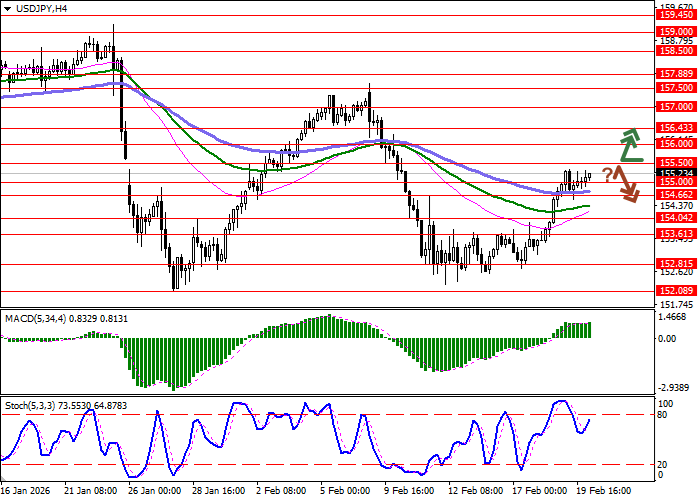
On the daily chart, Bollinger Bands are turning flat: the price range has remained virtually unchanged, although it is still wide enough to accommodate the current level of trading activity. The MACD is rising, maintaining a strong buy signal and remaining above its signal line. The Stochastic oscillator shows similar dynamics, although its line is approaching extreme levels, indicating risks of short-term overbought conditions for the US dollar.
Resistance levels: 155.50, 156.00, 156.43, 157.00.
Support levels: 155.00, 154.66, 154.04, 153.61.
Trading Scenarios and USD/JPY Forecast
Long positions can be considered after a confident breakout above 155.50, with a target at 156.43. Stop-loss — 155.00. Time horizon: 1–2 days.
A rebound from 155.50 as a resistance level followed by a breakout below 155.00 may serve as a signal to open new short positions with a target at 154.04. Stop-loss — 155.50.
Scenario
| Timeframe | Intraday |
| Recommendation | BUY STOP |
| Entry point | 155.55 |
| Take Profit | 156.43 |
| Stop Loss | 155.00 |
| Key levels | 153.61, 154.04, 154.66, 155.00, 155.50, 156.00, 156.43, 157.00 |
Alternative Scenario
| Recommendation | SELL STOP |
| Entry point | 154.95 |
| Take Profit | 154.04 |
| Stop Loss | 155.50 |
| Key levels | 153.61, 154.04, 154.66, 155.00, 155.50, 156.00, 156.43, 157.00 |