
Analysts expect nonfarm payrolls to slow from 115.0K to 85.0K, the unemployment rate to remain at 4.3%, and average hourly earnings to decline from 3.6% to 3.4% year-on-year. Any signs of continued resilience in the sector, combined with the acceleration of the ISM price index to 71.3 points, would strengthen hawkish expectations regarding the U.S. Federal Reserve, putting additional pressure on the asset. In this scenario, the pair may test the 1.1550–1.1570 support area and renew the April low at 1.1505.
Conversely, weak data could temporarily weaken the dollar, giving the euro an opportunity to correct toward 1.1630–1.1650. Investors are also assessing similar statistics from Automatic Data Processing: in May, employment rose by 122.0K, compared with forecasts of 117.0K and 105.0K previously. Yesterday, traders focused on jobless claims data: for the week ending May 29, initial claims increased from 212.0K to 225.0K, compared with expectations of 213.0K, while continuing claims decreased from 1.785 million to 1.777 million, below preliminary estimates of 1.780 million.
The EU gross domestic product report for the first quarter will be released at 11:00 (GMT+2). Experts do not expect changes from 0.1% quarter-on-quarter and 0.8% year-on-year, but they emphasize that results in the next period may be weaker, as confirmed by business activity data. The May S&P Global composite PMI for the eurozone was revised from 47.5 points to 48.5 points, the lowest level since November 2024, marking the second consecutive month of contraction in the private sector after April’s 48.8 points. The services index accelerated from 47.6 points to 47.7 points, remaining well below the 50.0-point growth threshold, while the manufacturing indicator declined from a four-year high of 52.2 points to 51.6 points, staying in expansion territory.
Markets are preparing for the upcoming European Central Bank meeting on June 11. Analysts now almost unanimously expect the interest rate to be raised by 25 basis points to 2.25%. Governing Council member Pierre Wunsch told the Financial Times that the monetary policy discussion would be “fairly easy” if the Middle East conflict remains unresolved, and that the regulator would adjust borrowing costs even if a peace agreement were concluded immediately before the meeting. Executive Board member Isabel Schnabel noted that even if U.S.–Iran talks succeed, a hawkish course is necessary because the energy crisis has significantly increased inflation risks in the region.
Meanwhile, April retail sales dynamics were mixed: the indicator slowed from 2.1% to 1.0% year-on-year, better than forecasts of 0.3%, and from 0.8% to –0.4% month-on-month, compared with expectations of 0.3%.
Support and resistance levels
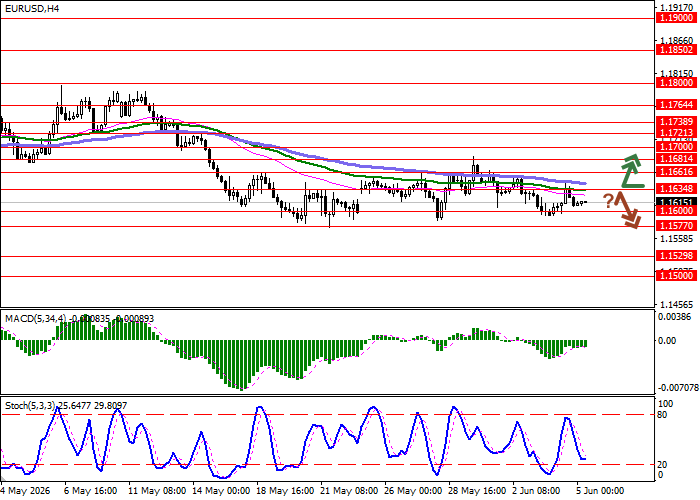
On the daily chart, Bollinger Bands are turning horizontal: the price range remains wide enough for the current level of market activity. The MACD indicator is rising, maintaining a weak buy signal as the histogram remains above the signal line, while Stochastic is attempting to consolidate below the “20” mark, indicating the likelihood of the asset being oversold.
Resistance levels: 1.1634, 1.1661, 1.1681, 1.1700.
Support levels: 1.1600, 1.1577, 1.1529, 1.1500.
EUR/USD trading scenarios and forecast
Long positions may be opened after a breakout above 1.1634, with a target at 1.1700. Stop-loss — 1.1600. Expected timeframe: 1–2 days. Short positions may be opened after a rebound from 1.1634 and a breakout below 1.1600, with a target at 1.1529. Stop-loss — 1.1634.
Scenario
| Timeframe | Intraday |
| Recommendation | BUY STOP |
| Entry point | 1.1635 |
| Take Profit | 1.1700 |
| Stop Loss | 1.1600 |
| Key levels | 1.1500, 1.1529, 1.1577, 1.1600, 1.1634, 1.1661, 1.1681, 1.1700 |
Alternative scenario
| Recommendation | SELL STOP |
| Entry point | 1.1595 |
| Take Profit | 1.1529 |
| Stop Loss | 1.1634 |
| Key levels | 1.1500, 1.1529, 1.1577, 1.1600, 1.1634, 1.1661, 1.1681, 1.1700 |
