
According to the UK Office for National Statistics (ONS), the Consumer Price Index rose by 0.1% month-on-month in June, while the annual inflation rate slowed from 2.8% to 2.6%. The data strengthened the case for the Bank of England to leave its current monetary policy settings unchanged at the 30 July meeting. Market participants will therefore focus not only on the interest rate decision itself, but also on policymakers’ assessment of the balance between supporting economic activity and keeping inflation under control.
Core CPI, which excludes energy, food, alcohol and tobacco, increased by 0.3% over the month and remained unchanged at 2.6% year-on-year. The main downward contribution to headline inflation came from transport, particularly motor fuels. Diesel and petrol prices declined during June, although the energy component remains highly sensitive to developments in the global oil market and the continuing conflict in the Middle East. As a result, investors are still considering the risk that UK inflation could accelerate again during the second half of the year.
The US dollar has regained ground as escalating tensions in the Middle East increase demand for defensive assets. Yemen’s Houthi movement claimed missile and drone attacks on two Saudi oil tankers, Encelia and Layla. Encelia was confirmed to have been struck near the Saudi port of Jizan, while the reported attack on Layla has not yet been independently confirmed. Several tankers have already changed course in the Red Sea, increasing the risk of further disruption near the Bab el-Mandeb Strait, a strategically important route connecting the Red Sea with the Gulf of Aden.
The US Dollar Index is holding near 101.35, reflecting continued demand for dollar-denominated assets amid elevated uncertainty. The market still sees no lasting signs of de-escalation, while potential disruptions to oil supplies are adding an additional inflation premium to commodity prices.
Under these conditions, investors have increased their expectations of a more restrictive policy stance from the US Federal Reserve. According to CME FedWatch pricing, the probability of a 25-basis-point rate increase at the 28–29 July meeting is currently estimated at approximately 35.8%. For the September meeting, markets assign a 55.4% probability to a cumulative 25-basis-point increase and a 24.7% probability to a cumulative 50-basis-point increase.
Nevertheless, the prevailing market expectation remains that the Federal Reserve will leave rates unchanged in July. Investors will therefore pay close attention to comments from Fed Chair Kevin Warsh, whose more restrained communication style marks a departure from the extensive forward guidance used under his predecessor, Jerome Powell.
Support and Resistance Levels
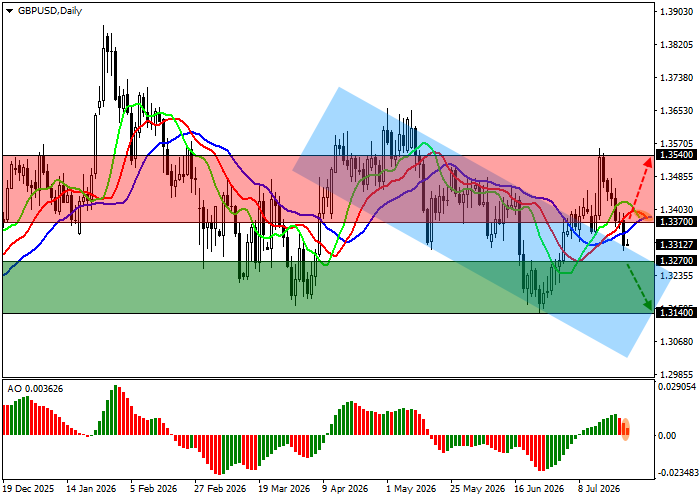
On the daily chart, GBP/USD is correcting slightly above the resistance line of a price channel with dynamic boundaries at 1.3340 and 1.3140.
Technical indicators have reversed and are showing signs that the previous bullish signal is losing momentum. The faster moving averages of the Alligator indicator remain slightly above the slower line, while the Awesome Oscillator histogram is forming new corrective bars in positive territory.
Support levels: 1.3270, 1.3140.
Resistance levels: 1.3370, 1.3540.
GBP/USD Trading Scenarios and Exchange Rate Forecast
The bearish scenario may become relevant after the price consolidates below 1.3270, opening the way towards 1.3140. The protective stop-loss level is set at 1.3370. Estimated timeframe: seven days or longer.
The alternative bullish scenario may become relevant after the price consolidates above 1.3370, with 1.3540 acting as the next target. The protective stop-loss level is set at 1.3300.
Bearish Scenario
| Timeframe | Weekly |
| Order Type | SELL STOP |
| Entry Point | 1.3270 |
| Take Profit | 1.3140 |
| Stop Loss | 1.3370 |
| Key Levels | 1.3140, 1.3270, 1.3370, 1.3540 |
Alternative Scenario
| Order Type | BUY STOP |
| Entry Point | 1.3370 |
| Take Profit | 1.3540 |
| Stop Loss | 1.3300 |
| Key Levels | 1.3140, 1.3270, 1.3370, 1.3540 |
