
Monetary authorities at the world’s leading central banks are increasingly sending signals to the market about a possible tightening of monetary conditions due to the developing Middle East crisis, which has already contributed to faster inflation. Bank of England Monetary Policy Committee member Megan Greene said that the arguments in favor of raising interest rates are becoming stronger as the blockade of the Strait of Hormuz continues. Even despite Israeli Prime Minister Benjamin Netanyahu’s statement that interested countries are developing alternative supply routes, changing delivery schedules will take time.
It is worth recalling that Greene is one of the most active hawkish representatives, and in her view, a rate increase at the June meeting is almost a settled matter, with officials only needing to decide on the size of the adjustment. In April, only Bank of England Chief Economist Huw Pill voted to change monetary parameters, while Greene herself took a neutral position, but this month the balance of votes will clearly be different. As for macroeconomic data, business activity in the services sector, which is most dependent on price dynamics, declined as expected to 49.3 points, entering the contraction zone for the first time since May last year, while the composite indicator fell from 52.6 points to 49.7 points.
Moreover, the United Kingdom is among the countries against which the White House is preparing to initiate new tariffs on goods produced using forced labor, which could again negatively affect bilateral trade relations. Last Tuesday, the Republican administration proposed introducing additional duties of 10.0% or 12.5% on imports from the United Kingdom, Norway, Switzerland, Japan, India, Israel, Qatar, Saudi Arabia, and other countries.
As for the U.S. dollar, its quotes are correcting today around 99.4 points in the USDX: the upward dynamics are supported by the escalation of the Middle East conflict. Representatives of the Islamic Revolutionary Guard Corps reported a strike on a U.S. airbase in Bahrain in response to attacks on military infrastructure on Qeshm Island. It is also claimed that after an attack on an Iranian oil tanker near the Strait of Hormuz overnight, naval forces responded “symmetrically” against the Panaya vessel linked to the United States and Israel. However, earlier, U.S. President Donald Trump and Secretary of State Marco Rubio said that bilateral consultations were still continuing and that separate issues of the nuclear deal were even being discussed. The market ignored these statements, not trusting repeated signals about a quick end to the crisis amid the absence of real steps in this direction.
Support and resistance levels
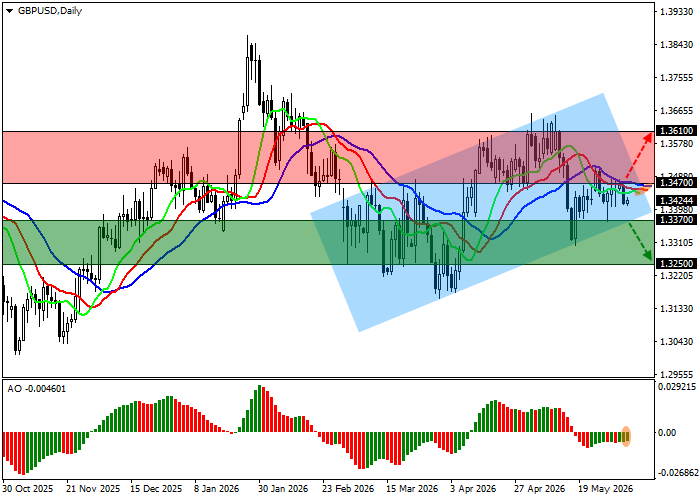
On the daily chart, the instrument is trading slightly above the support line of the ascending channel with dynamic boundaries at 1.3700–1.3400.
Technical indicators have long since turned downward and maintain an unstable sell signal, which is slowing amid the new correction: the fast EMAs on the Alligator indicator are fixed below the signal line, gradually approaching it, while the AO histogram is forming new corrective bars in the sell zone.
Support levels: 1.3370, 1.3250.
Resistance levels: 1.3470, 1.3610.
GBP/USD trading scenarios and forecast
Short positions may be opened after the price consolidates below 1.3370, with a target at 1.3250. Stop-loss — 1.3430. Expected timeframe: 7 days or more.
Long positions may be opened after the price consolidates above 1.3470, with a target at 1.3610. Stop-loss — 1.3400.
Scenario
| Timeframe | Weekly |
| Recommendation | SELL STOP |
| Entry point | 1.3365 |
| Take Profit | 1.3250 |
| Stop Loss | 1.3430 |
| Key levels | 1.3250, 1.3370, 1.3470, 1.3610 |
Alternative scenario
| Recommendation | BUY STOP |
| Entry point | 1.3475 |
| Take Profit | 1.3610 |
| Stop Loss | 1.3400 |
| Key levels | 1.3250, 1.3370, 1.3470, 1.3610 |
