
Investors and forex traders are focused on the results of Bank of Japan Governor Kazuo Ueda’s speech at the Kisaragi-kai economic forum the day before. The official confirmed that the regulator intends to continue tightening monetary policy in line with financial conditions, while the likelihood of faster inflation now appears more significant and may materialize earlier than a slowdown in business activity.
At the same time, he stressed that the hawkish stance will remain in place even if the situation in the Middle East stays uncertain, as the Bank of Japan is relying on incoming data. In 2025, the regulator has already raised the interest rate twice by a total of 50 basis points, and it now stands at 0.75%, the highest level since 1995. Based on this, investors estimate the probability of another borrowing cost adjustment at the June 15–16 meeting at 85.0%.
Nevertheless, Bloomberg analysts note that the regulator’s rhetoric is more cautious than before previous rate changes, which may be explained by a desire to preserve decision-making flexibility amid unstable geopolitical and domestic factors, including Japanese Prime Minister Sanae Takaichi’s position on monetary policy.
U.S. traders are assessing the Automatic Data Processing labor market report. In May, private nonfarm employment increased by 122.0K, exceeding both the revised April figure of 105.0K and expectations of 117.0K, reaching the highest level since January 2025. Importantly, job growth was broader than in previous months.
The main driver was the services sector, which added 114.0K jobs, while the goods-producing sector added only 8.0K. The May business activity index in the services sector accelerated from 53.6 points to a three-year high of 54.5 points, compared with expectations of 53.8 points. The new orders subindex reached 57.3 points, reflecting continued demand in the key sector of the U.S. economy. However, the employment indicator remained in the contraction zone at 47.9 points for the third consecutive month, while the prices index reached its highest level since August 2022 at 71.3 points.
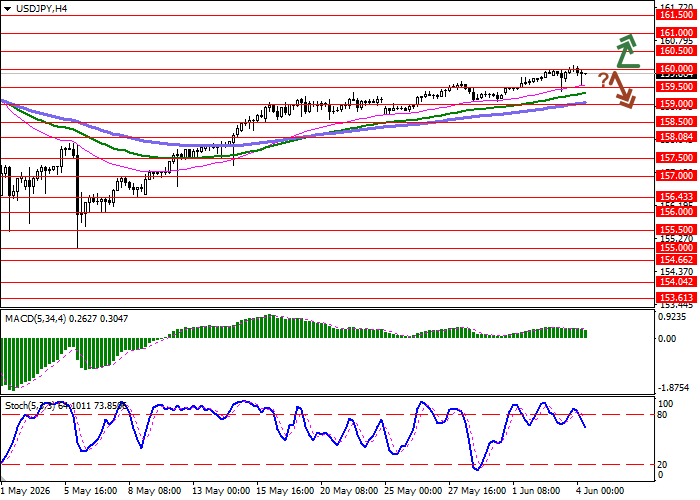
USD/JPY is trading near 160.00, which experts consider a key level for possible currency intervention. Finance Minister Satsuki Katayama once again issued a warning, saying that authorities are closely monitoring currency movements and are ready to respond appropriately to excessive volatility. It is worth noting that previous months have shown such measures provide only short-term support for the yen and are unable to change the fundamental trend.
Support and resistance levels
On the daily chart, Bollinger Bands are rising confidently: the price range is expanding but is not keeping pace with the increase in bullish sentiment. The MACD indicator maintains a buy signal, with the histogram above the signal line, while Stochastic, after reaching maximum values, is turning downward, signaling the possible development of a full bearish trend in the nearest timeframes.
Resistance levels: 160.50, 161.00, 161.50, 162.00.
Support levels: 160.00, 159.50, 159.00, 158.50.
USD/JPY trading scenarios and forecast
Long positions may be opened after a breakout above 160.00, with a target at 161.00. Stop-loss — 159.50. Expected timeframe: 1–2 days. Short positions may be opened after a rebound from 160.00 and a breakout below 159.50, with a target at 158.50. Stop-loss — 160.00.
Scenario
| Timeframe | Intraday |
| Recommendation | BUY STOP |
| Entry point | 160.05 |
| Take Profit | 161.00 |
| Stop Loss | 159.50 |
| Key levels | 158.50, 159.00, 159.50, 160.00, 160.50, 161.00, 161.50, 162.00 |
Alternative scenario
| Recommendation | SELL STOP |
| Entry point | 159.45 |
| Take Profit | 158.50 |
| Stop Loss | 160.00 |
| Key levels | 158.50, 159.00, 159.50, 160.00, 160.50, 161.00, 161.50, 162.00 |
