

This came several hours after official Tehran announced its withdrawal from negotiations due to the resumption of military operations by the Israel Defense Forces on Lebanese territory, including an offensive in the south of the country and the capture of Beaufort Castle, as well as strikes on positions of the Palestinian movement Hezbollah in Beirut.
At the same time, Iran’s Tasnim news agency confirmed that Tehran and its allies in the “axis of resistance”, including Lebanese and Iraqi militia groups, have developed an agenda for a full blockade of the Strait of Hormuz and are ready to close the Bab el-Mandeb Strait off the coast of Yemen.
It is assumed that the U.S. president managed to secure a ceasefire in Lebanon, which became the key factor that allowed the Iranian side to return to the negotiation process. However, despite local positive signals, the delegations are still far from final agreements, as there is still no consensus on key issues. Earlier, U.S. Secretary of State Marco Rubio said that discussions on the nuclear issue are highly complex and technical, meaning that more time is needed to work through them. At the same time, Tehran is now expressing interest in resolving the crisis. The official stressed, however, that the very fact of bilateral dialogue “is no guarantee that an agreement acceptable to the United States will ultimately emerge.”
As for inventory data, after a decline of 2.800 million barrels, the American Petroleum Institute recorded another drop of 3.600 million barrels. A similar report from the Energy Information Administration, which will be released today at 22:30 (GMT+2), is also likely to point to continued downside dynamics, from –3.327 million barrels to –1.200 million barrels, although this may still be insufficient to develop a bullish impulse.
Regarding investment demand, trading activity stabilized at the end of last month. According to data from the Chicago Mercantile Exchange, on June 1, 917.0K futures contract positions were traded, which corresponds to the average monthly level but is slightly below 1.05 million contracts seen in the final week of May. Options trading amounted to 218.0K contracts, above 150.0K recorded on May 28.
Support and resistance levels
On the daily chart, the price has returned to the area of lows located just above the support line of the local ascending channel with boundaries at 115.00–91.00, preparing for a stronger downward move already this week.
Technical indicators maintain a sell signal: the fast EMAs of the Alligator indicator are below the signal line and moving away from it again, while the AO histogram is forming corrective bars in the negative zone.
Support levels: 94.00, 84.20.
Resistance levels: 97.80, 105.70.
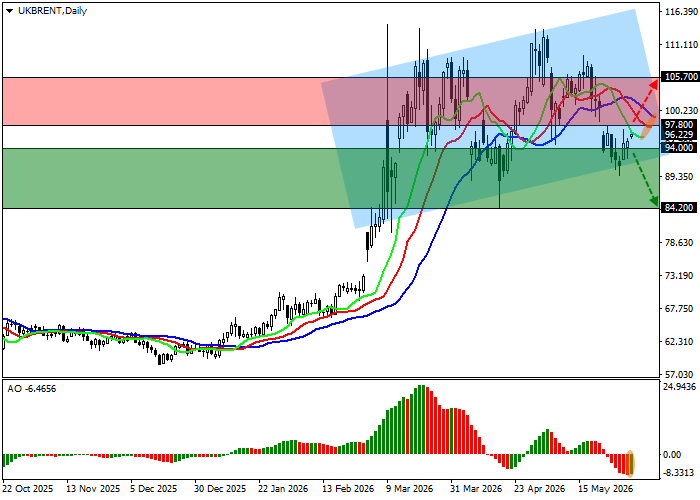
Brent Crude Oil trading scenarios and forecast
Short positions may be opened after the price consolidates below 94.00, with a target at 84.20. Stop-loss — 97.00. Expected timeframe: 7 days or more. Long positions may be opened after the price consolidates above 97.80, with a target at 105.70. Stop-loss — 94.00.
Scenario
| Timeframe | Weekly |
| Recommendation | SELL STOP |
| Entry point | 93.95 |
| Take Profit | 84.20 |
| Stop Loss | 97.00 |
| Key levels | 84.20, 94.00, 97.80, 105.70 |
Alternative scenario
| Recommendation | BUY STOP |
| Entry point | 97.85 |
| Take Profit | 105.70 |
| Stop Loss | 94.00 |
| Key levels | 84.20, 94.00, 97.80, 105.70 |
