

Weakening demand in Japan’s tourism sector remains an additional negative factor. According to a forecast by JTB Travel, the number of domestic trips during the 2026 summer holiday period, from July 15 to August 31, will total approximately 69.0 million, down 4.4% from the same period last year. If confirmed, this would be the first decline since 2020 and another sign of weakening consumer activity amid persistent inflationary pressure. Analysts attribute the negative trend mainly to travel costs rising faster than household disposable income. Despite wage increases and seasonal bonuses, real household income remains relatively weak. According to a JTB survey of approximately 10,000 respondents, only 30.6% of the population plans to travel during the summer holiday period, 3.6 percentage points below last year’s figure. This trend indicates a continued preference for saving despite the gradual improvement in the labour market and confirms that the recovery in domestic consumption remains one of the most vulnerable areas of the Japanese economy. Regarding international travel, JTB expects the number of Japanese residents travelling abroad this summer to fall by 8.8% to approximately 2.17 million, mainly due to the weak yen, higher airline fuel surcharges and geopolitical instability.
As for the US currency, after a strong advance at the end of last week, the USD Index entered a consolidation phase and is holding near 100.6 points, while fundamental conditions remain favourable for buyers. Escalating geopolitical tensions in the Middle East have increased demand for traditional safe-haven assets, with investors continuing to view the US Dollar as the world’s leading reserve currency and a key instrument for hedging risk. Reports of renewed disruption to shipping through the Strait of Hormuz, which previously handled up to 20.0% of global oil supplies, as well as statements by representatives of the Ansar Allah movement regarding possible restrictions on other strategically important maritime routes, have significantly supported the US currency. Persistently high energy prices could intensify inflationary pressure following the correction observed in recent months. Under these conditions, analysts are revising expectations for the start of monetary easing cycles by leading central banks. According to the current consensus forecast, the base-case scenario remains that the Federal Reserve will keep its interest rate unchanged within the 3.50–3.75% range at its next meeting. According to the CME FedWatch Tool, the probability of this outcome is estimated at approximately 85.6%. At the same time, the future trajectory of monetary policy will be determined primarily by inflation trends, labour market conditions and the scale of the geopolitical impact on global energy prices. Until new macroeconomic signals emerge, financial authorities are likely to maintain a cautious approach, seeking to minimise the risks associated with premature monetary easing. Meanwhile, the probability of a rate increase in September is again estimated at 52.4%.
Support and Resistance Levels
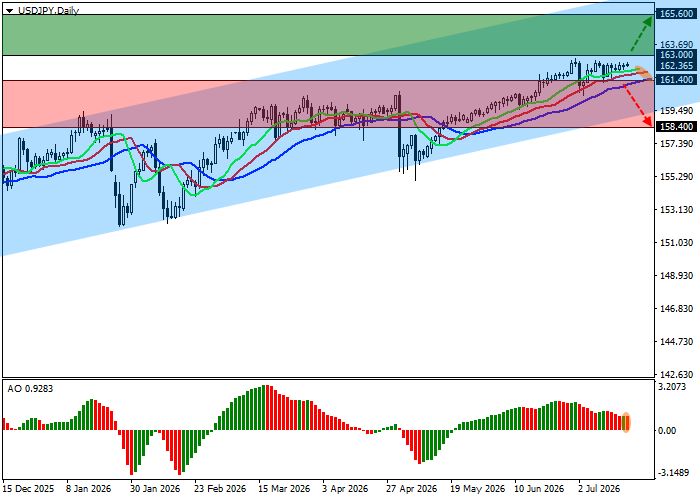
On the daily chart, the instrument is correcting within an upward trend and approaching the resistance line of the 167.00–159.50 price channel.
Technical indicators have fully reversed and continue to generate a buy signal, which remains stable even amid the current correction. The fast EMAs of the Alligator indicator are holding above the signal line, while the Awesome Oscillator histogram is forming new corrective bars above the transition level.
Support levels: 161.40, 158.40.
Resistance levels: 163.00, 165.60.
USD/JPY Trading Scenarios and Forecast
Long positions may be opened after the price consolidates above 163.00, with a target at 165.60. Stop-loss: 162.00. Estimated timeframe: seven days or longer.
Short positions may be opened after the price consolidates below 161.40, with a target at 158.40. Stop-loss: 162.50.
Scenario
| Timeframe | Weekly |
| Recommendation | BUY STOP |
| Entry Point | 163.00 |
| Take Profit | 165.60 |
| Stop Loss | 162.00 |
| Key Levels | 158.40, 161.40, 163.00, 165.60 |
Alternative Scenario
| Recommendation | SELL STOP |
| Entry Point | 161.40 |
| Take Profit | 158.40 |
| Stop Loss | 162.50 |
| Key Levels | 158.40, 161.40, 163.00, 165.60 |
