

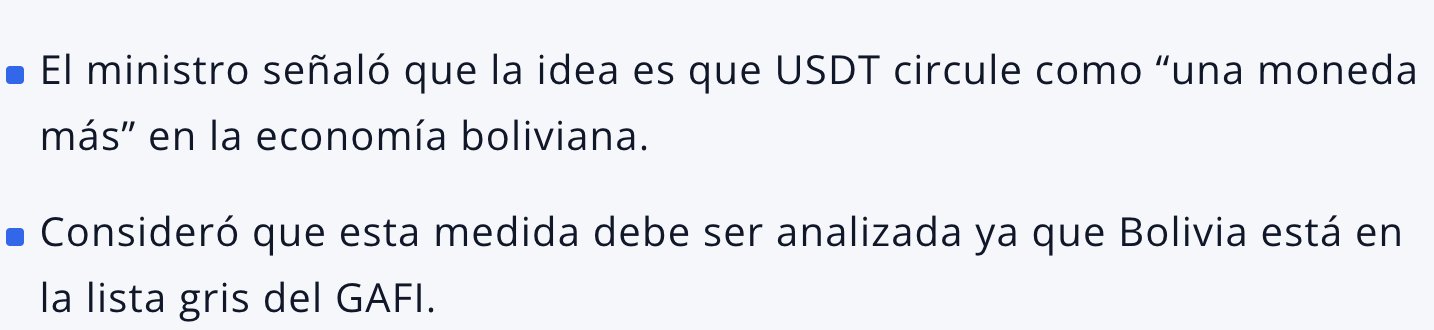
Espinoza said many Bolivians have already been using stablecoins due to real demand caused by the shortage of US dollars. As a result, the government is working on a legal framework to regulate the market instead of allowing it to continue developing without oversight. He also noted that lifting the crypto trading ban in 2024 was only the first step, as the country still lacks a comprehensive regulatory system for digital assets.
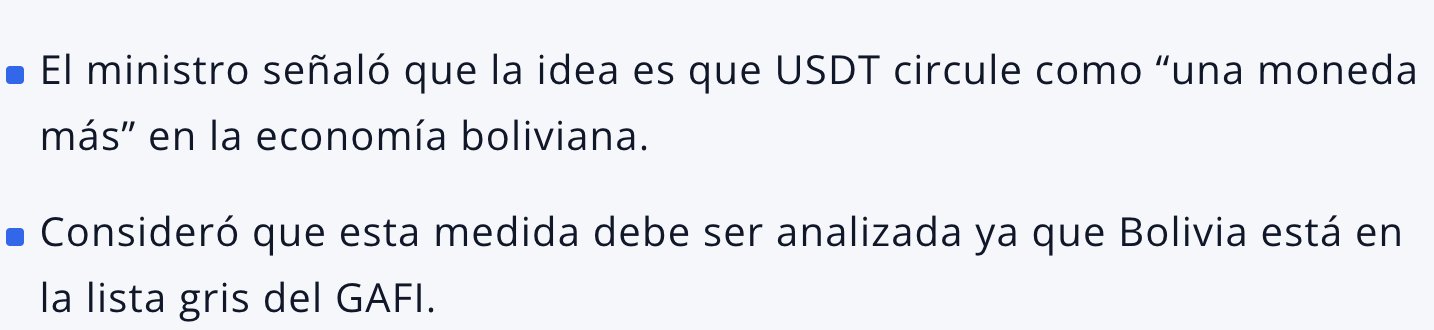
The new administration believes Bolivia’s economy has started to stabilise following reform measures introduced over the past eight months. The decision to consider integrating USDT also reflects the reality that demand for access to the US dollar remains very high across the economy.
Bolivia recently ended more than a decade of maintaining a fixed exchange rate and shifted to a flexible exchange rate system in late June 2026. The boliviano has weakened sharply against the US dollar, while the Central Bank’s reference rate was repeatedly adjusted above 10 bolivianos per USD in July.
In practice, USDT has already been present in Bolivia’s financial system since late 2024, when Banco Bisa, one of the country’s largest banks, launched custody, transfer and receiving services for USDT clients. It became the first bank in Bolivia to support a stablecoin, although it has not yet expanded its offering to other digital assets.
Citing Chainalysis data, Bolivia recorded around 14.8 billion USD in cryptocurrency transaction value between July 2024 and June 2025, ranking eighth in Latin America and surpassing Ecuador and Puerto Rico.
After the news was published, Tether CEO Paolo Ardoino wrote on X that USDT is increasingly becoming core infrastructure for many emerging economies, where people need a dollar-pegged asset for saving, payments and international transfers.
However, the driver behind USDT adoption in Bolivia is not speculation but pressure caused by foreign currency shortages. Research by the Central Bank of Bolivia shows that domestic digital asset transaction value rose by more than 530% in just one year, from 46.5 million USD in the first half of 2024 to around 294 million USD in the first half of 2025. The increase was mainly driven by demand for access to digital dollars as the supply of physical US dollars declined.
USDT remains the world’s largest stablecoin, with a market capitalisation of more than 184 billion USD. It is also the third-largest digital asset in the crypto market, behind only Bitcoin and Ethereum.
Сonclusion: Bolivia’s interest in USDT is driven mainly by limited access to physical dollars rather than crypto speculation.
