
Goldman Sachs Bans Employees From Using Prediction Markets
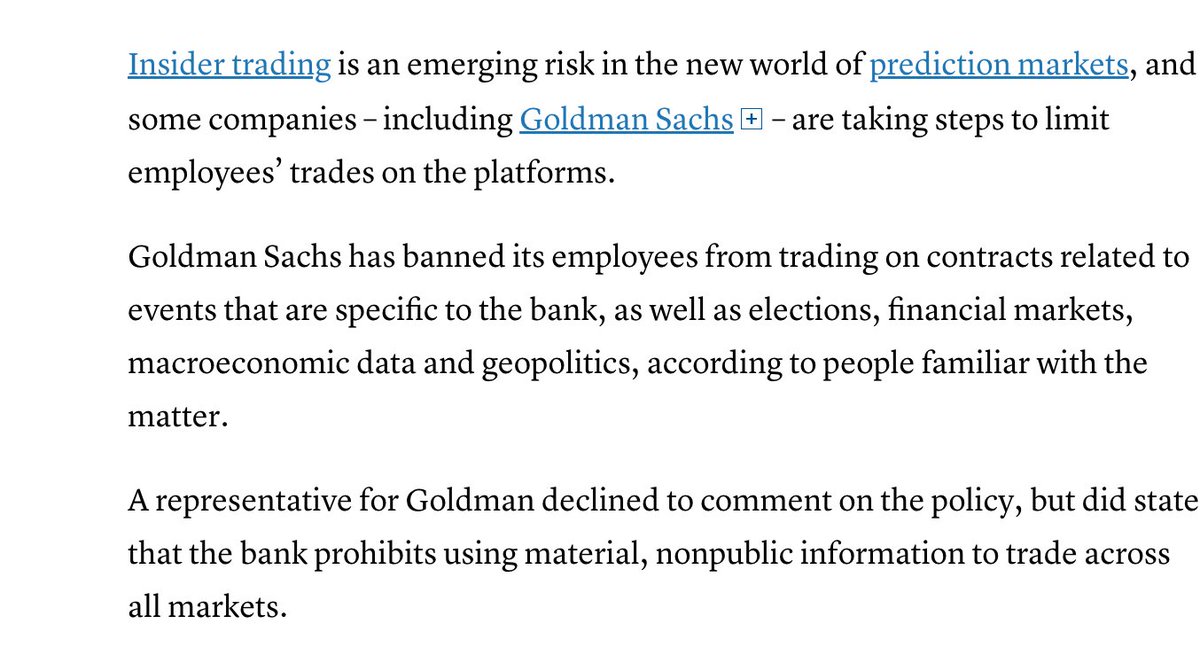
According to CNBC, Goldman Sachs, one of the world’s largest investment banks, has introduced rules prohibiting employees from trading prediction market contracts related to the bank itself, elections, financial markets, macroeconomic data and geopolitical events.
The move comes as a growing number of companies and regulators express concern that employees could use undisclosed internal information to profit on prediction market platforms.
Employees who violate the policy may be dismissed and required to surrender all profits generated from such trades.
Goldman Sachs has not disclosed the full details of the new policy. However, the bank said it has long prohibited employees from using material nonpublic information to trade in any type of market.
The extension of these rules to prediction markets is viewed by Goldman Sachs as an effort to close a regulatory gap as the sector continues to grow rapidly.
According to David Oliwenstein, a partner specializing in securities enforcement at law firm Pillsbury, companies, particularly heavily regulated financial institutions, are increasingly turning to legal advisers to assess risks and clarify regulators’ expectations regarding prediction markets.
Most Companies Still Lack Clear Prediction Market Policies
Goldman Sachs is not alone. CNBC said it contacted 50 public and private companies whose business activities were directly referenced in prediction market contracts to determine how they were addressing insider trading risks. The results showed that most companies were still not adequately prepared.
Only three companies confirmed that they had introduced dedicated prediction market policies, while two said they were in the process of updating their internal rules. Thirty-six companies did not respond, and seven declined to comment.
Financial institutions, however, appear to be reacting much faster.
In addition to Goldman Sachs, Morgan Stanley confirmed that it had added prediction market provisions to its employee code of conduct.
JPMorgan Chase has also advised employees to exercise particular caution when trading prediction market contracts related to the financial sector. Bank of America, meanwhile, is updating its internal policies to clarify prohibited activities and provide employees with more specific examples.
Even so, the monitoring and enforcement of insider trading rules in prediction markets remain at a very early stage.
According to legal experts, the US Commodity Futures Trading Commission, or CFTC, is effectively working from a blank slate because the sector is still new and there are very few legal precedents to rely on.
Many lawyers recommend that companies update their insider trading policies as soon as possible, add specific provisions covering event contracts on prediction markets and establish systems for monitoring unusual trades directly linked to their business activities.
Some experts have proposed even stricter measures, such as blocking access to prediction market platforms on company-managed devices or banning employees from trading during working hours.
Prediction market platforms are also stepping up their own controls. Kalshi and Polymarket have strengthened monitoring measures intended to reduce insider trading and have publicly taken action in several cases to deter future violations.
conclusion: The rapid growth of prediction markets is exposing a major gap in existing compliance frameworks. Financial institutions are likely to adopt stricter controls, but effective enforcement will remain difficult until regulators establish clearer standards and legal precedents.
