

The new business will develop privacy solutions for banks, investment funds and other financial institutions operating on Ethereum.
EthSystems is backed by several major names in the Ethereum ecosystem, including Ethereum co-founder and Consensys CEO Joseph Lubin, as well as BitMine, SharpLink and investment firm SNZ.
The company was founded by former Ethereum Foundation members Mo Jalil, Oskar Thorén and Aaryamann Challani, who previously led privacy research for financial institutions.
Privacy Remains a Major Barrier for Financial Institutions
Over the past year, the team has worked with hundreds of central banks, regulators, commercial banks and asset managers worldwide.
According to EthSystems, the biggest obstacle preventing financial institutions from moving their operations on-chain is not transaction speed or cost but data privacy.
Banks are unlikely to accept a system in which transactions, investment portfolios and customer information are publicly visible on a blockchain. EthSystems will therefore develop technology that allows financial institutions to transact on Ethereum while protecting sensitive information and complying with regulatory oversight requirements.
The company’s first planned commercial products include:
-
Private stablecoin transfer systems
-
Digital bond issuance using zero-knowledge proofs
-
Privacy-preserving cross-chain payments
-
Technical standards for financial institutions
Rather than building a separate private blockchain, EthSystems plans to add privacy layers directly to Ethereum. This approach would allow institutions to benefit from the transparency and security of a public blockchain while protecting confidential business information.
Why EthSystems Will Operate as a For-Profit Company
EthSystems said that operating as a commercial business is necessary because projects involving banks and major financial groups require a legal entity capable of signing contracts, providing services and assuming legal responsibility.
These functions are difficult for a nonprofit organisation such as the Ethereum Foundation to perform directly.
The creation of EthSystems comes at a sensitive time for the Foundation. Since the beginning of 2026, the organisation has faced criticism over its complex structure, slow pace of innovation and limited progress in attracting institutional adoption.
Ethereum Foundation Restructuring Continues
The organisation has experienced several senior leadership changes. Co-executive directors Tomasz Stańczak and Hsiao-Wei Wang both left their positions after less than a year, while several long-serving employees and research leaders also departed.
In response to growing pressure, the Ethereum Foundation reduced its workforce by 20% and began spinning out several departments as independent organisations.
Under the new structure:
-
EthLabs will focus on Ethereum’s core research and development.
-
Ethereum Institutional will manage relationships with banks, funds and companies.
-
EthSystems will commercialise research through institutional privacy products.
Ethereum Foundation Treasury Falls Sharply
Financial pressure on the Ethereum Foundation has also increased. After years of relying on ETH sales to finance ecosystem development, the value of its treasury reportedly declined from more than $950 million in September 2025 to approximately $200 million.
Ethereum co-founder Vitalik Buterin has announced plans to reduce the Foundation’s budget by 40% in 2026. The longer-term objective is to bring annual operating expenses down to around 5% of treasury value by 2030.
ETH Rises 6% Following Lower US Inflation
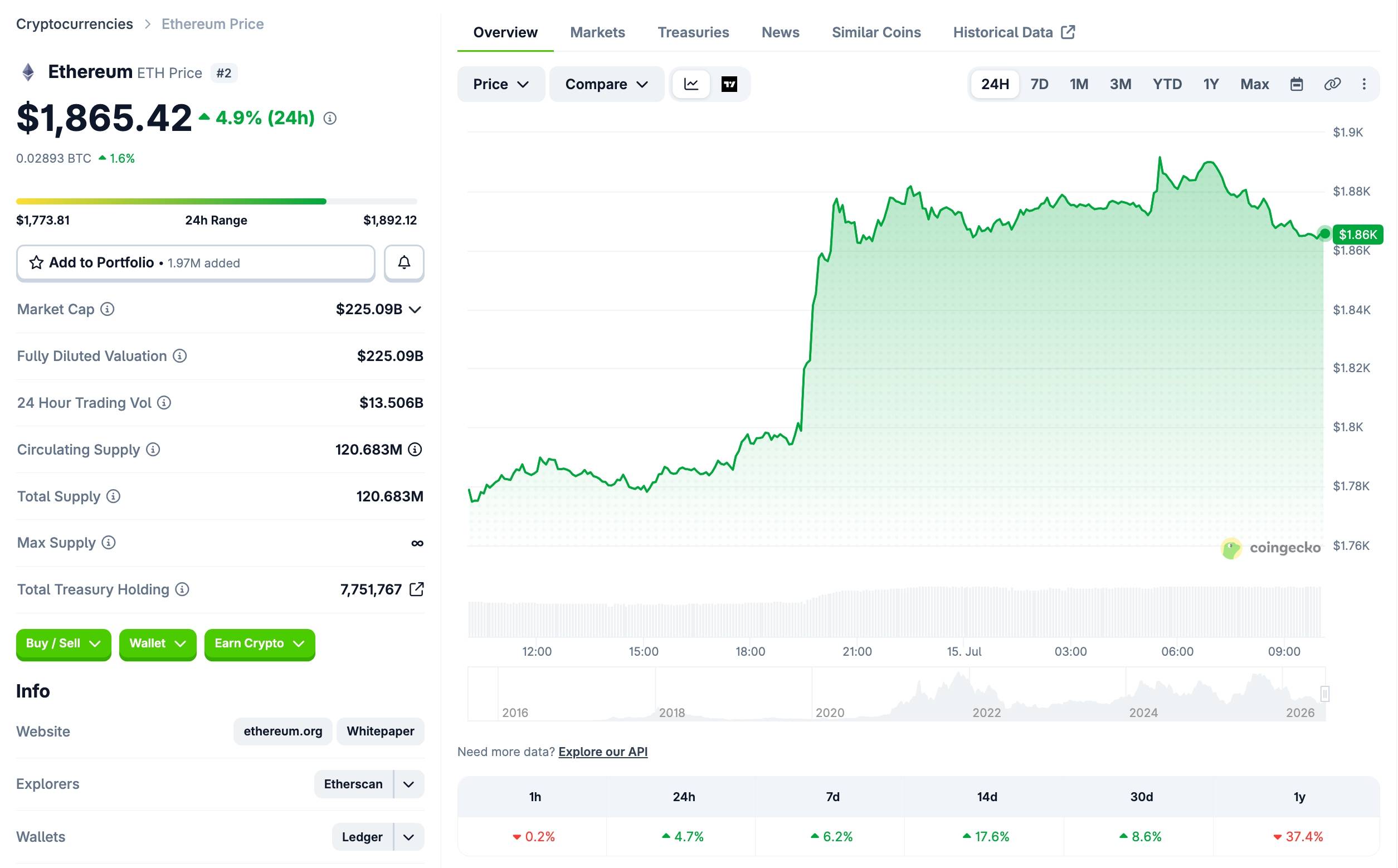
ETH has recorded a strong recovery, gaining approximately 6% over the past 24 hours. The price briefly moved above $1,890 before trading around $1,865–$1,870.
However, the advance appears to have been driven mainly by broader market optimism following the latest US inflation report rather than the EthSystems announcement.
US consumer inflation for June 2026 came in below expectations, slowing to 3.5%. Monthly CPI declined by 0.4%, marking the largest decrease since the COVID-19 period in 2020.
The data strengthened expectations that the US Federal Reserve will leave interest rates unchanged at its next meeting.
Conclusion: EthSystems could address one of the main barriers to institutional Ethereum adoption by combining transaction privacy with regulatory oversight. Its commercial success will depend on whether banks adopt public blockchain infrastructure instead of private networks.
