
How Galaxy GOFR Works
GOFR aggregates variable borrowing rates from leading DeFi protocols, including Aave, Morpho, Spark and Kamino. Galaxy dynamically combines these rates into a single continuously rebalanced financing rate.
Instead of interacting directly with several DeFi protocols, clients deal only with Galaxy. The company selects the protocols, executes transactions, manages collateral, monitors positions and handles the required blockchain interactions.
When Bitcoin is used as collateral, clients can transfer native BTC directly to Galaxy. The company then converts it into a suitable wrapped version for use within supported DeFi protocols, removing the need for clients to bridge or wrap the asset themselves.
Clients do not need to manage wallets, private keys or smart contract transactions. Galaxy acts as the direct counterparty between borrowers and on-chain money markets and has committed up to $100 million of its own capital as first-loss protection.
In a collateral-loss or impairment scenario, the committed Galaxy capital is intended to absorb losses before client capital, subject to the applicable terms and conditions. This protection does not eliminate the risks associated with smart contracts, collateral volatility, liquidity constraints or failures within individual DeFi protocols.
Max Bareiss, Head of Lending at Galaxy, said financial institutions recognise the potential of on-chain credit but are often reluctant to build and operate the complex infrastructure required to access it directly. GOFR is designed to remove this operational barrier and make DeFi financing more similar to a managed institutional service.
Galaxy Publishes GOFR as a Public Reference Point
Galaxy publishes daily indicative GOFR rates for financing denominated in USDC, USDT and ETH, together with seven-day and 30-day averages.
The published rates provide a public reference point for institutional participants assessing conditions across on-chain credit markets. However, they are indicative rather than binding. Actual financing terms may vary depending on the loan size, duration, collateral, market conditions and Galaxy’s risk assessment.
Galaxy continuously monitors protocol and collateral risks. The programme includes diversification limits intended to restrict exposure to individual protocols and automated circuit breakers that halt new capital deployment when predetermined risk thresholds are breached.
The minimum loan size is $1 million, while financing structures, eligible collateral and loan duration can be adjusted according to the requirements and risk profile of each institutional client.
DeFi-as-a-Service Gains Momentum
Packaging DeFi infrastructure into managed services for professional clients is becoming an increasingly prominent industry trend.
GOFR allows institutions to access variable rates from several DeFi protocols through a single regulated counterparty. This differs from decentralised credit marketplaces in which lenders and borrowers interact through specialised on-chain vaults.
FORECK.INFO previously examined Pareto’s institutional on-chain credit model, which uses curated Credit Vaults and off-chain borrower assessments to provide undercollateralised loans. Although Pareto and GOFR use different structures, both aim to reduce the operational barriers preventing financial institutions from participating in DeFi credit markets.
Coinbase has pursued a related model by integrating USDC loans backed by Bitcoin with the Morpho protocol on Base. Coinbase launched the service in January 2025 and later reported that total loan originations had exceeded $1 billion by the end of September that year.
These services illustrate a broader DeFi-as-a-Service model in which a centralised company handles onboarding, execution and user experience while the underlying lending activity is conducted through blockchain protocols.
GOFR Does Not Eliminate DeFi Risks
Galaxy’s first-loss capital and managed infrastructure may reduce some operational risks for clients, but GOFR does not make on-chain lending risk-free.
The programme remains exposed to smart contract vulnerabilities, liquidity shortages, collateral-price declines, blockchain congestion, governance changes and failures affecting the protocols used to deploy capital.
Galaxy also determines which protocols are included in the rate and how capital is allocated between them. The composition of GOFR may therefore change as market conditions and the company’s risk assessments evolve.
Clients remain dependent on Galaxy as their counterparty and on the company’s ability to monitor several protocols, manage collateral and respond rapidly to market disruptions.
Galaxy Reported a $216 Million Quarterly Loss
Galaxy’s expansion into managed on-chain financing comes during a challenging period for digital-asset markets.
The company reported a net loss of $216 million for the first quarter of 2026, compared with stronger results in the previous period. Galaxy said the loss was primarily driven by falling digital-asset prices, which reduced the value of investments and cryptocurrency positions held on its balance sheet.
The company ended the quarter with approximately $2.8 billion in total equity and $2.6 billion in cash and stablecoins. Its digital-assets business remained operationally active despite the broader market decline.
GLXY Shares Gain on the Announcement Day
Galaxy shares rose by approximately 3.7% on July 14, closing at around $24.22. The increase coincided with the GOFR announcement, although a single trading-session move cannot be attributed exclusively to one corporate development.
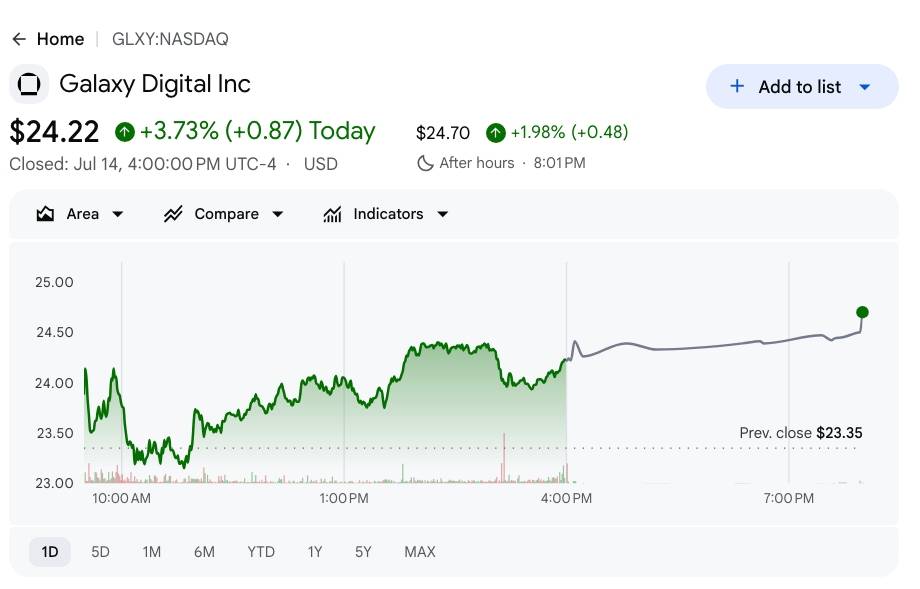
The longer-term market impact will depend on whether GOFR attracts substantial institutional borrowing, generates competitive returns and maintains effective risk controls during periods of severe cryptocurrency volatility.
Conclusion: GOFR could lower the operational barriers preventing financial institutions from using on-chain credit markets by providing access through Galaxy rather than requiring clients to manage wallets, smart contracts and multiple DeFi protocols themselves. Its prospects will depend on competitive borrowing rates, transparent rate calculation, effective risk controls and sustained institutional demand. Galaxy’s first-loss commitment provides an additional layer of protection, but it does not remove the underlying risks associated with DeFi lending and volatile digital-asset collateral.
