
On June 28, Layer-2 project Loopring announced the closure of all DEX and AMM trading services, bringing an end to the nearly eight-year journey of one of the earliest projects to apply zk-Rollup technology on Ethereum.
In a statement published on X, the team said that Loopring DEX would cease all trading activity immediately. Its relayer system — the component responsible for processing trade orders on Layer-2 — would also be shut down shortly after the announcement.
According to Loopring, maintaining a service that is no longer competitive would only continue to worsen the user experience. Rather than operating in a limited state, the development team decided to close the project.
Despite the DEX shutdown, Loopring stressed that all user assets remain safe and will be fully returned. The team said it would directly manage the entire process to make it easier for users to recover their funds and would cover all transaction costs associated with the asset distribution.
The project noted that only accounts with a total balance of USD 10 or more will be eligible for reimbursement in order to optimise processing costs. The process is expected to be completed within several weeks, with progress updates published through Loopring’s official X account.
Why Did Loopring Fail?
In its announcement, the development team openly acknowledged several reasons why Loopring was unable to grow into a large ecosystem.
First, although it was an early pioneer of zk-Rollups on Ethereum, Loopring launched before zkEVM technology emerged and was not EVM-compatible. This made it difficult for developers to deploy smart contracts on the network. As a result, the ecosystem did not expand significantly, lacked practical applications, and users mainly relied on the protocol for trading.
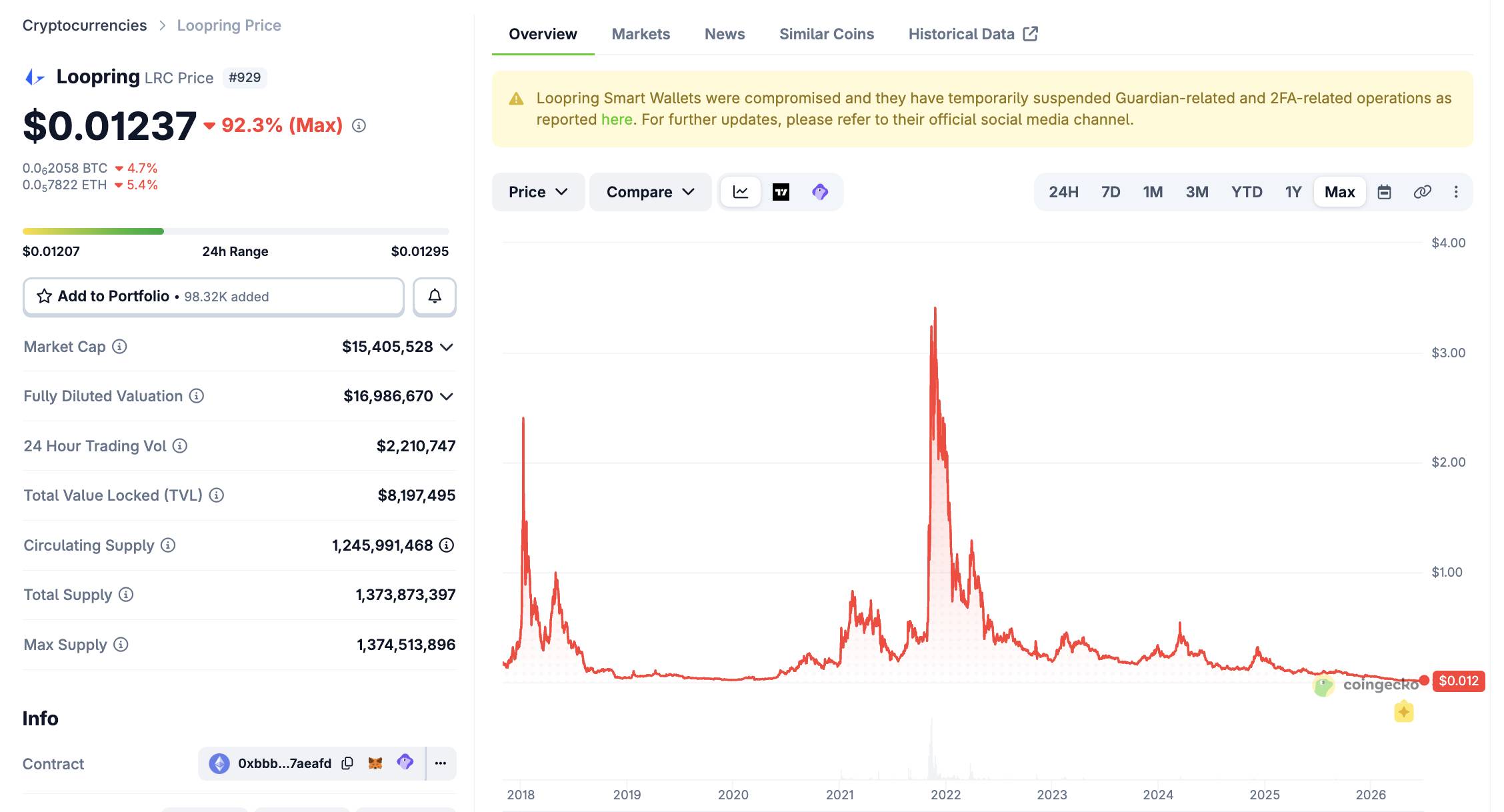
Several external factors also made it difficult for the project to continue operating. In 2026, the LRC token was repeatedly delisted by several exchanges, causing liquidity to decline sharply and reducing investor interest. LRC is now trading near USD 0.012, down more than 92% from its launch price and more than 300 times below its all-time high of USD 3.75.
In addition, the technology that once made Loopring a pioneer has now been surpassed by the new generation of zkEVM solutions. The team admitted that the project’s architecture has become outdated and is no longer capable of competing with modern Layer-2 platforms.
Loopring Began Scaling Back Operations Last Year
In reality, the shutdown of Loopring DEX was not an unexpected decision. Since July 2025, the project had already discontinued its entire Loopring DeFi segment, including Dual Investment, Portal, Block Trade, and ETH Staking, in order to concentrate resources on Layer-2 development.
At the time, the team said Loopring’s DeFi products were still heavily dependent on market makers on centralised exchanges, making them difficult to scale and compete with leading DeFi protocols. Meanwhile, the project’s architecture did not allow anyone to provide liquidity in a fully decentralised way.
Loopring therefore decided to discontinue all DeFi services while stating that the Layer-2 and DEX would continue operating and that user assets would remain protected. However, less than a year later, even Loopring DEX — the core product that once made the project one of Ethereum’s first zk-Rollup platforms — has officially said goodbye to the crypto community.
Loopring’s move also extends the broader decline of Layer-2 projects in 2026. In the first half of the year alone, at least three notable projects have halted operations: Botanix, a Bitcoin Layer-2 project that ended nearly four years of development; Zero Network, which ceased operations after around one and a half years; and Mint Blockchain, an NFT-focused Layer-2 project that is expected to shut down completely on October 20, 2026, after six months of gradual downsizing.
The shutdown of Loopring DEX highlights the importance of choosing reliable platforms for trading and managing digital assets. To compare available options, see the cryptocurrency exchange ranking on FORECK.INFO, where you can review fees, trading conditions, supported assets, security features, and the reliability of popular services.
