

The initiative will be submitted to a governance vote in the near future. If approved, Secret Network will take a snapshot of SCRT balances on September 1 and issue an ERC-20 version of SCRT on Arbitrum, paving the way for the entire ecosystem to transition to Ethereum.
Explaining the decision, Secret Network said the most concerning issue today is not scalability or user experience, but the speed at which AI is significantly reducing the cost of attacking older blockchain systems.
The development team noted that codebases that have existed for years but are no longer actively maintained are becoming a “gold mine” for new-generation AI models. These systems can automatically read smart contracts, trace processing logic, detect flawed assumptions and quickly turn extremely rare edge cases into complete attack scenarios.
This argument comes only a few weeks after the Axelar-Secret bridge attack, in which $4.67 million worth of assets was stolen. The hacker exploited a bug that had existed since 2023 in a modified ICS-20 contract used for the Axelar bridge, minting unbacked tokens and then swapping them for real assets on Axelar.
What is particularly notable is that the attack continued for seven days before being detected. After the incident, Axelar disabled its connection with Secret Network and coordinated the freezing of the hacker’s remaining assets to support recovery efforts for victims.
The Axelar-Secret incident also recalls the recent situation with Zcash. The Shielded Labs team discovered a bug in the Orchard mechanism that had silently existed since 2022 and could have been exploited to create an unlimited amount of fake ZEC. This vulnerability was even discovered by Anthropic’s AI model.
In this context, FORECK.INFO notes that Secret Network’s public recognition of AI as a factor increasing cyber risk reflects a new trend in the blockchain industry. As AI models become increasingly capable of analysing source code, systems that are many years old but rarely updated may quickly become attack targets, forcing projects to consider infrastructure restructuring rather than simply continuing to patch bugs.
Secret Network Follows Capital Flowing Out of Cosmos
Beyond security concerns, Secret Network admitted that Cosmos no longer has the same appeal it had during the 2020–2021 boom period.
The development team said liquidity on Cosmos has declined significantly, many core projects have left the ecosystem, and developer tools, wallets and infrastructure are no longer as strong as before. By contrast, Arbitrum now has a large developer ecosystem, deep liquidity and direct connectivity to most DeFi activity on Ethereum.
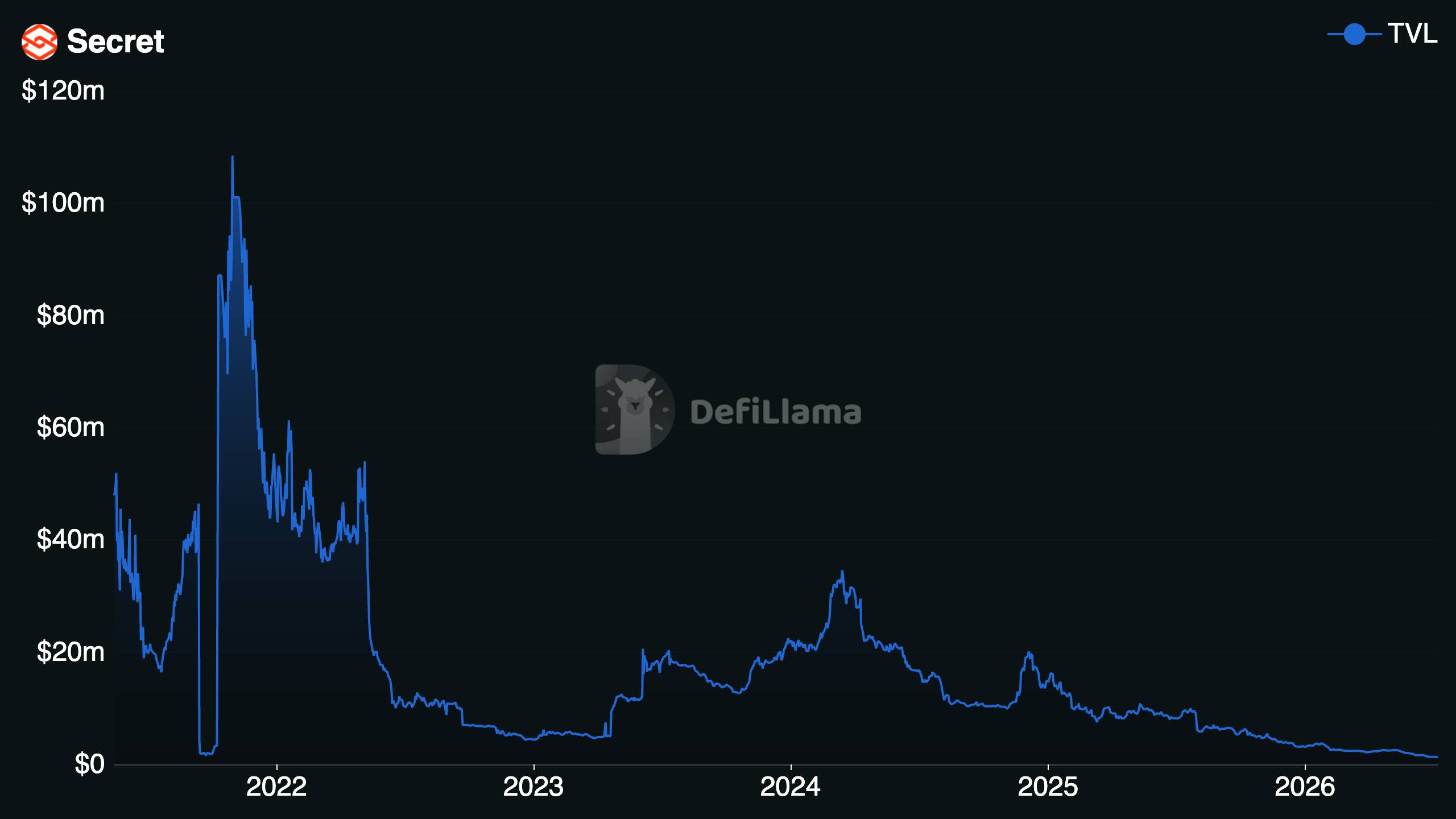
Market data clearly reflects this gap. The total value locked (TVL) across the entire Cosmos ecosystem is now only around $2 billion, down more than 85% from its 2021 bull-market peak. At the same time, Arbitrum remains Ethereum’s largest layer-2 network, with approximately $17.4 billion in assets tracked by L2Beat. Secret Network’s own TVL is now less than $1.3 million, a very modest figure compared with its peak.
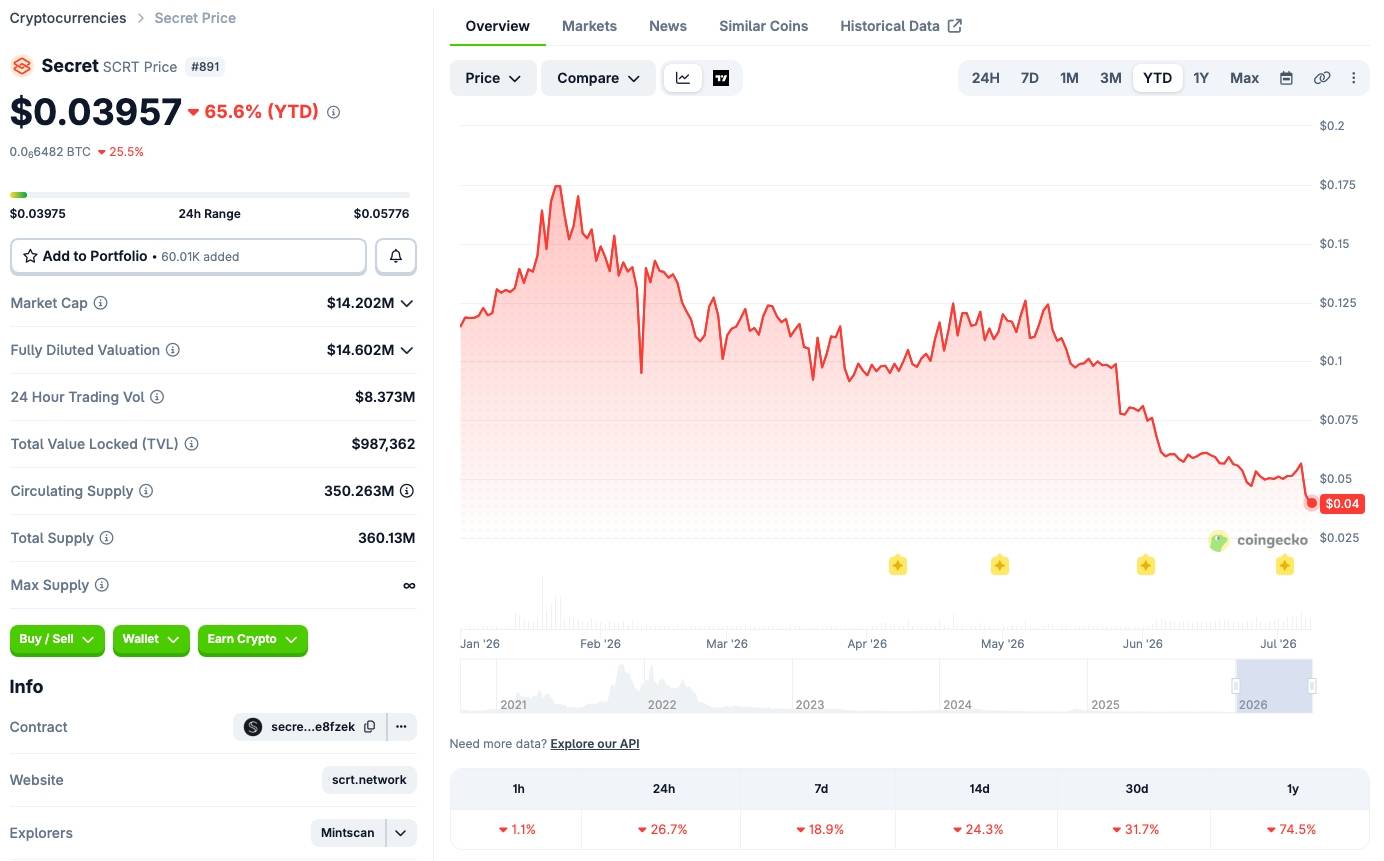
The SCRT token dropped as much as 30% within 24 hours after the proposal was announced and is now down tenfold from its all-time high in 2021.
However, Secret Network is not the first project to leave Cosmos. NilChain previously migrated to Ethereum in February, Noble also decided to build on Ethereum earlier this year, and Sei Network completed the removal of its Cosmos transaction layer last year, fully transitioning to an EVM architecture.
Conclusion:
Secret Network’s proposed migration shows how security, liquidity and ecosystem depth are becoming decisive factors for older blockchain projects. If approved, the move could improve access to Ethereum DeFi liquidity, but it also highlights the growing pressure on Cosmos-based networks to modernize or risk losing relevance.
