

The 616-page draft published on July 22 proposes banning federal officials, government employees and their spouses from issuing or sponsoring digital assets. Crypto trading platforms would also be prohibited from listing assets issued or sponsored by those individuals. The US Department of Justice (DOJ) would have primary responsibility for enforcing the rules.
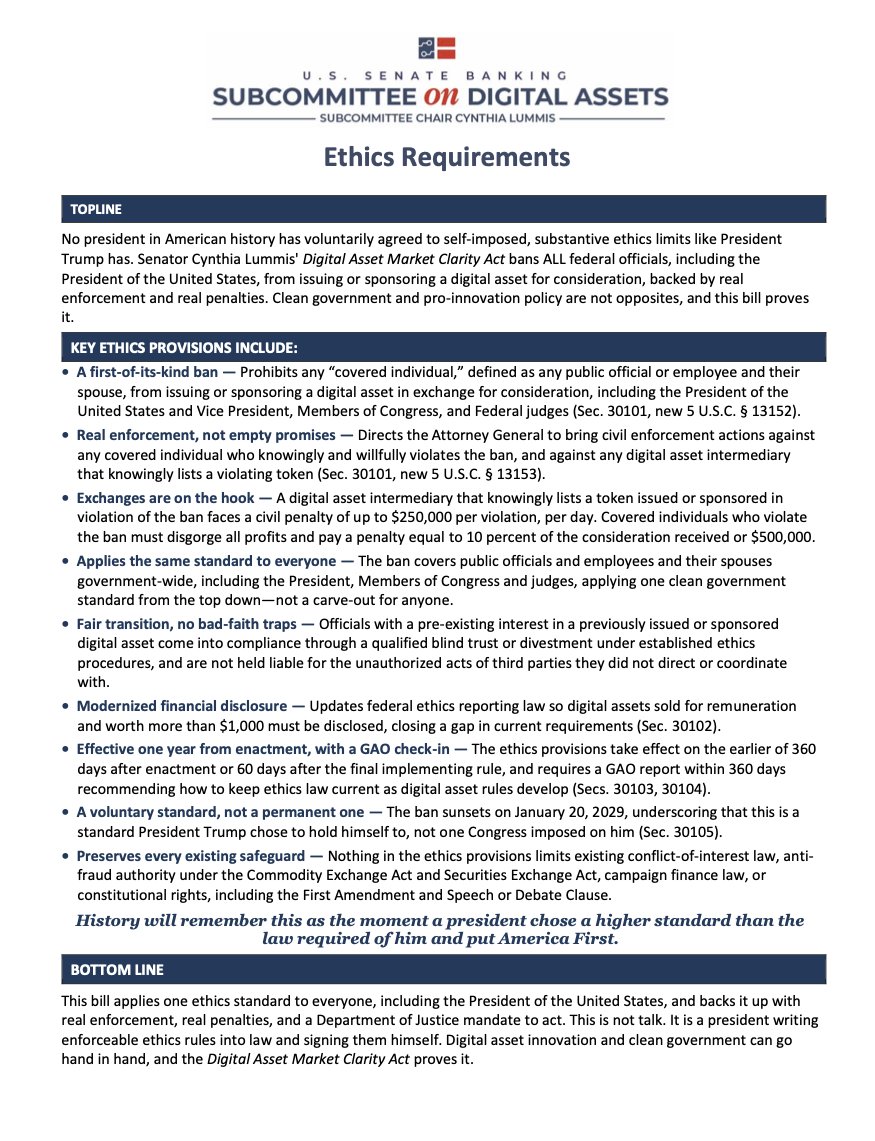
Senator Cynthia Lummis, one of the supporters of the CLARITY Act, said the ethics restrictions would apply to all officials, including President Donald Trump. However, the ban is intended to be temporary and is expected to expire on January 20, 2029, when Trump’s second presidential term ends. The relationship between political power and the Trump family’s crypto interests has long been a subject of controversy. According to Coin68, Trump earned more than $1.4 billion from crypto-related activities in 2025, making potential conflicts of interest one of the main obstacles to the CLARITY Act’s passage in the Senate.
Politically, the new provisions represent an important concession. The House of Representatives approved the CLARITY Act in 2025, while the bill passed the Senate Banking Committee in May 2026. However, it still requires at least 60 votes to pass the full Senate. Under the current balance of power, Republicans are unlikely to advance the legislation without support from some Democratic senators, after earlier negotiations focused on finding a bipartisan compromise over the CLARITY Act.
Another controversial issue is that the same restrictions would not apply to officials’ children. This is particularly sensitive in the case of the Trump family: three of the president’s sons are co-founders of World Liberty Financial, while two are involved in the American Bitcoin mining business. Transparency International U.S. argues that the new version of the bill still fails to resolve the core conflict of interest involving President Trump. The legislation would not require him to divest from companies, revenue-sharing agreements, licensing rights or other family business structures generating crypto-related income.
Senator Elizabeth Warren also criticized the new provision, arguing that it would not prevent Trump from continuing to earn billions of dollars from the crypto industry. Democratic analysts on the Senate Banking Committee noted that the bill would still allow the president to hold digital assets as investments. In addition, enforcement authority would be concentrated in the Department of Justice, while state attorneys general and other parties would not be permitted to bring independent legal action to enforce the ban.
CLARITY Act Caught Between Ethics and Political Interests
The ethics provisions could move the CLARITY Act closer to the 60 votes required in the Senate. At the same time, they highlight the initiative’s main weakness: who will independently oversee officials and hold them accountable for violations?
Under the new draft, the US Department of Justice would become the principal enforcement authority, while the powers of state authorities would be limited. This structure immediately raised concerns among some Democrats because the agency responsible for oversight operates under the same administration that the bill is intended to regulate. Senator Angela Alsobrooks warned that she could not support the CLARITY Act unless the enforcement mechanism were sufficiently independent to ensure equal accountability for all officials. The updated version of the bill also significantly expands disclosure requirements, adds a separate section on illicit finance and strengthens provisions governing the digital asset spot market.
Senate Republican leader John Thune still intends to bring the CLARITY Act to a vote as early as next week, even if there is no certainty that the bill has secured the necessary 60 votes. The Senate has limited time before lawmakers leave for recess and return to their states, while the approaching 2026 midterm elections are adding further pressure.
Pressure on Democratic senators is also increasing. Progressive groups recently criticized Senator Kirsten Gillibrand over her role in the CLARITY Act negotiations. Meanwhile, the crypto industry continues to wield significant political influence through lobbying organizations, including Fairshake, which holds approximately $125 million.
Conclusion: According to FORECK.INFO, the new ethics provisions could improve the CLARITY Act’s chances of passing the Senate, but the limited independence of the enforcement mechanism remains the main risk. If oversight is concentrated exclusively within the Department of Justice, the legislation may fail to resolve conflicts of interest between political power and the crypto industry.
