

Against this backdrop, investors are asking a key question: will the decline extend toward the $80,000 area, or is the market still capable of a traditional year-end rebound—the so-called Santa Claus rally?

Bitcoin outlook: chances of a Santa Claus rally remain
In traditional equity markets, the Santa Claus Rally effect is well known and statistically supported. Since 1929, the S&P 500 has posted gains in roughly 79% of so-called “Santa Claus periods”—the last five trading days of December and the first two days of January. Average returns during these windows have been around 1.6%. Data since 1950 paint a similar picture: the same 79% success rate and average gains of about 1.3%. Over the past eight years, the index has declined during this period only once, while the final two weeks of December rank among the strongest weeks for equities over the past 75 years.
However, applying this seasonal pattern directly to Bitcoin remains uncertain. Earlier in the year, BTC largely moved in step with the U.S. equity market, but that correlation has weakened noticeably in recent months. While the S&P 500 is up around 16% year-to-date, Bitcoin has declined by roughly 6% over the same period.
Why Bitcoin may be close to a bottom
Despite the weak price action, the data suggest that Bitcoin may be in oversold territory or close to forming a local bottom. One of the main arguments is the unusual breakdown in its correlation with global liquidity. Historically, BTC—an asset with a fixed supply—has shown a strong relationship with global liquidity conditions. Recently, however, that relationship has fractured.
There are two possible interpretations: either the correlation has structurally broken down, or the market is experiencing a temporary anomaly. In the latter case, Bitcoin could outperform in the coming weeks as the traditional relationship with liquidity is restored—an outcome that would also point to oversold conditions at current price levels.
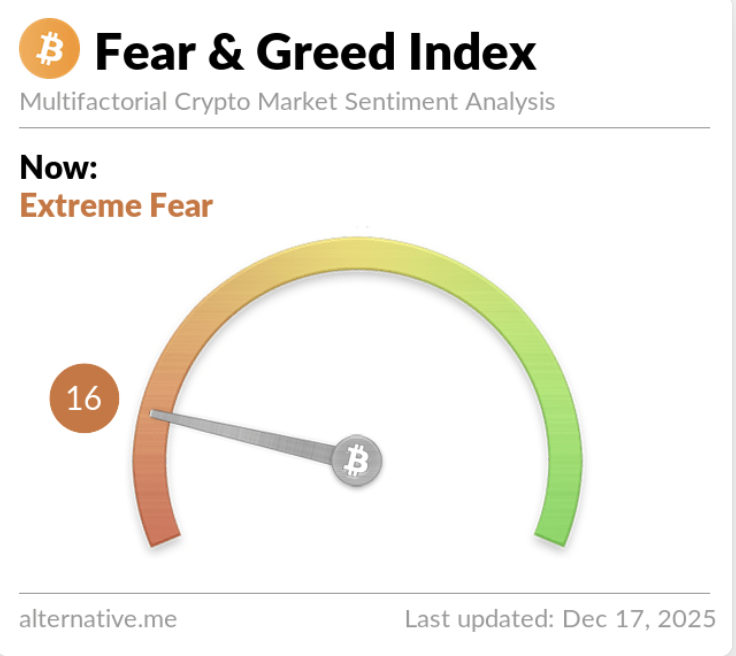
This view is reinforced by the Crypto Fear & Greed Index, which has fallen to 16 out of 100, firmly in extreme fear territory. Historically, such readings leave very limited room for further downside.
Whale activity: large players are accumulating BTC
Another constructive signal is the behavior of so-called Bitcoin whales. The number of wallets holding at least 1,000 BTC has increased to around 1,450. In early December alone, large investors purchased between 47,000 and 75,000 BTC, absorbing more than 240% of newly mined supply.
At the same time, despite the pullback toward the $90,000 area, significant BTC outflows from exchanges have been observed. This suggests a lack of strong selling pressure and a growing preference for long-term holding.
As analyst Matt Garland notes, “While retail investors panic during the drop toward $90,000, whales are quietly accumulating for the next upward move. This is classic behavior in a bull market.”
Macro factors still cap upside
That said, a sharp V-shaped rebound should not be expected. Global macroeconomic forces continue to restrain the market. A cautious stance from the U.S. Federal Reserve, along with the risk of interest rate hikes in Japan, remains a significant headwind for cryptocurrencies.
The Bank of Japan could raise its policy rate by 25 basis points to 0.75% as early as this week—the highest level in more than three decades. Such moves have traditionally weighed on risk assets, including cryptocurrencies.
Conclusion
Corrections are a natural part of the crypto market’s maturation and adoption process. Near all-time highs, long-term investors tend to lock in profits, which has driven the current pullback. However, it is still premature to speak of a full-scale bear market.
If Bitcoin manages to restore its long-term correlation with global liquidity and the U.S. equity market, the stage could be set for a modest year-end rally. A full-fledged bull run before year-end, however, appears unlikely, given the persistent macroeconomic risks—particularly those stemming from Japan.