
Armstrong outlined his position publicly on social media, arguing that prediction markets function as a genuine piece of financial infrastructure. He said state restrictions effectively block access to useful risk-management tools, curb innovation, and weaken price efficiency and discovery.
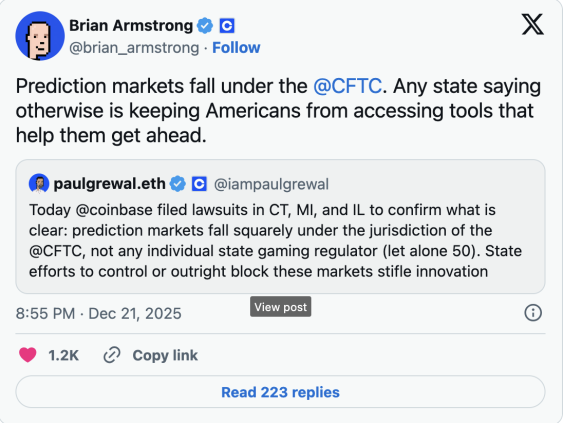
The remarks come as legal pressure intensifies. Last week, Coinbase filed lawsuits against authorities in Michigan, Illinois, and Connecticut, seeking judicial confirmation that the CFTC has exclusive authority over prediction-market regulation. Armstrong said the lawsuits are not meant to change the law, but to clarify what federal law already provides.
According to Armstrong, individual states do not have the authority to regulate these markets on their own. Fragmented oversight, he argues, creates legal uncertainty for both users and companies. Federal clarity, by contrast, would support liquidity, strengthen price discovery, and help the sector develop more efficiently.
Armstrong also tied the issue to U.S. competitiveness. He said restricting access to prediction markets puts American users at a disadvantage versus other jurisdictions and simultaneously weakens the ability to monitor illicit financial flows. In that context, he frames prediction markets as part of a broader financial ecosystem.
Coinbase challenges state-level bans
Coinbase’s lawsuits target actions taken by Connecticut, Michigan, and Illinois, where prediction-market platforms were restricted or effectively blocked. The company argues that these measures conflict with federal law.
In his comments, Armstrong stressed that prediction markets fall squarely under the Commodity Exchange Act. The law contains a clearly defined list of exclusions that do not qualify as commodities — for example, onions and movie box office receipts. Everything not on that list, he argues, is covered by the CFTC’s remit.
Armstrong says this structure signals Congress’s intent to grant the commission broad authority, including over contracts linked to sporting events. He rejects the argument used by some states that such markets should be categorized as gambling, insisting that the federal legislature deliberately took a different approach.
Coinbase also criticizes state enforcement, arguing it suppresses innovation and undermines legal consistency across markets. Armstrong warns that dozens of conflicting regulatory regimes create chaos and slow industry development.
Prediction markets and the role of federal oversight
Armstrong’s stance largely aligns with earlier positions from the CFTC itself, which has asserted jurisdiction over event-based contracts before, including markets tied to elections and macroeconomic outcomes. The agency treats these instruments as a type of derivative.
Supporters of federal oversight argue that centralized regulation improves transparency and reduces systemic risk through uniform reporting and compliance requirements. Armstrong echoes that view, describing prediction markets as efficiency tools that aggregate information through prices and, as a result, improve decision-making.
This framing is increasingly common across the crypto industry. Companies seek to distance prediction markets from the “casino” label by positioning them as analytical, information-driven mechanisms that belong within financial regulation.
The lawsuits are still at an early stage, but their outcome could materially shape the future of prediction markets in the U.S. A federal ruling could limit state intervention while strengthening the CFTC’s role as the key regulator for this segment.