

According to aggregated market data, the probability of a second consecutive rate hike at the May meeting is estimated at 75.0%, while the total adjustment this year could amount to 38–40 basis points. These expectations have been clearly reinforced by a series of signals from monetary authorities. RBA Deputy Governor Andrew Hauser noted that inflationary pressure remains significant and that the central bank is prepared to take the necessary measures to contain it. He emphasized that domestic capacity constraints have shifted from being a risk factor to a systemic driver of price dynamics. He also pointed out that policies aimed at keeping economic activity close to equilibrium increase sensitivity to changes in domestic demand, contributing to high volatility in the Australian dollar on global markets and affecting hedging and positioning strategies in commodity-linked instruments. According to the monetary policy statement published on February 6, core inflation—excluding food and energy prices—reached 3.4% year-on-year in the fourth quarter, significantly exceeding forecasts embedded in the November report. Price pressures intensified across services, retail goods, and construction, where rising momentum amid a recovery in housing demand was compounded by developers withdrawing discounts that had been in place during the market cooling phase. Authorities concluded that the economy is moving away from equilibrium, with price pressures largely driven by supply-side constraints that have proven more pronounced than expected. Against this backdrop, updated data from the University of Melbourne showed inflation expectations rising from 4.6% to 5.0% in February, further supporting the case for maintaining a hawkish policy stance at upcoming meetings.
Meanwhile, the U.S. dollar is strengthening following robust labor market data. The number of new nonfarm payroll jobs was revised to 130.0 thousand, nearly double the forecast of 70.0 thousand. The unemployment rate declined from 4.4% to 4.3%, while average hourly earnings held steady at around 3.7% year-on-year, indicating continued moderate wage dynamics. At the same time, initial jobless claims fell from 232.0 thousand to 227.0 thousand, while continuing claims increased from 1.841 million to 1.862 million. Overall, the data has largely neutralized arguments in favor of a return to a stable dovish cycle in U.S. Federal Reserve policy and a near-term rate cut from the current 3.50–3.75% range. It is also worth noting recent comments from Kansas City Fed President Jeffrey Schmid, who stated that authorities need to maintain a tight monetary stance amid the ongoing recovery of the U.S. economy and warned that lowering borrowing costs would only fuel inflationary pressure over a longer period.
Support and resistance levels
On the daily chart, Bollinger Bands are showing strong upward momentum, with the price range expanding to the upside and clearing the way for bulls toward new record highs. The MACD is turning downward, forming a fresh sell signal as the histogram attempts to move below the signal line. The Stochastic oscillator, having retreated from its peak levels, is also turning lower, signaling the potential development of a full-fledged correction in the near term.
Resistance levels: 0.7093, 0.7150, 0.7202, 0.7250.
Support levels: 0.7050, 0.7000, 0.6950, 0.6900.
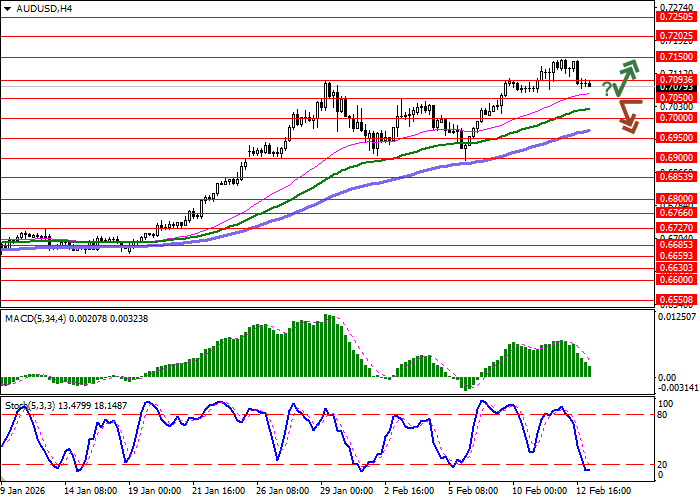
Trading scenarios and AUD/USD forecast
Short positions may be opened after a confident downside breakout below 0.7050, targeting 0.6950. Stop-loss: 0.7093. Time horizon: 1–2 days.
A rebound from the 0.7050 support level followed by an upside breakout above 0.7093 could signal the opening of long positions with a target at 0.7202. Stop-loss: 0.7050.
Scenario
| Timeframe | Intraday |
| Recommendation | SELL STOP |
| Entry point | 0.7045 |
| Take Profit | 0.6950 |
| Stop Loss | 0.7093 |
| Key levels | 0.6900, 0.6950, 0.7000, 0.7050, 0.7093, 0.7150, 0.7202, 0.7250 |
Alternative scenario
| Recommendation | BUY STOP |
| Entry point | 0.7095 |
| Take Profit | 0.7202 |
| Stop Loss | 0.7050 |
| Key levels | 0.6900, 0.6950, 0.7000, 0.7050, 0.7093, 0.7150, 0.7202, 0.7250 |