
According to Lagarde, the regulator does not expect major consumer price fluctuations in the coming months, and its main task is to preserve financial stability. Eurostat data showed that annual inflation in the region rose to 2.2% in September compared to 2.0% in August — the highest reading in the past five months. The services sector remained the main driver, up 3.2% year-on-year. Business activity also shows signs of recovery: the services PMI rose to 51.3, while Germany’s index increased to 51.5, signaling that the bloc’s largest economy is gradually emerging from stagnation — mainly driven by domestic demand, as external demand remains weak. Meanwhile, Italian Economy Minister Giancarlo Giorgetti stated that ECB policymakers should return to a “dovish” tone to revive the EU economy, which remains close to stagnation.
Against the backdrop of improving macroeconomic indicators, ECB officials are shifting more attention to the non-banking financial sector. Lagarde called for stricter oversight of hedge funds, private equity, and credit institutions, noting that their advantages over traditional banks create “unequal competitive conditions” and increase systemic vulnerability. She pointed out that the share of non-bank institutions in the eurozone economy has grown from 250% of GDP in 2008 to over 350% today. Executive Board member Isabel Schnabel added that these entities form new channels for financial shocks and require a “macroprudential framework” for regulation. Unlike the U.S., where credit requirements are being eased, the eurozone — according to Lagarde — should maintain a strict regulatory stance to minimize hidden risks within the financial system.
Investors are also closely watching the U.S. budget crisis, where the government shutdown has already halted the work of federal agencies, causing an estimated $18 billion loss to New York infrastructure projects and $8 billion to climate programs. President Donald Trump stated he intends to use the situation to downsize federal agencies, increasing uncertainty amid ongoing political confrontation in Washington.
Support and Resistance Levels
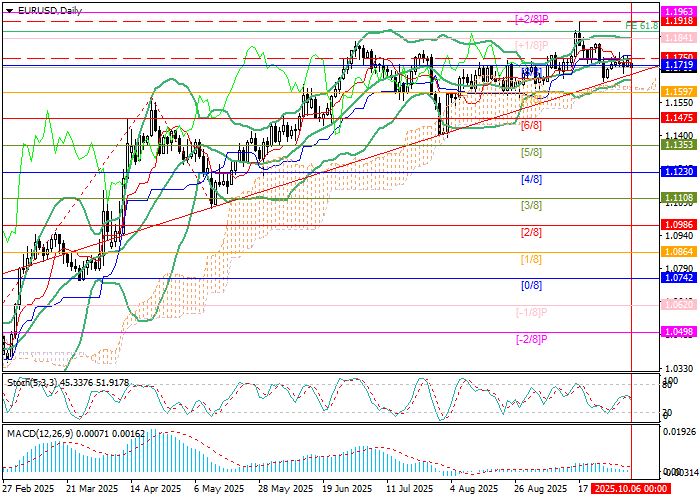
The pair continues to test the middle line of the Bollinger Bands (1.1750). A breakout above this area may lead to growth toward 1.1918 (yearly highs zone) and 1.1963 (Murray level [+2/8]). Conversely, a decline below 1.1597 (Murray [7/8]) would open the way to 1.1475 (Murray [6/8]) and 1.1353 (Murray [5/8]).
Technical indicators show mixed signals: Bollinger Bands have turned flat after a rise, the Stochastic points downward, while MACD hovers near the zero line with low volumes. A long-term uptrend continues to form on the weekly chart, supporting further bullish potential.
Resistance levels: 1.1750, 1.1918, 1.1963.
Support levels: 1.1597, 1.1475, 1.1353.
Trading Scenarios and EUR/USD Forecast
Long positions can be opened above 1.1750 with targets at 1.1918 and 1.1963, and a stop loss at 1.1660. Estimated duration: 5–7 days.
Short positions can be considered below 1.1597 with targets at 1.1475 and 1.1353, and a stop loss at 1.1680.
Scenario
| Timeframe | Weekly |
| Recommendation | BUY STOP |
| Entry Point | 1.1750 |
| Take Profit | 1.1918, 1.1963 |
| Stop Loss | 1.1660 |
| Key Levels | 1.1353, 1.1475, 1.1597, 1.1750, 1.1918, 1.1963 |
Alternative Scenario
| Recommendation | SELL STOP |
| Entry Point | 1.1595 |
| Take Profit | 1.1475, 1.1353 |
| Stop Loss | 1.1680 |
| Key Levels | 1.1353, 1.1475, 1.1597, 1.1750, 1.1918, 1.1963 |
