
The regulator is expected to keep the interest rate within the 3.50–3.75% range, where it has remained after a series of cuts in 2025, and to reduce the probability of further easing until mid-2026, as analysts note that policymakers in the current cycle are taking a wait-and-see approach, prioritizing economic data analysis before making additional adjustments. At the same time, the meeting is taking place amid significant political and legal uncertainty surrounding Fed Chair Jerome Powell: the US Department of Justice has launched an investigation into his actions related to the renovation of the Federal Reserve headquarters in Washington, an unprecedented case involving a sitting Fed chief, fueling domestic political disputes over the regulator’s independence and future leadership. President Donald Trump, whose authority to appoint the Fed Chair expires with the end of Powell’s four-year term in May 2026, is considering announcing a successor early, with BlackRock executive Rick Rieder named among the leading candidates. This adds further uncertainty to markets and may influence investor expectations regarding the future direction of monetary policy. The situation is further complicated by reports of a possible coordinated currency intervention by the US and Japan aimed at halting the yen’s decline. Combined with the monetary pause and political instability, this boosts dollar volatility and keeps uncertainty elevated, signaling the Republican administration’s willingness to tolerate a weaker national currency to support exports.
Additional pressure on the US dollar stems from unprecedented political uncertainty, as well as the domestic and foreign policies of the Trump administration. Inconsistent White House actions, including escalating demands regarding Greenland, have significantly undermined investor confidence in the dollar as a safe-haven asset. Markets have begun pricing in a political risk premium, triggering capital outflows from dollar-denominated assets. A key indicator of extremely negative expectations has been record demand for options that profit from further dollar weakness; premiums on such short-term contracts have reached their highest levels since record-keeping began in 2011.
Amid the broader reallocation of investor capital, the euro is strengthening, although the fundamental backdrop in the eurozone, while showing signs of improvement, remains restrained and mixed. A key positive signal came from Germany, where the economy grew by 0.2% in 2025 for the first time since 2022, while construction activity indicators and overall economic sentiment reached multi-year highs. This has led some analysts to speak of the first convincing signs of regional economic recovery after a prolonged period of stagnation. Political instability in France has also eased, as the government successfully survived no-confidence votes that had previously weighed on the single currency.
Nevertheless, the bloc’s economic growth is largely driven by a sharp increase in defense spending amid the ongoing Russia–Ukraine conflict. Social spending is often being cut: energy prices in January remain around $95.0 per barrel for Brent crude, while December inflation reached 5.1% year-on-year, significantly exceeding the European Central Bank’s (ECB) 2.0% target. Tomorrow at 12:00 (GMT+2), January business sentiment data will be released: analysts expect the eurozone economic sentiment index to rise from 96.7 to 97.0 points, while consumer confidence is likely to remain at –12.4 points.
Support and resistance levels
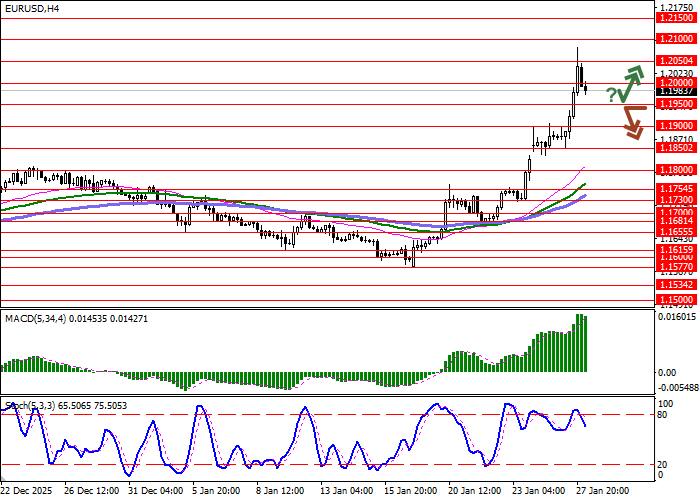
Bollinger Bands on the daily chart show sharp expansion: the price range is trying to keep pace with recent bullish momentum, but the growth rate remains extremely high. The MACD is rising, maintaining a strong buy signal (the histogram is above the signal line). The Stochastic oscillator is turning downward after reaching the maximum level of 100, indicating significant short-term overbought risks for the euro.
Resistance levels: 1.2000, 1.2050, 1.2100, 1.2150.
Support levels: 1.1950, 1.1900, 1.1850, 1.1800.
EUR/USD trading scenarios
Short positions may be opened after a confident breakout below 1.1950, targeting 1.1850. Stop-loss: 1.2000. Time horizon: 1–2 days.
A rebound from the 1.1950 support level followed by a breakout above 1.2000 may serve as a signal to open new long positions, targeting 1.2100. Stop-loss: 1.1950.
Scenario
| Timeframe | Intraday |
| Recommendation | SELL STOP |
| Entry point | 1.1950 |
| Take Profit | 1.1850 |
| Stop Loss | 1.2000 |
| Key levels | 1.1800, 1.1850, 1.1900, 1.1950, 1.2000, 1.2050, 1.2100, 1.2150 |
Alternative scenario
| Recommendation | BUY STOP |
| Entry point | 1.2000 |
| Take Profit | 1.2100 |
| Stop Loss | 1.1950 |
| Key levels | 1.1800, 1.1850, 1.1900, 1.1950, 1.2000, 1.2050, 1.2100, 1.2150 |