

Experts have assessed last week’s January labor market and inflation data as confirmation that the US Federal Reserve is likely to maintain its current monetary policy stance for an extended period. The unemployment rate declined to 4.3%, versus expectations of 4.4%, while nonfarm payrolls rose by 130.0K compared with forecasts of 66.0K. Average hourly earnings accelerated from 0.1% to 0.4%, exceeding expectations of 0.3%, which increases the risk of renewed upward pressure on consumer prices. Nevertheless, headline inflation eased from 2.7% to 2.4% year-on-year, while core inflation slowed from 2.6% to 2.5%. Analysts note that the disinflation trend is largely driven by lower gasoline prices and rent costs, whereas services and essential goods such as food and medicines continue to rise in price. Overall, inflation remains above the 2.0% target, limiting the scope for further interest rate cuts. In addition, expectations of a near-term shift toward a more dovish stance are affected by procedural delays in the Senate’s approval of Kevin Warsh as the new Fed Chair. While many senators are prepared to support his nomination, some have linked their backing to the termination of legal proceedings against current Fed Chair Jerome Powell. Minutes from the latest FOMC meeting will be released tomorrow at 21:00 (GMT+2), and any signals regarding future policy may trigger heightened market volatility.
The euro is under pressure from macroeconomic data. Industrial output in the euro area declined by 1.4% month-on-month in December, slightly better than the expected –1.5%, while annual growth slowed to 1.2% from 2.2%. Germany’s consumer price index rose from 0.0% to 0.1% month-on-month and from 1.8% to 2.1% year-on-year. Overall, the bloc is experiencing a cooling industrial sector while inflation remains close to the European Central Bank’s target. This backdrop could prompt policymakers to return to a more dovish stance, although most analysts still do not expect any interest rate adjustments this year.
Support and Resistance Levels
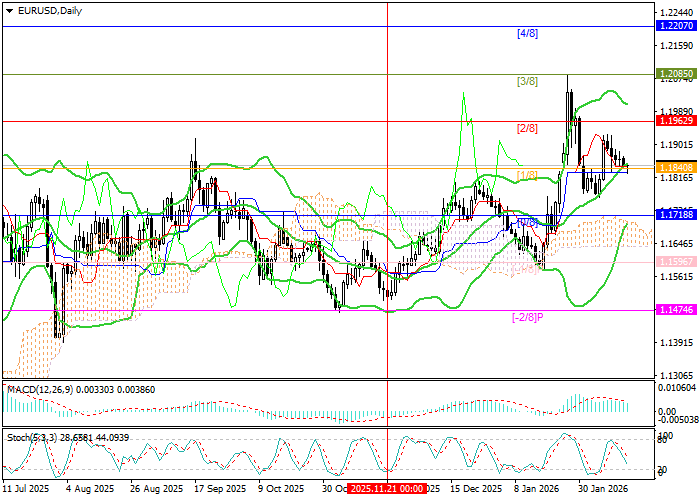
The instrument is testing the middle line of the Bollinger Bands at 1.1840 (Murray level [1/8]). A firm break below this level would open the way toward 1.1718 (Murray level [0/8]). Conversely, a breakout above 1.1962 (Murray level [2/8]) would signal renewed growth toward 1.2085 (Murray level [3/8]) and 1.2207.
Downside potential appears limited, as technical indicators continue to signal a buy bias: Bollinger Bands remain upward-sloping, the MACD histogram is stable in positive territory, and the Stochastic oscillator is approaching oversold levels, which does not rule out a near-term reversal.
Resistance levels: 1.1962, 1.2085, 1.2207.
Support levels: 1.1840, 1.1718.
Trading Scenarios and EUR/USD Forecast
Long positions may be opened above 1.1962 or on a rebound near 1.1718, with targets at 1.2085 and 1.2207 and stop-losses at 1.1885 and 1.1650, respectively. Time horizon: 5–7 days.
Scenario
| Timeframe | Weekly |
| Recommendation | BUY STOP |
| Entry Point | 1.1965 |
| Take Profit | 1.2085, 1.2207 |
| Stop Loss | 1.1885 |
| Key Levels | 1.1718, 1.1840, 1.1962, 1.2085, 1.2207 |
Alternative Scenario
| Recommendation | BUY LIMIT |
| Entry Point | 1.1718 |
| Take Profit | 1.2085, 1.2207 |
| Stop Loss | 1.1650 |
| Key Levels | 1.1718, 1.1840, 1.1962, 1.2085, 1.2207 |