
Inflation across the EU continues to ease, while business activity has yet to return to a clear recovery path. In January, France’s services PMI fell from 50.1 to 48.4 points, and the composite index declined from 50.0 to 49.1, slipping back into contraction territory. The situation looks slightly more resilient in Germany, where the services PMI edged down from 52.7 to 52.4, while the composite index improved from 51.3 to 52.1. At the eurozone level, services activity softened from 52.4 to 51.6, and the composite PMI eased from 51.5 to 51.3.
Consumer price data also reflected disinflationary trends: headline CPI posted a monthly reading of –0.5%, while core inflation, excluding food and energy, rose by 2.3% month-on-month. On an annual basis, this translated into a slowdown from 2.0% to 1.7% for headline inflation and from 2.3% to 2.2% for core CPI.
The US dollar, which continues to drive the pair’s overall direction, is holding near 97.60 on the USDX, maintaining a modest bullish bias that emerged after President Donald Trump signaled a potential nomination of Kevin Warsh as the next Chair of the Federal Reserve. Earlier, Fed Vice Chair for Supervision Michelle Bowman highlighted that policymakers are increasingly focused on labor market risks, with greater attention shifting toward employment support.
Despite keeping interest rates unchanged, Bowman pointed to a slowdown in private-sector job creation to around 30,000 per month in the final quarter of last year. She warned that the current environment of “low hiring, low firing” could quickly turn into broader layoffs if economic momentum weakens further. Bowman also noted that three rate adjustments are planned this year, describing the recent pause as a difficult balance between protecting the labor market and gathering clearer data following the government shutdown.
At the same time, US service-sector activity remains relatively firm: the S&P Global Services PMI rose from 52.5 to 52.7, while the composite index increased from 52.7 to 53.0. Some pressure on the dollar came from the preliminary ADP employment report, which showed private payroll growth slowing from 37,000 to 22,000.
Support and resistance levels
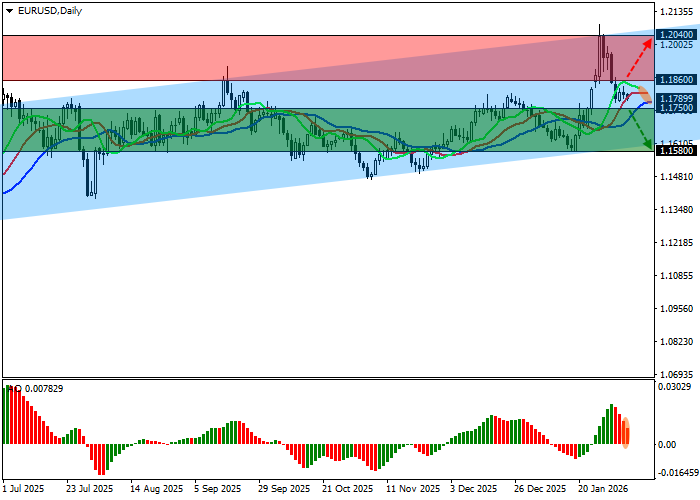
On the daily chart, the pair is drifting toward the lower boundary of a local ascending channel, currently defined by the 1.2050–1.1600 range.
Technical indicators are starting to cool the buy signal formed in late January. The fast EMAs of the Alligator indicator remain above the signal line but are converging, while the Awesome Oscillator histogram is forming corrective bars while staying in positive territory.
Support levels: 1.1750, 1.1580.
Resistance levels: 1.1860, 1.2040.
Trading scenarios and EUR/USD outlook
Short positions may be considered after a clear break and daily close below 1.1750, with a downside target at 1.1580. A stop-loss can be placed around 1.1830. The expected holding period is seven days or longer.
Long positions could be considered if the price breaks above 1.1860 and holds, opening the way toward 1.2040. A protective stop-loss is recommended near 1.1780.
Scenario
| Timeframe | Weekly |
| Recommendation | SELL STOP |
| Entry point | 1.1745 |
| Take Profit | 1.1580 |
| Stop Loss | 1.1830 |
| Key levels | 1.1580, 1.1750, 1.1860, 1.2040 |
Alternative scenario
| Recommendation | BUY STOP |
| Entry point | 1.1865 |
| Take Profit | 1.2040 |
| Stop Loss | 1.1780 |
| Key levels | 1.1580, 1.1750, 1.1860, 1.2040 |