
Undoubtedly, the key event was the decision of the US Supreme Court, which ruled that President Donald Trump exceeded his authority by using the 1977 International Emergency Economic Powers Act (IEEPA) to impose broad tariffs on major trading partners. In particular, the court declared “reciprocal” tariffs on imports from most countries illegal, as well as the 25.0% duties on goods from Canada, Mexico, and China. In response, the White House immediately announced new 15.0% taxes as part of a broader plan, restoring uncertainty to the markets and putting pressure on the US dollar. Trump himself called the ruling “deeply disappointing” and accused the judges of serving “foreign interests.”
Economists note that the actual impact of the court decision on the Canadian economy may be limited. According to their estimates, a significant portion of Canadian exports to the US had already been exempt from the disputed tariffs under existing exclusions and quota mechanisms. In particular, many shipments of raw materials and intermediate goods integrated into North American production chains continued to be supplied on preferential terms, reducing the direct negative impact of tariffs on trade turnover. At the same time, the ruling did not affect the key sectoral restrictions that pose the greatest risks to the Canadian economy—primarily sensitive industries such as metallurgy, timber processing, and certain manufacturing segments, where structural trade barriers and anti-dumping investigations remain in place. These sectors account for a substantial share of export revenues and employment in several provinces.
Last Friday, investors also focused on US Personal Consumption Expenditures (PCE) price index data for December, which showed an acceleration in the annual headline figure from 2.8% to 3.0% versus preliminary estimates of 2.9%, and a monthly increase from 0.2% to 0.4% compared with expectations of 0.3%. The core indicator adjusted from 2.8% to 2.9% year-on-year and rose from 0.2% to 0.4% month-on-month. Given that this data is a key metric for the Federal Reserve when assessing underlying inflation trends and directly influences market expectations regarding potential changes in the benchmark interest rate, faster growth in spending strengthens the case for a wait-and-see stance by the regulator or even tighter monetary conditions in the near future.
Markets are also evaluating how revised inflation expectations from the University of Michigan may affect the future path of borrowing costs: February’s one-year inflation outlook was lowered from 3.5% to 3.4%, while the five-year forecast declined from 3.4% to 3.3%.
At the same time, Canadian investors are analyzing retail sales data. In December, sales fell by 0.4% following a solid 1.2% increase in the previous month, while analysts had expected a correction of –0.5%. Retail sales excluding automobiles slowed from 1.6% to 0.1%, compared with preliminary estimates of –0.3%. Weaker-than-expected data reflects a decline in domestic demand in Canada, but also points to more moderate inflation risks.
Support and resistance levels
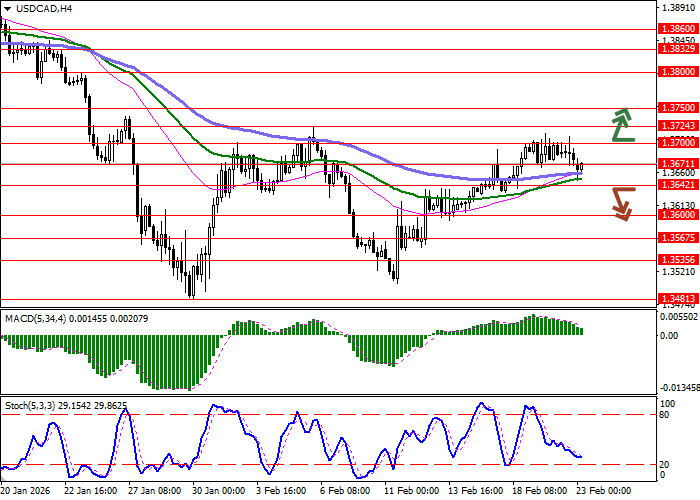
On the daily chart, the Bollinger Bands show a slight upward bias: the price range remains largely unchanged, staying sufficiently wide for the current level of market activity. The MACD is rising, maintaining a weak buy signal and remaining above the signal line. The Stochastic oscillator, having retreated from its highs, retains a downward orientation, signaling the potential for a more pronounced decline in the near term.
Resistance levels: 1.3671, 1.3700, 1.3724, 1.3750.
Support levels: 1.3642, 1.3600, 1.3567, 1.3535.
Trading scenarios and USD/CAD outlook
Short positions can be considered after a confident break below 1.3642, with a target at 1.3567. Stop-loss: 1.3680. Time horizon: 1–2 days.
A return of bullish momentum followed by an upside break above 1.3700 could signal an opportunity to open long positions targeting 1.3750. Stop-loss: 1.3671.
Scenario
| Timeframe | Intraday |
| Recommendation | SELL STOP |
| Entry point | 1.3640 |
| Take Profit | 1.3567 |
| Stop Loss | 1.3680 |
| Key levels | 1.3535, 1.3567, 1.3600, 1.3642, 1.3671, 1.3700, 1.3724, 1.3750 |
Alternative scenario
| Recommendation | BUY STOP |
| Entry point | 1.3705 |
| Take Profit | 1.3750 |
| Stop Loss | 1.3671 |
| Key levels | 1.3535, 1.3567, 1.3600, 1.3642, 1.3671, 1.3700, 1.3724, 1.3750 |