

Undoubtedly, the key event of the week will be the European Central Bank (ECB) meeting scheduled for February 4–5. Most analysts and investors broadly expect monetary parameters to remain unchanged for the fifth consecutive time following the aggressive dovish cycle of 2025. The main refinancing rate, deposit facility rate, and marginal lending rate are likely to be held near 2.15%, 2.00%, and 2.40%, respectively. As before, the decision will be guided primarily by inflation dynamics, which remain the central benchmark for assessing economic growth risks. As of November, the annual inflation rate stood at 2.1%, close to the 2.0% target, reflecting moderate but stable price pressure across the region. The main drivers of inflation continue to be higher energy and food prices, which show uneven dynamics across eurozone countries. Energy prices rose by an average of 5.2% year-on-year, while food prices increased by 3.1%, whereas services and industrial goods prices showed minimal fluctuations.
At the same time, concerns are growing within the ECB’s Governing Council about the trajectory of the single currency. Board members, including Martin Kocher and François Villeroy de Galhau, have warned that further euro appreciation could force the regulator to consider restarting monetary easing in order to counter disinflationary pressure and preserve the export competitiveness of eurozone economies.
Meanwhile, recently released macroeconomic data from the euro area were cautiously optimistic. Investors focused in particular on an acceleration in Germany’s annual retail sales growth in December, which rose from 1.3% to 1.5% year-on-year. On a monthly basis, sales increased by just 0.1%, though it is worth recalling that the indicator stood near –0.5% back in November. In addition, Germany’s manufacturing PMI from S&P Global and Hamburg Commercial Bank (HCOB) edged up from 48.7 to 49.1 points in January, defying expectations for no change. The eurozone-wide PMI also improved slightly, from 49.4 to 49.5 points, though it remains in contraction territory.
U.S. macroeconomic data, by contrast, exceeded market expectations, providing support for the dollar. The S&P Global manufacturing PMI rose from 51.9 to 52.4 points in January, beating neutral forecasts. An even stronger signal came from the Institute for Supply Management (ISM), where the same indicator surged from 47.9 to 52.6 points, far above the consensus forecast of 48.5.
Additional support for the dollar came from comments by U.S. House Speaker Mike Johnson, who expressed confidence that the partial federal government shutdown would be resolved as early as today. A partial technical shutdown began in the U.S. on Saturday, but the Senate approved a funding bill for key government agencies the same day, easing political uncertainty and strengthening investor confidence in dollar-denominated assets.
Support and resistance levels
On the daily chart, Bollinger Bands are showing steady upward movement. The price range is narrowing from below, but remains wide enough to accommodate the current level of market activity.
The MACD continues to hold a firm sell signal, remaining below its signal line and showing little reaction so far to attempts at a corrective rebound. The Stochastic oscillator is falling even more decisively and is currently hovering near the zero level, pointing to significant oversold risks for the euro in the very short term.
Resistance levels: 1.1850, 1.1900, 1.1950, 1.2000.
Support levels: 1.1800, 1.1764, 1.1730, 1.1700.
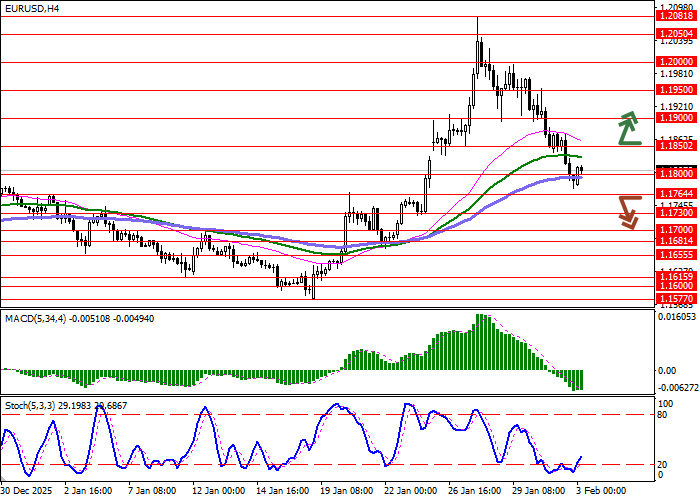
Trading scenarios and EUR/USD outlook
Short positions may be opened after a confident downside breakout below 1.1764, targeting 1.1681. Stop-loss: 1.1800. Time horizon: 2–3 days.
A continuation of corrective momentum followed by a breakout above 1.1850 could serve as a signal to open long positions with a target at 1.1950. Stop-loss: 1.1800.
Scenario
| Timeframe | Intraday |
| Recommendation | SELL STOP |
| Entry point | 1.1760 |
| Take Profit | 1.1681 |
| Stop Loss | 1.1800 |
| Key levels | 1.1700, 1.1730, 1.1764, 1.1800, 1.1850, 1.1900, 1.1950, 1.2000 |
Alternative scenario
| Recommendation | BUY STOP |
| Entry point | 1.1855 |
| Take Profit | 1.1950 |
| Stop Loss | 1.1800 |
| Key levels | 1.1700, 1.1730, 1.1764, 1.1800, 1.1850, 1.1900, 1.1950, 1.2000 |