

The key domestic factor weighing on the yen is monetary policy. The Bank of Japan has kept its benchmark interest rate at 0.75%, well below the U.S. range of 3.50–3.75%, creating a persistent yield gap. This differential supports the attractiveness of carry trade strategies, where investors borrow in low-yielding yen to invest in higher-yielding dollar-denominated assets, generating structural demand for USD/JPY. Expectations for further monetary tightening in Japan weakened after last Friday’s Tokyo inflation data for January showed a slowdown. Core CPI, which excludes fresh food and energy, eased from 2.3% to 2.0%.
Retail sales data also disappointed. In December, sales fell by 0.9% year-on-year after a 1.0% decline in the previous month, compared with market expectations of a 0.7% contraction. Large retailers saw growth slow sharply from 5.0% to 2.0%. Some modest support for the yen came from housing data: housing starts rose 1.3% at the end of the year after plunging 8.5% in November, while forecasts had pointed to another decline of around 4.1%. At the same time, total construction orders posted a strong annual increase of 20.2%, accelerating from 9.5% in November.
Meanwhile, last week Japan’s Prime Minister Sanae Takaichi said she would suspend the 8.0% consumption tax on food and non-alcoholic beverages for two years if her government returns to power following the dissolution of the House of Representatives on January 23. According to official estimates, this measure would reduce annual budget revenues by roughly ¥5.0 trillion (about $31.7 billion). Takaichi, a consistent supporter of the economic approach associated with former Prime Minister Shinzo Abe—based on aggressive fiscal stimulus and ultra-loose monetary policy—argued that the resulting deficit could be offset by revising government spending and tax incentives, although no specific mechanisms were outlined.
These comments came shortly after Takaichi’s cabinet approved the largest fiscal stimulus package since the COVID-19 pandemic in November, totaling ¥21.3 trillion (around $137.0 billion). The package includes one-off payments of ¥20,000 per child, utility subsidies of roughly ¥7,000 per household for three months, and food vouchers worth ¥3,000 per person. Such measures have raised serious concerns among investors about the sustainability of Japan’s already world-leading public debt, which exceeds 230% of GDP. Still, recent data suggest a gradual cooling of the labor market without a sharp deterioration in fundamentals, reducing the risk of an abrupt slowdown in economic activity.
U.S. investors are now focused on the January U.S. labor market report, which will be the key indicator shaping expectations for the Federal Reserve’s next policy steps—and, by extension, the direction of the dollar. Analysts expect the data to confirm a stabilization trend following a period of cooling. The Chicago Fed’s forecast, updated on January 29, points to a slight decline in the unemployment rate to 4.35% in January from 4.38%, while layoffs remain historically low. Economists at RBC Capital Markets expect around 63,000 new jobs to be created, with unemployment easing to 4.3%, marking a third consecutive month above the estimated “equilibrium” level.
Support and resistance levels
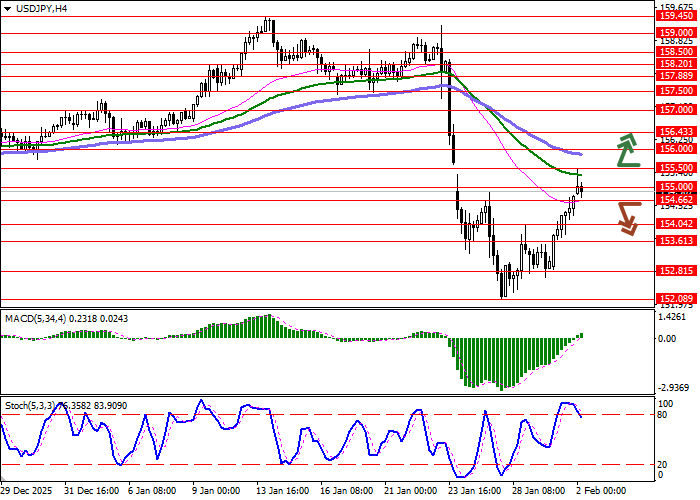
On the daily chart, Bollinger Bands continue to slope lower, with the upper boundary narrowing, reflecting mixed trading conditions in the short and very short term. The MACD is turning higher and forming a fresh buy signal, with the histogram holding above the signal line. The Stochastic oscillator is near the middle of its range, suggesting bulls still have room to maneuver in the near term.
Resistance levels: 155.00, 155.50, 156.00, 156.43.
Support levels: 154.66, 154.04, 153.61, 152.81.
Trading scenarios and USD/JPY outlook
Long positions may be considered after a confident breakout above 155.50, with a target at 156.43. Stop-loss: 155.00. Time horizon: 1–2 days.
A return of bearish momentum followed by a break below 154.66 could signal short positions targeting 153.61. Stop-loss: 155.20.
Scenario
| Timeframe | Intraday |
| Recommendation | BUY STOP |
| Entry point | 155.50 |
| Take Profit | 156.43 |
| Stop Loss | 155.00 |
| Key levels | 152.81, 153.61, 154.04, 154.66, 155.00, 155.50, 156.00, 156.43 |
Alternative scenario
| Recommendation | SELL STOP |
| Entry point | 154.65 |
| Take Profit | 153.61 |
| Stop Loss | 155.20 |
| Key levels | 152.81, 153.61, 154.04, 154.66, 155.00, 155.50, 156.00, 156.43 |