
Part of the released capital, judging by market dynamics, has been redirected into the US dollar, which has rebounded by 2.45% from last week’s lows. The key driver behind this swift upward move was the nomination of Kevin Warsh as the next Chair of the US Federal Reserve. Market participants interpreted this as a signal of a potential shift toward tighter inflation control, as the new leadership is likely to place greater emphasis on long-term macroeconomic sustainability and financial stability. This could limit the scope for aggressive stimulus or overly accommodative policy in the near term and increase the appeal of the US dollar for yield-oriented investors. According to the CME FedWatch Tool, the probability of keeping the policy rate in the 3.50–3.75% range at the next meeting stands at 77.3%, up sharply from 48.9% a month ago. This shift underscores a market reassessment of future monetary policy steps and creates a foundation for short-term pressure on safe-haven asset prices.
Meanwhile, the Swiss National Bank continues to pursue an ultra-loose monetary policy, keeping borrowing costs at zero. According to the latest data, inflation in Switzerland stands at just 0.1% year-on-year, well below the central bank’s 2.0% target, meaning that even positive domestic economic signals are providing little support for the franc this week. At the same time, a study prepared by Implement Consulting Group on behalf of Google LLC and the Digitalswitzerland association—promoting the digital transformation of the Swiss economy—highlighted the significant potential of artificial intelligence (AI) technologies. The authors estimate that large-scale AI adoption could lift Switzerland’s GDP by 11.0% over the next decade, equivalent to additional value added of CHF 80.0–85.0 billion. The report emphasizes that AI is viewed not as an auxiliary tool but as a structural driver of long-term economic growth capable of strengthening global competitiveness. Particular attention is paid to the impact on the R&D sector, where innovation could boost labor productivity by 10.0–20.0%, generating additional annual budget revenues of CHF 15.0 billion by 2034.
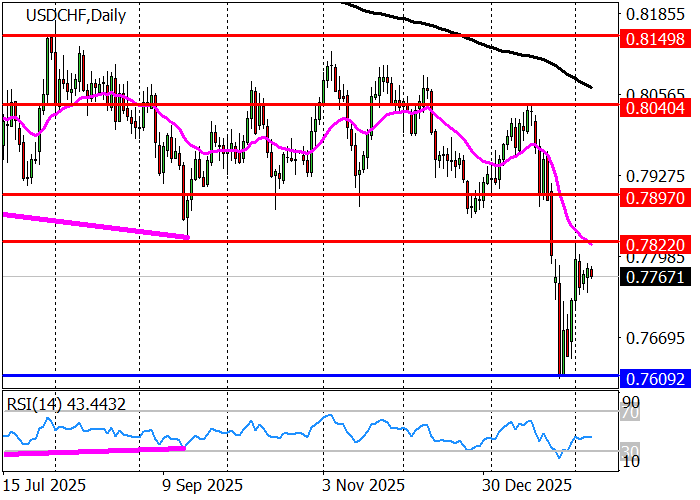
The long-term trend remains bearish: the price has обновила the July 2011 low and is now preparing to test the 0.7578 level. Within the current corrective phase, USD/CHF is approaching the 0.7822 resistance, and if sellers hold this level, fresh short positions may be considered with a target at the January low of 0.7609. Thereafter, prices are likely to attempt a test of 0.7578, a downside break of which would act as a catalyst for an acceleration of bearish momentum toward 0.7092. If bulls manage to break above 0.7822, the correction could extend toward the January peak at 0.8040. The pair is trading below the 21- and 190-period EMAs, indicating that both short- and long-term trends remain bearish. RSI (14) dipped into oversold territory in late January, confirming the onset of a corrective rebound, but has since returned to neutral levels, allowing for the consideration of new short positions.
Within the medium-term trend, market participants broke through zone 2 (0.7898–0.7871) and then zone 3 (0.7679–0.7658), which was nevertheless defended by buyers, prompting profit-taking on shorts and the development of the current upward correction. The instrument is heading toward the trend boundary at 0.7840–0.7818. Upon reaching this area, new short positions may be considered with an initial target at 0.7722 and a second at 0.7604. However, a breakout above the key resistance would imply a shift in momentum and open the way for buying toward the 0.8068–0.8044 area.
Support and Resistance Levels
Resistance levels: 0.7822, 0.7897, 0.8040.
Support levels: 0.7609, 0.7578, 0.7092.
Trading Scenarios and USD/CHF Forecast
Short positions can be opened from the 0.7822 level with a target at 0.7610 and a stop loss at 0.7890. Time horizon: 9–12 days.
Long positions can be opened above 0.7900 with a target at 0.8040 and a stop loss at 0.7834.
Scenario
| Timeframe | Weekly |
| Recommendation | SELL LIMIT |
| Entry Point | 0.7822 |
| Take Profit | 0.7610 |
| Stop Loss | 0.7890 |
| Key Levels | 0.7092, 0.7578, 0.7609, 0.7822, 0.7897, 0.8040 |
Alternative Scenario
| Recommendation | BUY STOP |
| Entry Point | 0.7905 |
| Take Profit | 0.8040 |
| Stop Loss | 0.7834 |
| Key Levels | 0.7092, 0.7578, 0.7609, 0.7822, 0.7897, 0.8040 |