

Analysts believe that lowering borrowing costs would ease pressure on the Labour government after Chancellor Rachel Reeves announced significant tax increases in the Autumn Budget due on November 29. She previously stated that the measures are aimed at slowing inflation and creating conditions for monetary policy easing to support economic growth and living standards. However, according to the National Institute of Economic and Social Research, the U.K.’s debt trajectory is “unsustainable,” and to change it the Chancellor would, for the first time in 25 years, need to deliver a primary budget surplus—around £50 billion—to stabilize the financial system and protect against future shocks. The last time this occurred was in 2001–2002, when the economy was growing much faster and public debt was only 30% of GDP, whereas the latest statistics show a record £2.9 trillion.
Meanwhile, U.S. investors are adjusting expectations for Federal Reserve policy easing at the December meeting. On Wednesday, ADP’s October employment report showed an increase of 42,000 nonfarm jobs versus a preliminary estimate of 32,000. In the absence of official national labor market data due to the ongoing government shutdown, market participants are focusing on private reports. Analysts at Challenger, Gray & Christmas calculated that U.S. companies announced 153,074 job cuts in October—the highest since 2008—compared with around 54,064 the month before. Key reasons cited include the adoption of artificial intelligence (AI) technologies as well as reductions in consumer spending and capital investment.
Support and resistance levels
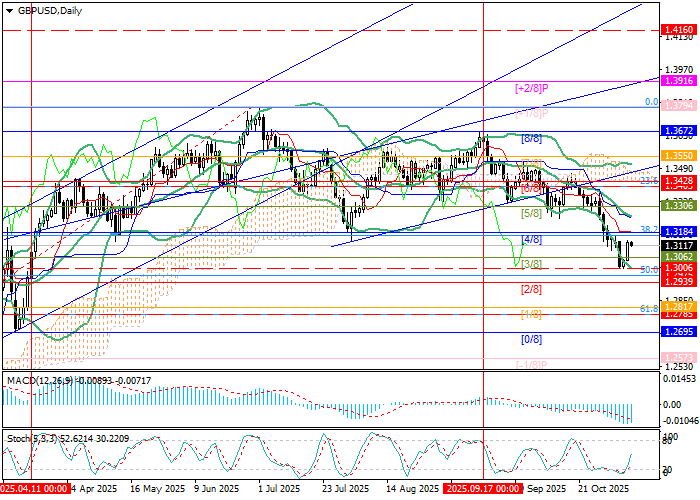
The instrument has been trending lower for a third month: this week the price touched an eight-month low near 1.3006, but then recovered part of the losses. Overall, quotes have consolidated below 1.3184 (Murray level [0/8], 38.2% Fibonacci retracement), which could lead to further declines toward 1.2785 (61.8% Fibonacci) and 1.2573 (Murray level [–1/8]). The key level for the bulls remains 1.3306 (Murray level [5/8]), above the middle line of the Bollinger Bands: a breakout there would reopen the path to 1.3550 (Murray [7/8]) and 1.3672 (Murray [8/8]), though this scenario is currently seen as less likely.
Technical indicators confirm the bearish bias: Bollinger Bands are sloping downward, MACD remains in negative territory, and Stochastic is turning up from oversold—allowing for a corrective bounce, though its potential appears limited.
Resistance levels: 1.3306, 1.3550, 1.3672.
Support levels: 1.2785, 1.2573.
Trading scenarios and GBP/USD outlook
Short positions can be opened from 1.3070 with targets at 1.2785 and 1.2573 and a stop-loss at 1.3170. Implementation horizon: 5–7 days.
Long positions can be opened above 1.3306 with targets at 1.3550 and 1.3672 and a stop-loss at 1.3190.
Scenario
| Timeframe | Weekly |
| Recommendation | SELL STOP |
| Entry point | 1.3070 |
| Take Profit | 1.2785, 1.2573 |
| Stop Loss | 1.3170 |
| Key levels | 1.2573, 1.2785, 1.3306, 1.3550, 1.3672 |
Alternative scenario
| Recommendation | BUY STOP |
| Entry point | 1.3310 |
| Take Profit | 1.3550, 1.3672 |
| Stop Loss | 1.3190 |
| Key levels | 1.2573, 1.2785, 1.3306, 1.3550, 1.3672 |