

Economists warn that the U.S. economy could face irreversible losses of about 14 billion dollars if the government does not reopen before Thanksgiving. For example, due to labor shortages—particularly a lack of air traffic controllers—the Federal Aviation Administration (FAA) plans to reduce air traffic by 10% across forty of the country’s largest airports starting November 7. In addition, the dollar is supported by comments from Federal Reserve Chair Jerome Powell, who noted the possibility of pausing interest rate adjustments at the next monetary policy meeting.
In Switzerland, the October Consumer Price Index came in at –0.3% month-on-month, below forecasts of –0.1% and the previous reading of –0.2%. This weaker inflation data could influence the Swiss National Bank’s decision at its December 11 meeting. Since officials have already signaled a readiness to return to negative interest rates if necessary, any hint of policy easing is likely to pressure the Swiss franc. Meanwhile, on November 4, U.S. President Donald Trump met in Washington with six Swiss billionaires, including executives of companies that own luxury brands such as Rolex and Cartier. According to *Tribune de Genève*, the discussions focused on a potential reduction of import tariffs on Swiss goods by as much as 39%, though no official outcome has yet been reported.
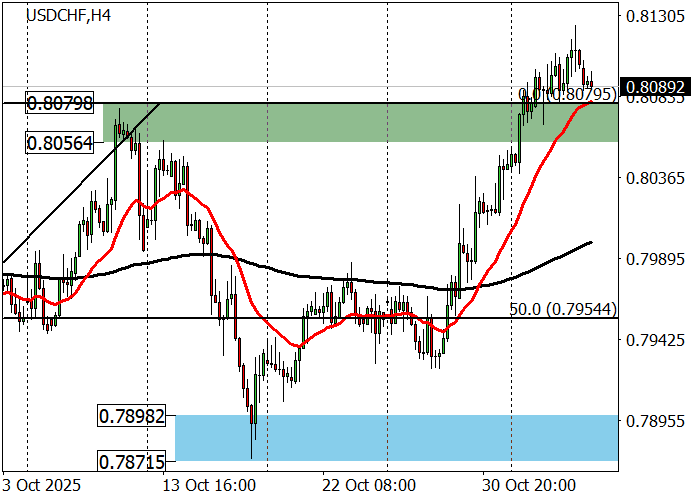
Nevertheless, the long-term trend remains bearish. After testing the support level at 0.7897 in September, the pair renewed its October highs and broke through resistance at 0.8065, heading toward the July peak at 0.8150. A firm close above this level would signal a reversal to an uptrend with targets at 0.8250 and 0.8440. However, if the price fails to sustain above 0.8150, a pullback toward 0.8065 and 0.7897 (October low) is expected. The instrument is currently trading above the 21-period EMA and below the 190-period EMA, indicating a short-term bullish but long-term bearish outlook. The RSI (14) indicator is approaching overbought territory, allowing traders to consider both long and short positions.
Within the medium-term downtrend, the asset tested the 0.7898–0.7871 zone in mid-October before correcting to the October 9 high near the key resistance area 0.8080–0.8056. If the weekly candle closes above 0.8080, the trading bias will shift upward, making long positions relevant with targets in the 0.8321–0.8297 resistance zone. Otherwise, the downward impulse could push the pair toward 0.7954 and 0.7829.
Support and Resistance Levels
Resistance levels: 0.8150, 0.8250, 0.8440.
Support levels: 0.8065, 0.7897, 0.7822.
Trading Scenarios and USD/CHF Forecast
Short positions can be opened from 0.8150 with a target at 0.8065 and a stop-loss at 0.8180. Estimated duration: 9–12 days.
Long positions can be opened above 0.8180 with a target at 0.8250 and a stop-loss at 0.8150.
Scenario
| Timeframe | Weekly |
| Recommendation | SELL LIMIT |
| Entry Point | 0.8150 |
| Take Profit | 0.8065 |
| Stop Loss | 0.8180 |
| Key Levels | 0.7822, 0.7897, 0.8065, 0.8150, 0.8250, 0.8440 |
Alternative Scenario
| Recommendation | BUY STOP |
| Entry Point | 0.8185 |
| Take Profit | 0.8250 |
| Stop Loss | 0.8150 |
| Key Levels | 0.7822, 0.7897, 0.8065, 0.8150, 0.8250, 0.8440 |