
In November, nonfarm payrolls increased by 64.0K, beating the 50.0K forecast, while the unemployment rate accelerated from 4.4% to 4.6% versus expectations of 4.5%. In addition, the S&P Global Services PMI for December eased from 54.1 to 52.9, below the 54.0 estimate; the Manufacturing PMI slipped from 52.2 to 51.8 versus 52.0; and the Composite PMI fell from 54.2 to 53.0 instead of 53.9. These figures point to emerging stress in the economy, which has weighed on the U.S. dollar.
Meanwhile, the Swiss National Bank (SNB) has left its monetary policy unchanged for several consecutive months: the last move was a rate cut to 0.0% in June 2025, and the rate is expected to remain unchanged at the next meeting on January 8. Inflation slowing to 0.0% year-on-year, combined with low borrowing costs, supports the Swiss franc and has kept pressure on USD/CHF since the start of the year.
The SNB revised its 2026 consumer price index forecast to 0.3%, which does not create conditions for further policy adjustments. At the same time, GDP expectations remain moderate: just under 1.5% in 2025 and around 1.0% in 2026. A gradual rise in unemployment is also likely, reflecting the broader slowdown in economic activity, meaning any rate change is only expected in the second half of 2027. According to the SNB, the GDP contraction in Q3 was driven by a decline in the pharmaceutical industry amid U.S. sanctions. In other manufacturing segments and in services, value added rose only slightly and did not offset weakness in the key sector.
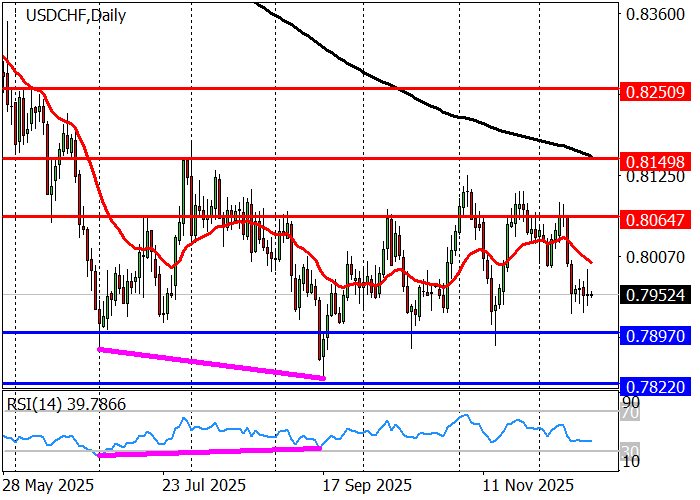
The long-term trend in USD/CHF remains bearish: support levels at 0.7897 and 0.7822 were formed in July–September, after which price corrected toward the 0.8065 resistance. In October–December, quotes tested this level but ultimately turned lower toward 0.7897, 0.7822, and 0.7610. On the other hand, consolidation above 0.7897 would act as a catalyst for a move toward 0.8065. The instrument is trading below the EMA (21) and EMA (190), reflecting short- and long-term downtrends, while the RSI (14) in neutral territory allows for trades in either direction.
The medium-term trend is also bearish: price is trading between the resistance area of 0.8080–0.8056 and Zone 2 (0.7898–0.7871). A downside break of Zone 2 makes a move toward Zone 3 (0.7679–0.7658) likely. If upward momentum develops toward 0.8080 and the pair consolidates above it, the trend would shift and long positions would become relevant, with targets in the 0.8321–0.8297 resistance area.
Support and resistance levels
Resistance levels: 0.8065, 0.8150, 0.8250.
Support levels: 0.7897, 0.7822, 0.7610.
Trading scenarios and USD/CHF forecast
Short positions can be opened from 0.8065 with a target at 0.7897 and a stop-loss at 0.8120. Time horizon: 9–12 days.
Long positions can be opened above 0.8120 with a target at 0.8250 and a stop-loss at 0.8060.
Scenario
| Timeframe | Weekly |
| Recommendation | SELL LIMIT |
| Entry point | 0.8065 |
| Take Profit | 0.7897 |
| Stop Loss | 0.8120 |
| Key levels | 0.7610, 0.7822, 0.7897, 0.8065, 0.8150, 0.8250 |
Alternative scenario
| Recommendation | BUY STOP |
| Entry point | 0.8125 |
| Take Profit | 0.8250 |
| Stop Loss | 0.8060 |
| Key levels | 0.7610, 0.7822, 0.7897, 0.8065, 0.8150, 0.825 |