

In September, the Fed cut its key interest rate by 25 basis points while keeping the door open for further monetary easing. Later, Chair Jerome Powell cautioned markets against expecting prolonged cheap borrowing costs, stressing that policymakers would rely primarily on macroeconomic data. Nonetheless, most members of the Federal Open Market Committee (FOMC) currently support additional easing. Analysts forecast another 25-basis-point cut in October, with a probability close to 100%, and a similar move in December if labor market data again disappoint. The September labor report has not been released due to the ongoing U.S. government shutdown, as Democrats and Republicans in Congress remain deadlocked over the new fiscal year’s budget. Earlier this week, the Senate once again failed to pass a temporary funding bill extending operations through November, and traders now anticipate greater pressure from President Donald Trump’s administration, which has previously warned of mass layoffs if the budget impasse continues.
Meanwhile, the yen remains under pressure after Sanae Takaichi’s victory in the Liberal Democratic Party leadership election. She is expected to be confirmed by parliament on October 15 as Japan’s first female Prime Minister. Her administration is expected to pursue a softer economic policy stance, potentially hindering the Bank of Japan’s efforts to raise borrowing costs further. Takaichi’s pro-defense and nationalist agenda could also heighten regional tensions. In the first half of the fiscal year, which began on April 1, Japan recorded a surge in corporate bankruptcies — 5,100 cases, the highest since 2013, when data collection began. The number has risen for the fourth consecutive year. Over 70% of the failed companies had capital below 10 million yen and debts under 100 million yen, with the main causes being labor shortages, rising personnel costs, and inflation. Most closures occurred in the services and construction sectors, where building material prices have significantly increased.
Support and Resistance Levels
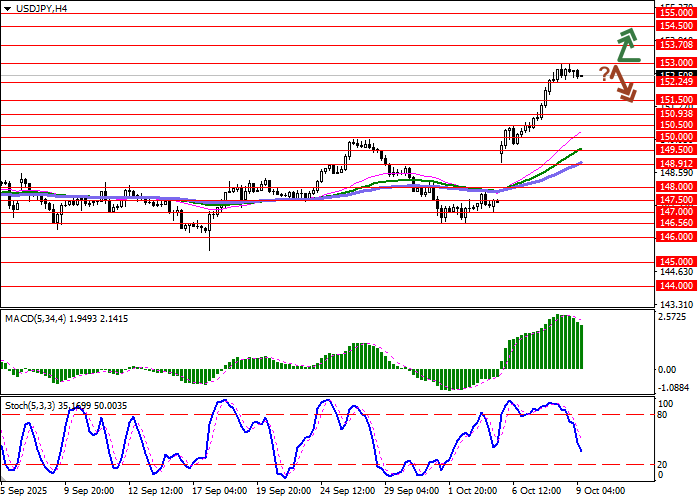
On the daily chart, Bollinger Bands show a steady upward trend with widening price channels, though recent bullish momentum has slightly outpaced the indicator. MACD continues to rise, maintaining a strong buy signal (histogram above the signal line). The Stochastic oscillator, having reached overbought territory, is flattening, suggesting short-term risks of a U.S. dollar pullback.
Resistance levels: 153.00, 153.70, 154.50, 155.00.
Support levels: 152.24, 151.50, 150.93, 150.50.
Trading Scenarios and USD/JPY Forecast
Long positions may be opened after a confident breakout above 153.00 with a target at 154.50. Stop-loss — 152.24. Implementation time: 1–2 days. A rebound from 153.00 as resistance followed by a breakdown below 152.24 could serve as a signal to open new short positions with a target at 150.50. Stop-loss — 153.00.
Scenario
| Timeframe | Intraday |
| Recommendation | BUY STOP |
| Entry Point | 153.00 |
| Take Profit | 154.50 |
| Stop Loss | 152.24 |
| Key Levels | 150.50, 150.93, 151.50, 152.24, 153.00, 153.70, 154.50, 155.00 |
Alternative Scenario
| Recommendation | SELL STOP |
| Entry Point | 152.20 |
| Take Profit | 150.50 |
| Stop Loss | 153.00 |
| Key Levels | 150.50, 150.93, 151.50, 152.24, 153.00, 153.70, 154.50, 155.00 |
