

In the third quarter, the Tankan services index held steady at 34.0 points, while the large manufacturers index slipped from 13.0 to 14.0, missing forecasts of 15.0. Overall, the large manufacturers’ sentiment index, which tracks conditions such as business climate, demand and supply, production, prices, income, employment, investment, and taxation, rose from 11.5% to 12.5%. These results may influence the Bank of Japan’s upcoming rate decision. Analysts expect the central bank to tighten policy soon, though it remains unclear whether that will happen at the end of October or later. Earlier this year, the BoJ raised its key rate from 0.1% to 0.5%.
Business sentiment has shifted following a tariff agreement with the US reached in July. Under the deal, Washington will apply a base tariff of 15.0% to most Japanese imports, alongside sector-specific measures for automobiles and parts, aerospace products, generics, and raw materials not produced domestically. In exchange, Japan will expand imports of agricultural goods, energy, and aerospace technology, while lifting restrictions on US auto imports. Nevertheless, higher export duties to the world’s largest market continue to weigh on profits, wages, investment, and spending across industries.
At the same time, markets are closely watching the potential US government shutdown, highlighting ongoing political division in Congress. President Donald Trump has blamed Democrats for stalling the budget bill, citing their push to extend Medicaid and healthcare funding. This would not be the first shutdown under Trump: during his first term, the longest shutdown in US history lasted 34 days but caused no major economic damage. This time, however, key macroeconomic data releases, including the September jobs report, may be delayed.
Meanwhile, Japanese investors await the results of the prime ministerial election set for October 4. The Liberal Democratic Party (LDP) will vote for a new leader after Shigeru Ishibu resigned on September 7. Still, there is no guarantee the new party head will automatically assume the role of prime minister.
Support and Resistance Levels
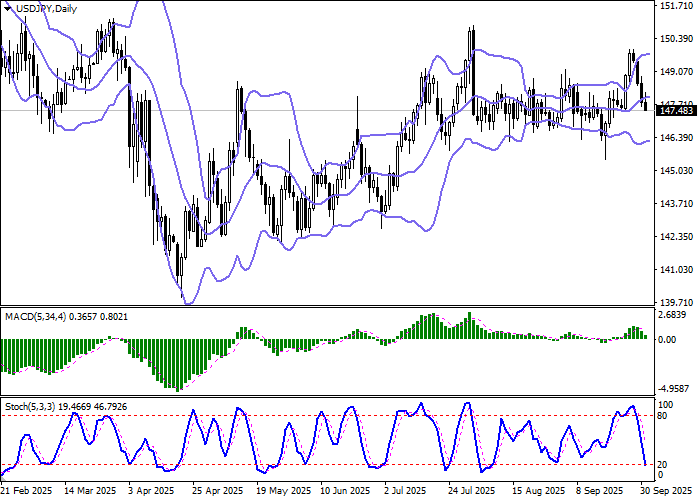
On the daily chart, Bollinger Bands are flattening, showing a narrowing but still wide-enough range for current market activity. MACD is trending lower but still gives a modest buy signal as the histogram remains below the signal line. The Stochastic oscillator is pointing downward but hovers near the 20 mark, signaling oversold risks for the US dollar in the very short term.
Resistance levels: 148.00, 148.91, 149.50, 150.00.
Support levels: 147.50, 147.00, 146.56, 146.00.
Trading Scenarios and USD/JPY Forecast
Short positions can be considered after a confident break below 147.00 with a target of 146.00. Stop-loss at 147.50. Timeframe: 1–2 days.
A return to bullish momentum and a breakout above 148.00 may open the way for new long positions targeting 148.91. Stop-loss at 147.50.
Scenario
| Timeframe | Intraday |
| Recommendation | SELL STOP |
| Entry Point | 147.00 |
| Take Profit | 146.00 |
| Stop Loss | 147.50 |
| Key Levels | 146.00, 146.56, 147.00, 147.50, 148.00, 148.91, 149.50, 150.00 |
Alternative Scenario
| Recommendation | BUY STOP |
| Entry Point | 148.00 |
| Take Profit | 148.91 |
| Stop Loss | 147.50 |
| Key Levels | 146.00, 146.56, 147.00, 147.50, 148.00, 148.91, 149.50, 150.00 |