

The victory of Sanae Takaichi in the Liberal Democratic Party leadership race became a key factor shaping investor sentiment. Analysts believe that for Takaichi — who will assume the role of prime minister on October 15 — economic recovery remains a top priority. Her calls for close cooperation with the Bank of Japan may help maintain a dovish policy stance. Previously, Takaichi stated that raising interest rates under current conditions would be a mistake, as the national economy teeters on the brink of stagnation.
Macroeconomic data paint a mixed picture. Inflation remains persistent, and according to Teikoku Databank, prices for over 3,000 food items are expected to rise in October — marking the tenth consecutive month of increases and the longest stretch since 2022. The Tokyo Core CPI came in at 2.5% year-on-year in September, below market expectations of 2.8%, while the index excluding fresh food and fuel eased from 3.0% to 2.5%. On the other hand, household spending in August rose by 0.6% month-on-month and 2.3% year-on-year, surpassing forecasts. With the Bank of Japan likely to maintain its accommodative stance, Japan’s Nikkei 225 index reached a new all-time high of 48,000.0 — earlier than expected by analysts who projected such levels only by year-end.
Meanwhile, global uncertainty persists. In the U.S., the government shutdown continues since October 1, as the Senate failed to approve a funding bill. According to the White House National Economic Council, the partial closure may cost the economy up to $15 billion per week. President Donald Trump has hinted at potential layoffs in federal agencies he claims do not align with his “Make America Great Again (MAGA)” agenda. The situation is heightening volatility across global markets, leaving traders awaiting fresh signals from major central banks on the future of monetary policy.
Support and resistance levels
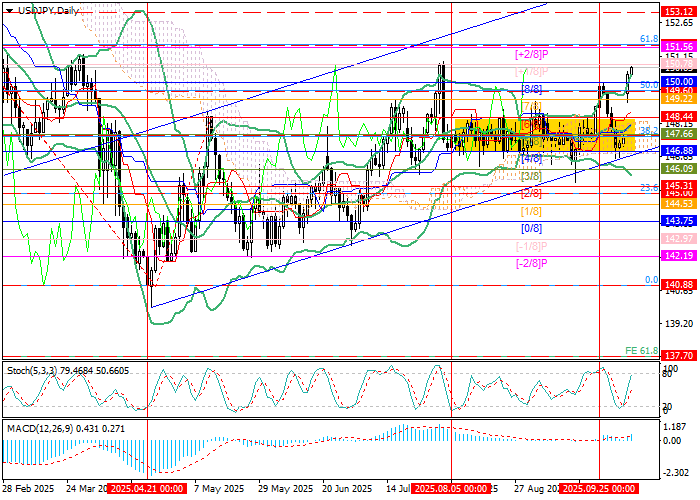
The instrument resumed growth, breaking out of the medium-term sideways range of 148.44–146.88 (Murray levels [6/8]–[4/8]) and is now approaching 150.78 (Murray level [+1/8]). A breakout above this level could push prices toward 151.56 (Murray level [+2/8], 61.8% Fibonacci retracement) and 153.12 (Murray level [5/8], W1). However, a drop below the middle Bollinger Band at 148.44 (Murray level [6/8]) would signal a return to the channel and further decline toward 146.88 (Murray level [4/8]) and 145.00 (23.6% Fibonacci retracement).
Technical indicators support the bullish outlook: Bollinger Bands and Stochastic are turning upward, while the MACD histogram is expanding in positive territory.
Resistance levels: 150.78, 151.56, 153.12.
Support levels: 148.44, 146.88, 145.00.
Trading scenarios and USD/JPY forecast
Long positions can be opened above 150.78 with targets at 151.56 and 153.12, and a stop-loss at 150.15. Implementation period: 5–7 days.
Short positions can be opened below 148.44 with targets at 146.88 and 145.00, and a stop-loss at 149.40.
Scenario
| Timeframe | Weekly |
| Recommendation | BUY STOP |
| Entry point | 150.80 |
| Take Profit | 151.56, 153.12 |
| Stop Loss | 150.15 |
| Key levels | 145.00, 146.88, 148.44, 150.78, 151.56, 153.12 |
Alternative scenario
| Recommendation | SELL STOP |
| Entry point | 148.40 |
| Take Profit | 146.88, 145.00 |
| Stop Loss | 149.40 |
| Key levels | 145.00, 146.88, 148.44, 150.78, 151.56, 153.12 |