

For now, pressure on the US currency comes from expectations of fresh macroeconomic data following the end of the record-long government shutdown. Investors are primarily focused on upcoming inflation and labor-market reports — the two key indicators that will shape the Federal Reserve’s next policy steps. Fed Chair Jerome Powell recently reiterated the need for caution when assessing the likelihood of a December rate cut, stressing that any decision will depend fully on incoming data. According to forecasts, the Producer Price Index due at 17:00 (GMT+2) is expected to remain at 2.6% year-over-year and rise from –0.1% to 0.3% month-over-month, which would support the case for a pause in the Fed’s dovish cycle and offer the dollar moderate support.
The Turkish lira remains under pressure amid ongoing economic uncertainty. The Central Bank of the Republic of Türkiye continues its gradual rate-cutting cycle as domestic inflation risks ease. In October, the annual consumer inflation rate slowed from 33.29% to 32.87%, still above the central bank’s year-end target of 30.0%. For 2026, officials expect inflation to decline toward 20.0%, while the policy rate was recently adjusted from 40.50% to 39.50%.
Meanwhile, S&P Global Ratings affirmed Türkiye’s long-term credit rating at “BB–” with a stable outlook, noting balanced risks and stronger-than-expected financial performance. Despite progress, the country continues to struggle with elevated inflation. After falling from 70% to 30%, further progress could require tighter fiscal policy and closer coordination between monetary and government measures. Financial stability is supported by rising net international reserves and a narrowing current-account deficit, now near 1% of GDP — a factor that reduces short-term external financing needs. Analysts stress that achieving 2025 inflation targets will require strict control over non-emergency spending and consistent support for government revenue.
Support and Resistance Levels
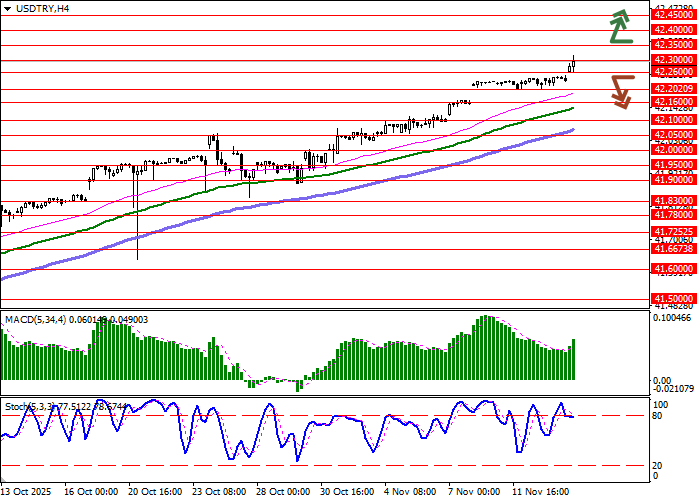
On the daily chart, Bollinger Bands continue to widen, confirming upward momentum and opening the path to new local highs. The MACD indicator is turning higher, forming a fresh buy signal as the histogram moves above the signal line. The Stochastic oscillator has been hovering near overbought territory for two sessions, indicating short-term risks of dollar overheating.
Resistance levels: 42.3000, 42.3500, 42.4000, 42.4500.
Support levels: 42.2600, 42.2020, 42.1600, 42.1000.
Trading Scenarios and USD/TRY Forecast
Long positions may be considered after a breakout above 42.3500, targeting 42.4500. Stop-loss: 42.3000. Horizon: 2–3 days.
Short positions may be considered after a breakout below 42.2600, targeting 42.1600. Stop-loss: 42.3200.
Scenario
| Timeframe | Intraday |
| Recommendation | BUY STOP |
| Entry Point | 42.3500 |
| Take Profit | 42.4500 |
| Stop Loss | 42.3000 |
| Key Levels | 42.1000, 42.1600, 42.2020, 42.2600, 42.3000, 42.3500, 42.4000, 42.4500 |
Alternative Scenario
| Recommendation | SELL STOP |
| Entry Point | 42.2600 |
| Take Profit | 42.1600 |
| Stop Loss | 42.3200 |
| Key Levels | 42.1000, 42.1600, 42.2020, 42.2600, 42.3000, 42.3500, 42.4000, 42.4500 |