

The market is trading on high volumes, and quotes moved even further away from the recent local low at 84.00 the day before: although the situation in the Persian Gulf region remains tense, escalation risks have been almost neutralized after the leaders of Iran and the United States signed a memorandum of understanding, which will launch 60-day technical negotiations on the parameters of the Islamic Republic’s nuclear program and the issue of compensation for damage caused by military actions.
In addition to the immediate cessation of hostilities on all fronts, the document provides for the resumption of shipping through the Strait of Hormuz, the lifting of oil sanctions against Iran, and the withdrawal of American troops from the region. The parties announced that a peace agreement had been reached on the night of June 15, after which U.S. President Donald Trump said that merchant vessels and oil tankers had already begun leaving the key waterway.
According to data from analytical company Kpler Holding, in reality, more than 500 tankers are still waiting for the opportunity to pass along the route, while Bloomberg analysts report that shipowners and energy companies fear the risks of the temporary ceasefire not being respected and are increasingly using alternative routes to deliver raw materials to consumers. At the moment, traffic through the Strait of Hormuz is estimated at around 1.3 million barrels per day, compared with 7.5 million barrels for other routes.
The American Petroleum Institute (API) report on fuel reserves, after a noticeable decline in the indicator last week by –9.119 million barrels, reflected the continuation of the trend at –8.330 million barrels, while data from the U.S. Energy Information Administration (EIA) recorded a decline from –7.227 million barrels to –8.263 million barrels. In the middle of the month, trading activity increased somewhat, and volumes are now above the average levels seen at the beginning of June: according to information from the Chicago Mercantile Exchange (CME Group), the number of futures contracts on June 17 reached 829.0 thousand, while options contracts amounted to 133.0 thousand, below the average of 165.0 thousand positions recorded at the beginning of June.
Support and resistance levels
On the daily chart, the trading instrument is declining, staying noticeably below the support line of the descending channel with boundaries at 110.00–84.00.
Technical indicators maintain a sell signal: the fast EMAs of the Alligator indicator are moving away from the signal line downward, while the AO histogram is forming corrective bars in the sell zone.
Resistance levels: 81.20, 91.30.
Support levels: 75.00, 65.20.
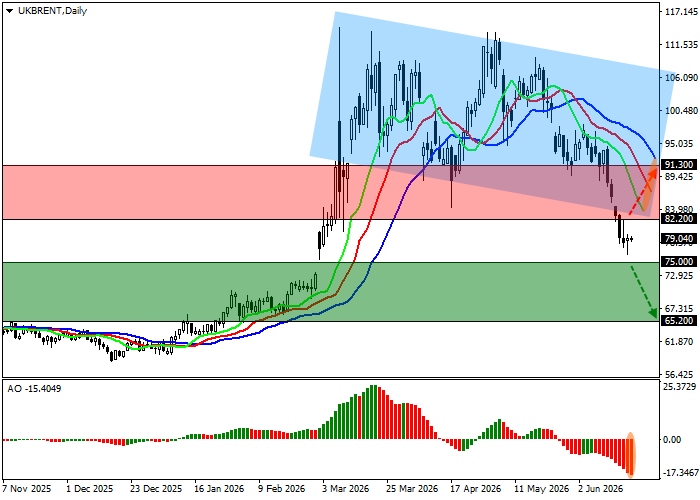
Brent Crude Oil trading scenarios and forecast
Short positions may be opened after the price declines and consolidates below 75.00, with a target at 65.20. Stop-loss — 78.00. Expected timeframe: 7 days or more. Long positions may be opened after the price rises and consolidates above 81.20, with a target at 91.30. Stop-loss — 78.0
Scenario
| Timeframe | Weekly |
| Recommendation | SELL STOP |
| Entry point | 74.95 |
| Take Profit | 65.20 |
| Stop Loss | 78.00 |
| Key levels | 65.20, 75.00, 81.20, 91.30 |
Alternative scenario
| Recommendation | BUY STOP |
| Entry point | 81.25 |
| Take Profit | 91.30 |
| Stop Loss | 78.00 |
| Key levels | 65.20, 75.00, 81.20, 91.30 |
