

Tensions in the Middle East remain the main driver of the oil market. Over the weekend, US President Donald Trump said American forces would hold off on new planned strikes against Iran while regional mediators attempted to establish the terms of a possible agreement. The proposed framework would include reopening the Strait of Hormuz and addressing concerns surrounding Iran’s nuclear programme.
However, official Tehran denied that direct negotiations with the United States were taking place. Iran’s Foreign Ministry said no meetings with Washington had been scheduled, although discussions with Oman concerning maritime traffic were continuing.
Shipping through the Strait of Hormuz remains severely restricted rather than completely halted. Vessel-tracking data showed that six ships, including three tankers and three bulk carriers, crossed the waterway on Monday, compared with seven the previous day. The actual number may be higher because vessels operating with their transponders switched off are not included in publicly available tracking data.
The conflicting statements have kept the geopolitical risk premium in oil prices elevated. Signs of progress toward reopening the waterway could pressure Brent, while renewed military action or attacks on commercial vessels would increase the risk of another sharp advance.
Similar sensitivity to developments in the Persian Gulf can be seen across the wider commodities market.
Investors are also awaiting the American Petroleum Institute’s weekly estimate of US fuel inventories, which is expected later today at approximately 22:30 (GMT+2). Market forecasts point to a modest increase in crude stocks, although these expectations may change before the publication.
The US Energy Information Administration will release its official Weekly Petroleum Status Report tomorrow at 16:30 (GMT+2). In the previous report, commercial crude oil inventories excluding the Strategic Petroleum Reserve fell by 7.2 million barrels to 404.5 million barrels, around 6% below the five-year average for this time of year.
Trading activity recovered slightly after falling toward the lower end of its recent range at the end of July. According to CME Group, Brent futures volume increased from 166,638 contracts on July 31 to 172,459 contracts on August 3. The previously cited figure of around 670,000 contracts referred to WTI futures rather than Brent.
Support and Resistance Levels
On the daily chart, the trading instrument is moving higher while remaining below the resistance line of the global descending channel, whose boundaries are currently located near 90.00 and 63.00.
Technical indicators maintain a buy signal. The Alligator indicator’s fast exponential moving averages remain above the slow line, although the distance between them is still limited, while the Awesome Oscillator histogram is forming corrective bars in positive territory.
Resistance levels: 86.90, 95.00.
Support levels: 81.40, 71.20.
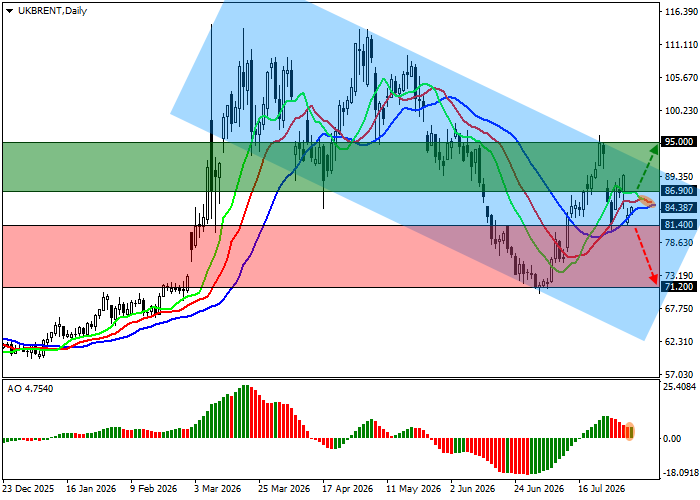
Brent Crude Oil Trading Scenarios and Price Forecast
Long positions may be opened after the price rises and consolidates above 86.90, with a target at 95.00 and a stop-loss at 82.00. Time horizon: seven days or more.
Short positions may be opened after the price falls and consolidates below 81.40, with a target at 71.20 and a stop-loss at 86.00.
Scenario
| Timeframe | Weekly |
| Recommendation | BUY STOP |
| Entry Point | 86.90 |
| Take Profit | 95.00 |
| Stop Loss | 82.00 |
| Key Levels | 71.20, 81.40, 86.90, 95.00 |
Alternative Scenario
| Recommendation | SELL STOP |
| Entry Point | 81.40 |
| Take Profit | 71.20 |
| Stop Loss | 86.00 |
| Key Levels | 71.20, 81.40, 86.90, 95.00 |
