

The euro is receiving support from the latest eurozone manufacturing data. The HCOB Eurozone Manufacturing PMI, compiled by S&P Global, rose from 51.4 in June to 51.9 in July, broadly matching the preliminary estimate of 52.0 and signalling a faster improvement in operating conditions.
Manufacturing output expanded at a stronger pace, with the corresponding index rising to 52.9, its highest level since March 2022. However, the acceleration was partly supported by companies completing previously accumulated orders rather than by a substantial increase in new demand.
New orders increased only marginally and continued to lag behind output growth, while export orders declined again. Weak performance in France, Italy, Spain and Austria partly offset stronger results in other eurozone economies. This suggests that the current expansion could lose momentum unless domestic and external demand improves during the coming months.
The recent improvement therefore does not eliminate broader economic risks. A renewed increase in energy, transportation or production costs linked to developments in the Middle East could strengthen inflationary pressure and limit economic growth during the autumn.
FORECK.INFO recently examined the effect of Federal Reserve policy and changing interest-rate expectations on the pair in its July 31 EUR/USD forecast.
The US dollar remains under pressure as investors reassess the outlook for Federal Reserve policy and await new labour-market data. The earlier claim that the move followed a coordinated foreign exchange intervention by the Federal Reserve and the Bank of Japan has been removed because no corresponding official announcement could be confirmed.
Market attention is now focused on the US Job Openings and Labor Turnover Survey. The Bureau of Labor Statistics is scheduled to publish the June report at 10:00 a.m. ET on August 4. The previous release showed 7.594 million job openings in May, while market forecasts point to a moderate decline. A weaker-than-expected result could indicate cooling labour demand and place additional pressure on the dollar.
Support and Resistance Levels
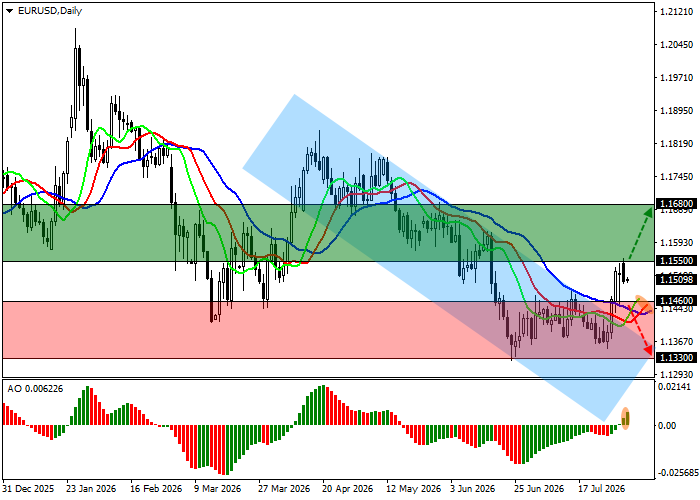
On the daily chart, the trading instrument is attempting to hold above the upper boundary of the descending channel, with the main support area located between 1.1460 and 1.1330.
Technical indicators are strengthening the recently generated buy signal. The Alligator indicator’s fast exponential moving averages remain above the slow line and are beginning to widen, while the Awesome Oscillator histogram is forming corrective bars in positive territory.
Resistance levels: 1.1550, 1.1680.
Support levels: 1.1460, 1.1330.
EUR/USD Trading Scenarios and Price Forecast
Long positions may be opened after the price rises and consolidates above 1.1550, with a target at 1.1680 and a stop-loss at 1.1480. Time horizon: seven days or more.
Short positions may be opened after the price falls and consolidates below 1.1460, with a target at 1.1330 and a stop-loss at 1.1540.
Scenario
| Timeframe | Weekly |
| Recommendation | BUY STOP |
| Entry Point | 1.1550 |
| Take Profit | 1.1680 |
| Stop Loss | 1.1480 |
| Key Levels | 1.1330, 1.1460, 1.1550, 1.1680 |
Alternative Scenario
| Recommendation | SELL STOP |
| Entry Point | 1.1460 |
| Take Profit | 1.1330 |
| Stop Loss | 1.1540 |
| Key Levels | 1.1330, 1.1460, 1.1550, 1.1680 |
