

On Tuesday, the Reserve Bank of Australia (RBA) held its policy meeting, raising the interest rate from 3.85% to 4.10% amid growing inflation risks driven by both domestic and external factors. Although consumer price growth slowed after its 2022 peak, inflation accelerated again in the second half of 2025 and received additional support in March 2026 due to rising energy prices following Iran’s blockade of the Strait of Hormuz. As a result, inflation may remain above the 2.00% target level.
At the same time, the Australian economy continues to demonstrate resilience. In January, unemployment came in below forecasts despite low levels of labor underutilization, indicating a still-tight labor market and persistent demand-side pressure. In this context, monetary tightening is aimed at preemptively containing consumption, which exceeded expectations in the second half of 2025, supported by business investment and accessible credit conditions for households and companies.
Financial conditions have already begun to tighten: government bond yields, money market rates, and the national currency have all increased. However, the regulator has emphasized that the full effect of the 2025 rate cuts has not yet been fully transmitted to the economy. As a result, with risks shifting toward higher inflation, the RBA signals its readiness to maintain or further increase borrowing costs if necessary.
Meanwhile, Prime Minister Anthony Albanese stated that the impact of the US-Iran conflict is comparable to the effects of the COVID-19 pandemic and will affect people globally despite geographic distance. He highlighted the significant impact of global supply chain disruptions on the domestic economy and stressed the need to adapt to new realities by building a more resilient and self-sufficient economic model based on internal resources and competitive advantages. While fuel supplies to Australia have not been significantly disrupted, localized shortages and empty gas stations have occurred due to panic buying. To stabilize the situation, authorities released part of the strategic reserves, and an emergency national cabinet meeting was convened.
Labor market data released this week also showed mixed signals. In February, the unemployment rate rose to 4.3%, above both the forecast of 4.1% and the previous reading of 4.1%. At the same time, employment growth exceeded expectations, reaching 48.9K compared to a forecast of 20.8K, while the previous figure was revised up from 17.8K to 26.1K, creating a mixed impact on the currency.
Additional pressure on the pair comes from the Federal Reserve’s meeting, where the interest rate remained at 3.50–3.75%. Officials noted continued economic recovery but weak nonfarm payroll growth. Updated projections supported bullish sentiment for the US dollar: GDP is expected to grow by 2.4%, slightly above previous estimates, while forecasts for 2027 and 2028 were revised upward. At the same time, inflation expectations increased to 2.7% by the end of the year. During the press conference, Fed Chair Jerome Powell stated that if inflation does not decline, the regulator may abandon its dovish stance, which pushed the US dollar higher by 0.64%.
Support and resistance levels
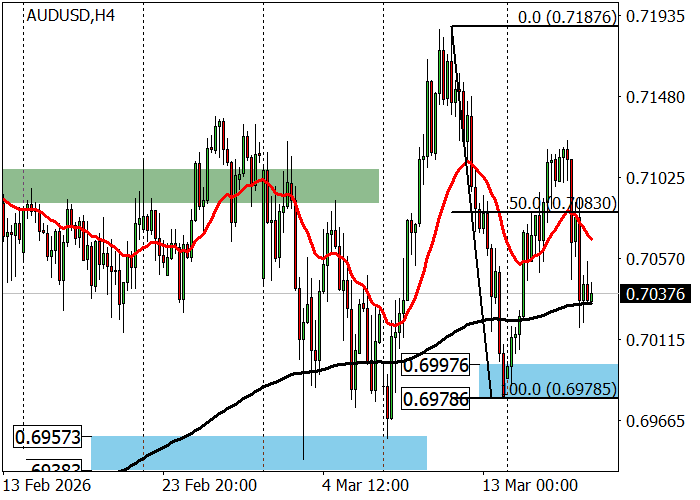
The long-term trend remains upward, but since February the price has been forming a range between 0.7140 and 0.6985. A breakout above 0.7140 would open the way toward 0.7188 and 0.7268, while a break below 0.6985 could trigger a deeper correction toward 0.6925 and 0.6740.
The medium-term trend also remains bullish. In early March, the pair tested the support zone at 0.6957–0.6983, then updated the February high at 0.7147 before correcting again to 0.6997–0.6978. The asset has now resumed upward movement, reaching 0.7083 and heading toward last week’s high at 0.7187.
Resistance levels: 0.7140, 0.7188, 0.7268.
Support levels: 0.6985, 0.6942, 0.6740.
Trading scenarios and AUD/USD forecast
Long positions can be considered near 0.6985 with a target at 0.7140 and a stop-loss at 0.6935. Timeframe: 9–12 days.
Short positions can be considered below 0.6935 with a target at 0.6740 and a stop-loss at 0.7005.
Scenario
| Timeframe | Weekly |
| Recommendation | BUY LIMIT |
| Entry point | 0.6985 |
| Take Profit | 0.7140 |
| Stop Loss | 0.6935 |
| Key levels | 0.6740, 0.6942, 0.6985, 0.7140, 0.7188, 0.7268 |
Alternative scenario
| Recommendation | SELL STOP |
| Entry point | 0.6930 |
| Take Profit | 0.6740 |
| Stop Loss | 0.7005 |
| Key levels | 0.6740, 0.6942, 0.6985, 0.7140, 0.7188, 0.7268 |
